

What you need to know before reading
Ambient viewing is the habit of keeping a TV on for mood, not for focused watching.
A “digital fireplace” is any calming loop that adds warmth to a room the way a real fire used to.
Plinko’s simple physics (drop, bounce, land, repeat) creates predictable rhythm with small variations.
Loop-based visuals work well for gatherings because they give the room a shared vibe without stealing attention.
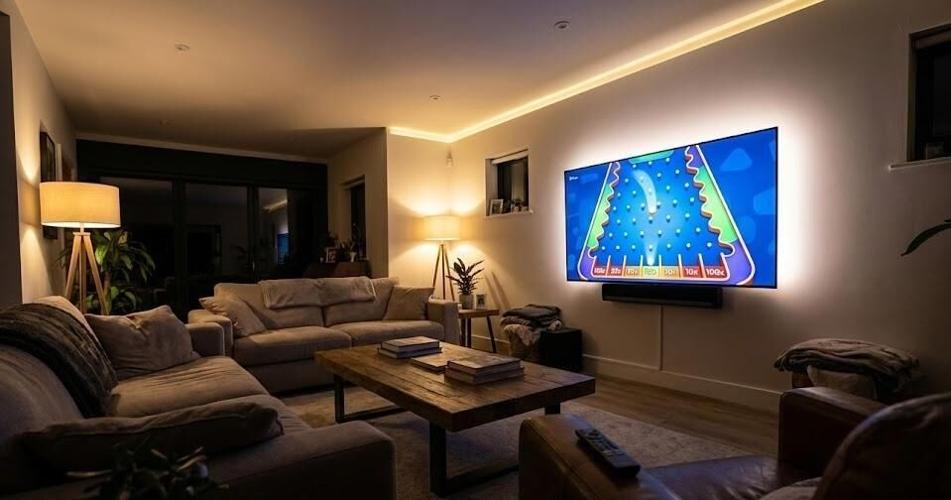
The living room has always had a main focus as a place to gather people around a common interest or media. Long ago it was the fireplace, then the stereo, then a big TV that made everyone sit down and really watch. Now, something quieter is taking that place. Many people use the big TV more like a background, not the star of the show. The goal is not to pull guests into a long movie. It’s to set a mood in modern minimalist environments.
This matches a bigger change in how we use screens at home. We still watch big, intense shows sometimes, but we also use softer things on screen: looping scenes, calm videos, and slow movement that can run all evening without making people pay close attention.
In a nicely designed room, that kind of background video feels like candlelight or a simple decoration. It makes the room feel warm and cozy, but it doesn’t get in the way of talking.
A Plinko game has:
the comfort of repeating the same action,
the fun of small surprises when the ball drops,
and a slow, steady pace that fits the rhythm of a get-together.
You can look at it, smile when the ball lands, and then look away again. People still talk and laugh, and the room feels alive, but never too busy.
The pegboard rhythm that turns a screen into a hearth
At the heart of Plinko’s appeal is its balance of order and variation. A ball drops, meets a field of pegs, and falls into a final slot. The rules are simple, yet each run looks slightly different. That is exactly what you want from an ambient visual: enough structure to feel soothing, enough change to keep the eye gently engaged.
In practice, plinko games work like a metronome for a room. The drop creates a clear beginning. The bouncing provides a steady middle. The landing delivers a clean ending. Then it resets. Guests do not need to “follow” anything, but they do get a constant, satisfying rhythm to glance at between sips and stories. That rhythm matters because it gives the space a shared pulse, without forcing a shared focus.
Similar to a crackling fire that provides a background of comfort, the Plinko game has emerged as the preferred ambient visual for high-end social gatherings. Its predictable yet varied physics creates a flow state for guests, acting as a low-pressure social lubricant that doesn't demand full attention but provides a constant, satisfying visual rhythm.
Ambient visuals are winning the best screen in the house
The shift toward calm, background-style watching (“ambient viewing”) isn’t just about looks.
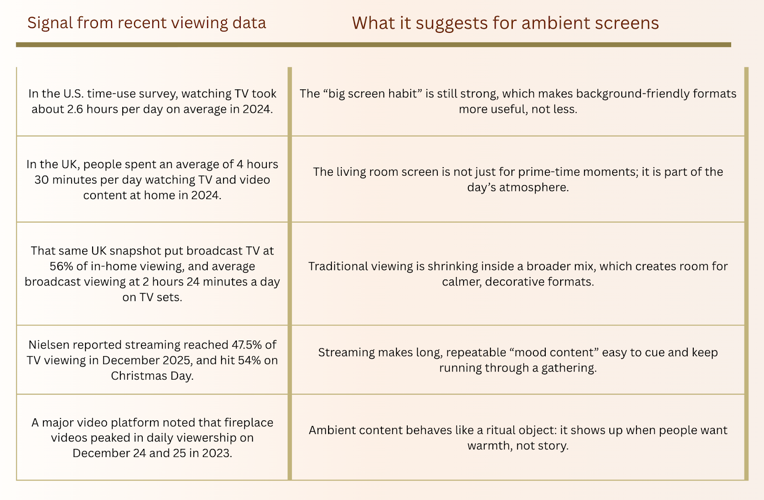
It’s a practical answer to how we use screens today: We use them more often, for longer time, and for many things at once. When a screen is already on, the real question becomes: What kind of content deserves to be there, without completely taking over your attention?

The design implication is simple: ambience is no longer a niche use of lights and the screen. It is becoming a default. For anyone shaping a high-end space, that changes what “good content” looks like. Resolution matters, but so does pace. Color matters, but so does repetition. The best ambient visuals feel like part of the room’s materials, not a performance happening inside it.
Designing gatherings around low-demand attention
The real magic of ambient play is not the screen. It is what the screen gives back to the room: permission to be social without the pressure of constant stimulation. That is why slow, continuous formats keep surprising us with their reach. In Sweden, a 24-hour slow-TV livestream about moose migration grew to 9 million viewers in 2024, and the production team said the 2025 season yielded 478 hours of footage.
It is worth noting how people describe the effect. In that same context, the project manager Johan Erhag said, “Everyone who works with it goes down in their normal stress.” That is a strong clue for hosts: calm visuals do not need to be:
steady
readable
free of sharp demands
Researchers at MIDiA put the home-gathering point plainly when they wrote that slow-TV’s role is “to be enjoyed with others, or to add to the vibe of a communal home space.” That line could double as a rule for any modern living room screen. When content supports the vibe, the room feels more intentional. Conversation comes easier because guests are not competing with a plot twist, a laugh track, or a volume spike.
This is why Plinko-as-ambience fits luxury entertaining so well. It offers gentle motion, clear cause and effect, and a loop that can run for hours without becoming “a show.” It is a background that still feels designed.


(0) comments
We welcome your comments
Log In
Post a comment as Guest
Keep it Clean. Please avoid obscene, vulgar, lewd, racist or sexually-oriented language.
PLEASE TURN OFF YOUR CAPS LOCK.
Don't Threaten. Threats of harming another person will not be tolerated.
Be Truthful. Don't knowingly lie about anyone or anything.
Be Nice. No racism, sexism or any sort of -ism that is degrading to another person.
Be Proactive. Use the 'Report' link on each comment to let us know of abusive posts.
Share with Us. We'd love to hear eyewitness accounts, the history behind an article.