
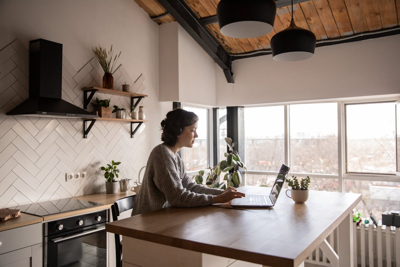

Which is probably a scary question to think about at first, right? But the question is fair, because now more than ever, the lines are blurred. It’s not necessarily bad, but it does at least need to be addressed here. And yeah, by all means here, working from the living room sounds lovely in theory. It’s all cozy sofa, snacks right there, sunlight making everything feel cute and productive. There’s no commute, and for some people, they work in their bedroom, so the commute is from their bed to their desk (or maybe they stay in bed).
While it all sounds amazing, it’s not always like that. Seriously, here, once the dining table has to be both the office and the place where dinner happens, things get mixed together fast. If you’re a parent, then it might be harder as young kids don’t understand boundaries. Overall, the message here is that trying to make home and work share the same space feels like juggling two completely different lives at once. It’s doable, it’s tough, but there are honestly a few ways to at least pull it off.
You Need to Have a Work Spot, Even if it’s Tiny
Well, most people don’t have a whole spare room waiting to become a Pinterest-worthy office. Of course, that would be great, but that’s basically a luxury for the average person. So, a corner of the sofa counts. Even a small spot on the dining table counts, and of course, a little window nook that magically becomes “the work area” the second the laptop opens counts. If a certain chair means “work mode”, the brain catches on quickly, and things feel more structured. But you need to stick to one space, and make that space your space for working.
Pack Work Away when it’s Time to Stop
For some people, it’s literally as simple as just closing their laptop and tucking it away somewhere, that whole “out of sight, out of mind” sort of thing. So, to reiterate here, if work shows up in the middle of the living room, it should also disappear like it was never there once you’re finished with work. So, this could be a shelf, a trolley, a storage cube, basically, anything that hides the laptop, planner, pens, and random office bits so evenings actually feel like evenings.
But ideally, try and have a shelf or desk. Like with IKEA desks (as an example), theres are add-ons you can buy for a few series. So you can have your desk somewhere like the living room, and you can have yout printer, you can have office supplies stored like paper and HP ink cartridges in these, and everything can be hidden quite nicely when the work day is over. But the point here is to just hide your stuff so your mind can shift into leisure mode.
Use Lighting Like an On/Off Switch
While this might be a weird one, just bear with it for a moment; lighting tells the brain what’s happening, it’s kind of hilarious in a way. Alright, so how it works is that bright lights during the day say “okay, focus time,” and then softer lighting later says “nope, work’s done”. Your brain shuts off and wants to relax in the evening. Just try it sometime, it helps a lot.

(0) comments
We welcome your comments
Log In
Post a comment as Guest
Keep it Clean. Please avoid obscene, vulgar, lewd, racist or sexually-oriented language.
PLEASE TURN OFF YOUR CAPS LOCK.
Don't Threaten. Threats of harming another person will not be tolerated.
Be Truthful. Don't knowingly lie about anyone or anything.
Be Nice. No racism, sexism or any sort of -ism that is degrading to another person.
Be Proactive. Use the 'Report' link on each comment to let us know of abusive posts.
Share with Us. We'd love to hear eyewitness accounts, the history behind an article.