
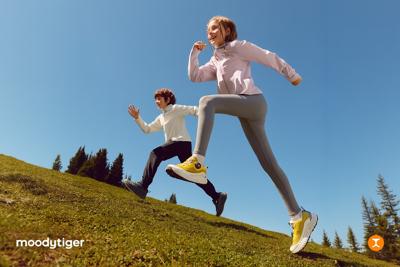

At some point, nearly every family that runs together arrives at the same quiet realization: the kids are bored of the loop. The same stretch of pavement, the same four corners, the same barking dog behind the same fence, the same lamppost that marks the halfway point. The running itself is fine; the setting has gone stale. And the instinctive fix — add more distance, make it a challenge — is exactly wrong. The fix is not more sidewalk. The fix is dirt.
Trail running with children sounds like an ambitious, gear-intensive undertaking for serious outdoor families, and it is very nearly the opposite. The great secret is that trails are self-entertaining in a way pavement can never be. There are roots to leap and puddles to assess and rocks to balance on and sticks that are, self-evidently, swords. A kid who whines and drags through two flat kilometers of neighborhood sidewalk will happily cover twice that distance on a wooded hillside and call it an adventure — because, unlike the loop, it genuinely is one. The terrain does the motivating for you.
The way to begin is to start much smaller than feels necessary, and then go smaller still. Pick a loop you could walk in under half an hour. Let the kids set the pace entirely, even when it's maddeningly slow. And quietly redefine what 'running' even means out here: you walk the steep ups, jog the flats and gentle downs, and celebrate every descent like it's a gift. Bring roughly twice the snacks you think you'll need. The only goal of the first five outings — the entire success metric — is embarrassingly simple: that they ask to go again. Distance, pace, and fitness are problems for a future year. Right now you are only building the wanting.
Footwear is the one place where gear genuinely, non-negotiably matters, and it's worth being a little fussy about. Ordinary road sneakers turn slappy and dangerously slick the instant the ground goes soft or wet — smooth soles on mud are basically skis — and a slip that scares a kid can end the whole experiment. Proper kids trail running shoes are built for exactly this: deeper lugs that bite into mud and loose gravel, a firmer edge that holds a sidehill, and a reinforced toe cap for the inevitable rock that every child on earth eventually kicks at full speed. The grip and stability matter double for children, whose ankles are still learning their trade and appreciate every bit of help staying under them on uneven ground. Trail-ready is close to the default at moodytiger, whose kids' range runs from quick-dry layers to lugged trail shoes built for exactly this kind of ground.
As for where to actually go, you need far less wilderness than the phrase 'trail running' suggests. You are not summiting anything. A flat rail-trail, the unpaved back loop of the county park, the little nature reserve you have driven past four hundred times without stopping — anything with dirt underfoot and a bit of gentle up and down qualifies completely. What reads as flat and boring to your adult legs is genuinely varied, interesting terrain to someone whose legs are half the length of yours and who has never been there before. Save the mountains and the epic views for a later year. Right now the entire point is repetition and delight, not elevation.
Dress them in thin layers they can shed as the first climb warms them up, and make peace, in advance, with the fact that everything is coming home decorated with the trail. That is not damage to be scolded; that is evidence of a day well spent. This is where honest, technical kids' clothing quietly pays for itself — most of the pieces in the new fall collection from moodytiger are built precisely for this kind of cheerful abuse: quick-drying fabrics that shrug off a surprise puddle, knees reinforced to survive a scramble up a bank, and colors chosen to hide a respectable amount of honest mud between washes. Gear you have to protect from the very activity it's for is gear that will keep your kid out of the fun.
A few field notes from the trail, since nobody warns you. First, everything takes twice as long as you plan, so plan for that and let it happen — a family trail outing has its own physics of time. Second, pockets fill. You will leave home empty-handed and return carrying an unexplained collection of acorns, one perfect leaf, a rock of deep personal significance, and a stick that has been formally named and cannot, under any circumstances, be left behind. Third, snacks are load-bearing infrastructure, not a treat; deploy them at the first flagging and consider a small summit ritual — a special treat produced only at the turnaround point works wonders.
A quiet word on safety that keeps the whole thing relaxed rather than fraught. Trails ask a little more than sidewalks, but the basics are simple and worth making into unspoken habit. Agree a rule that at every fork the lead kid stops and waits, so nobody rounds a bend alone. Teach the youngest that 'if you can't see a grown-up, hug a tree and shout' — staying put makes a lost child findable in minutes rather than hours. Carry water even on a short loop, keep a phone with a charge in a zip pocket, and glance at the sky, because woods go dark earlier and faster than open ground once autumn sets in. None of it needs to be heavy-handed; framed as 'trail rules,' kids adopt it happily and even enforce it on each other.
And a gentle note on managing your own expectations, because they're the thing most likely to spoil it. The first few outings may involve some whining, a refusal or two, and at least one dramatic declaration that someone's legs 'don't work anymore.' This is normal and it passes. Don't respond by cutting the trip short in frustration or by turning it into a lecture about attitude — just slow down, produce a snack, find something genuinely interesting to crouch over, and let the mood reset. Trail love is built slowly, outing by outing, on the accumulated memory of good times, not manufactured in a single triumphant march. Play the long game and the trail becomes their idea, which is the only version that lasts.
Folding in a bit of gentle learning, without it ever feeling like a lesson, is effortless on a trail — just follow their questions. Why is that log soft and crumbly? What made that hole in the bank? Which way is the stream actually flowing, and how can you tell? You don't need to know the answers; wondering out loud together is the entire exercise, and half the time a phone photo and a look-it-up-at-home is more fun than an instant answer anyway. A short field guide to local leaves or birds, or a simple scavenger list — something round, something older than you, something that was alive — turns an ordinary loop into a treasure hunt and buys you another cheerful half-hour on the trail. Curiosity, it turns out, is the best pace-setter of all.
And here's the last and most honest warning before your first outing: trail time is slower than road time and infinitely better at hiding how it passes. You will set out for a modest thirty-minute jog and reappear two hours later, mud past everyone's ankles, one child on your shoulders, all of you inexplicably happy, carrying that pocketful of acorns you have no memory of agreeing to transport. You will have covered almost no measurable distance. This is not the outing going wrong. This is the sport working exactly as intended. The sidewalk and its tidy, countable kilometers will still be there waiting in the spring. The hills are far better company until then — take the kids and go get pleasantly, thoroughly lost.
(0) comments
We welcome your comments
Log In
Post a comment as Guest
Keep it Clean. Please avoid obscene, vulgar, lewd, racist or sexually-oriented language.
PLEASE TURN OFF YOUR CAPS LOCK.
Don't Threaten. Threats of harming another person will not be tolerated.
Be Truthful. Don't knowingly lie about anyone or anything.
Be Nice. No racism, sexism or any sort of -ism that is degrading to another person.
Be Proactive. Use the 'Report' link on each comment to let us know of abusive posts.
Share with Us. We'd love to hear eyewitness accounts, the history behind an article.