
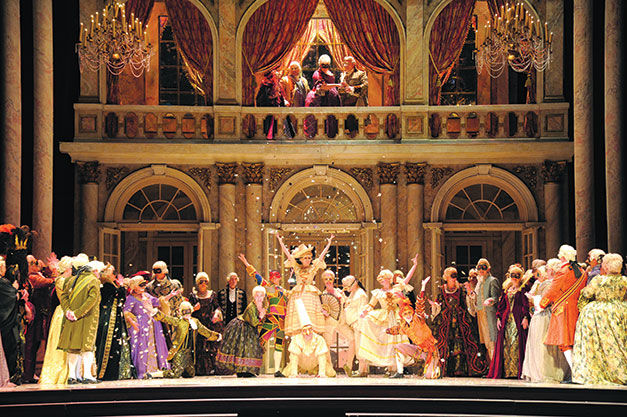
A Wagner-loving cat and a childhood listening to the Metropolitan Opera broadcasts influenced Lesley Koenig’s eventual plunge into the world of opera. Now a jet-setting director, she brings her brilliance and expertise to San Diego Opera’s exciting production of Verdi’s opera A Masked Ball, with costumes designed by John Conklin and choreography by Kenneth von Heidecke. Based on the true story of the assassination of King Gustav III of Sweden in 1792, the opera’s climactic scene takes place at a colorful, elaborately costumed masked ball. I sat down with Lesley to discuss the concept she has developed for this strikingly beautiful masterwork.
EM: You’re always so well prepared when you arrive in a city for a production. What is your process?
LK: It’s all about preparation, all about process. When people ask what we directors do for a living, I think the answer should be "homework." I walk all around my house, practicing each person’s moves, where I want them to move and to go. By the time I get to rehearsals, it’s all planned out.
EM: I admire your analytical approach. I’m guessing you already knew this opera pretty well.
LK: Just since eight months ago. I’ve only staged two Verdi operas myself, at the Met. I assisted on a few other ones when I was younger. But A Masked Ball is completely new to me.
EM: How do you learn a whole new opera?
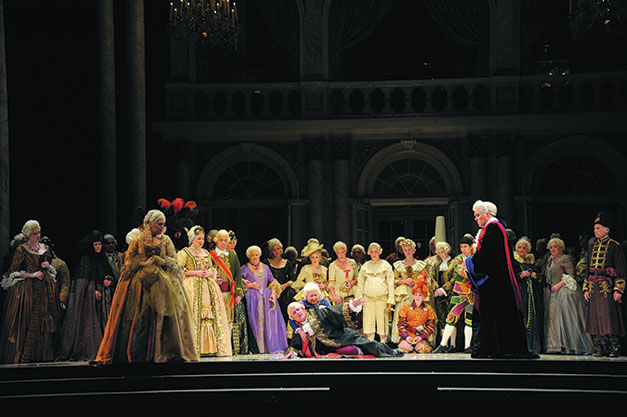
LK: I like to walk on the treadmill to exercise. And I walk a lot. So I put the opera on while I’m walking and just listen and listen to it. A Masked Ball is brilliant, one incredibly new idea following the next, and wonderful characters. In every single scene people are in disguise and lose their disguise. In Act 3 the king decides everybody’s going to get dressed up and go to the masked ball. It’s the setting for his assassination.
EM: Getting and losing disguises. I never quite thought of it that way.
LK: For the first scene of Act 1 I’ve asked them to build a diorama of the last scene of the last act—the masked ball in miniature, but it’s on the stage—as if the king is thinking about how he’s going to decorate the palace for the masked ball. So in the first scene you see it, there on the table. Then you have masks that are entered in. For the second scene everybody’s in disguise—the king, the noblemen, et al—then in Act 2 Amelia (the king’s married love interest) is not in disguise but ends up veiled, and when she loses her disguise she almost loses her life, and destroys her husband’s life. It continues until everybody at the ball in the last act is in disguise. And it just builds and builds, musically and dramatically. I love the sort of hymn the chorus sings at the end of the opera. I cry every time I hear it.
EM: The millions of times I played Ballo at the Met, I’ve loved it more every time.
LK: And we have a dream cast of singers—a wonderful bunch of people, too. What senses of humor. We laugh our heads off. I’d say this is one of the two or three happiest things I’ve ever put together in my life, in terms of a fantastic experience.
EM: Great opera, dream cast, wonderful people. Sounds like fun.
LK: It’s supposed to be fun. Why else would anyone choose to be involved in this profession?
EM: I totally agree. Have a blast.
LK: I will!


(0) comments
We welcome your comments
Log In
Post a comment as Guest
Keep it Clean. Please avoid obscene, vulgar, lewd, racist or sexually-oriented language.
PLEASE TURN OFF YOUR CAPS LOCK.
Don't Threaten. Threats of harming another person will not be tolerated.
Be Truthful. Don't knowingly lie about anyone or anything.
Be Nice. No racism, sexism or any sort of -ism that is degrading to another person.
Be Proactive. Use the 'Report' link on each comment to let us know of abusive posts.
Share with Us. We'd love to hear eyewitness accounts, the history behind an article.