
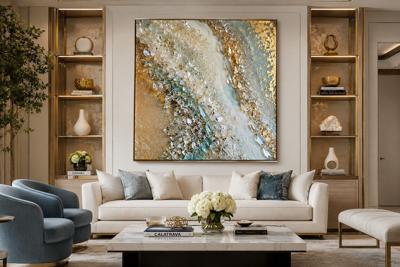

Artwork is often one of the last elements added to a room, but it should never feel like an afterthought. The right piece can give an interior its emotional center, introduce contrast, establish a focal point and reveal something meaningful about the people who live there.
Learning how to choose art for your home is not about finding something that perfectly matches the sofa. It is about understanding how art relates to the room’s mood, architecture, light, furnishings and personal history.
That distinction matters as interiors become more individualized. Homeowners are moving away from rooms that resemble coordinated showroom displays and toward spaces that feel collected over time. Original artwork, commissioned pieces, photography, sculpture and dimensional mixed media can all contribute to that sense of identity.
The goal is not to make every piece conform to the room. It is to create a thoughtful relationship between the artwork and everything around it.
Begin With the Feeling You Want the Room to Create
Before considering size, frame style or color, decide how you want the room to feel. Art can make a space appear peaceful, energetic, dramatic, playful, intimate or contemplative.
A bedroom may benefit from quiet landscapes, soft abstract forms or photography with an atmospheric quality. A living room or entryway can support greater visual tension, stronger color and work that immediately encourages conversation. Dining rooms can handle pieces with movement and personality, while a home office may call for artwork that feels focused, optimistic or intellectually engaging.
Mixed media artist Neha Shah, founder of Neha Shah Creative, advises homeowners to think about emotional energy rather than aesthetics alone.
“People are no longer just filling empty wall space,” Shah says. “They want pieces that evoke emotion, spark conversation, reflect their personality and completely transform the feeling of a room.”
This does not mean color is irrelevant. Instead, color should support the emotional direction rather than become the sole reason for purchasing a piece. Artwork does not need to repeat every shade in a rug or pillow. A contrasting color can enliven a neutral room, while a restrained work can give a colorful interior a necessary moment of calm.
Choose Art That Has a Personal Connection
A well-designed home should reveal more than current decorating trends. It should contain objects, images and ideas that have a genuine connection to the people living there.
Meaningful art might include a work discovered while traveling, a piece by a local artist, an inherited painting, a limited-edition photograph or an image that recalls an important place. It could also be an abstract work that creates an immediate emotional response, even when that response is difficult to explain.
Do not dismiss a piece simply because it does not fit neatly into an established design category. A traditional portrait can add depth to a contemporary room. Modern abstract art can provide welcome tension in a historic home. A sculptural textile or dimensional installation can soften an otherwise formal interior.
Commissioned art offers another way to build a personal connection. Rather than ordering a generic piece in predetermined colors, the homeowner can work with an artist to interpret a memory, milestone, relationship, location or personal idea.
Shah’s commissioned works frequently incorporate broken glass, resin, reflective materials, Swarovski crystals and 24K gold foil. These materials are used to communicate movement and emotion while allowing the artwork to shift visually as the surrounding light changes. Her studio also donates 10% of each commissioned purchase to a charity selected by the client.
When considering a commission, review the artist’s existing portfolio carefully. The finished piece should still reflect the artist’s recognizable point of view. A successful commission is a collaboration, not an attempt to turn an artist into a custom printing service.
Let Scale Respond to the Furniture and Architecture
Scale is one of the most common reasons artwork feels wrong in a room. A beautiful piece can appear insignificant when it is too small for the wall, while an oversized work can feel crowded if the surrounding architecture does not provide enough breathing room.
When hanging art above a sofa, console, bed or fireplace, consider the artwork and furniture as one visual composition. The piece should feel connected to what is beneath it rather than floating by itself near the ceiling.
Large rooms do not always require several small pictures. One substantial work can anchor an open living area more effectively than a collection of unrelated frames. Shah says many of her commissioned statement works measure approximately 46 by 60 inches, a scale intended to establish a central presence within the room.
Before purchasing, outline the proposed dimensions on the wall with removable painter’s tape. Live with the outline for a day and view it from several positions. Check how it appears while entering the room, sitting on the primary furniture and looking through adjoining spaces.
For a better sense of proportion, photograph the wall and create a simple digital mock-up. Some galleries and art platforms also offer augmented-reality previews that allow shoppers to visualize pieces within their homes before committing. Digital previews will not reproduce texture or exact color perfectly, but they can help identify obvious problems with scale.
Decide Between One Statement Piece and a Gallery Wall
A statement piece and a gallery wall create very different effects.
One large artwork tends to make a room feel more architectural, controlled and visually calm. It is particularly effective above a long sofa, in a double-height entryway, at the end of a hallway or on a wall visible from several rooms.
A gallery wall creates rhythm and allows a homeowner to combine several stories. It can include paintings, family photographs, drawings, textiles, small sculptural objects and collected prints. The arrangement should have a clear connecting idea, even if the frames and media are varied.
That connection might come from a consistent color palette, matching mats, similar frame finishes, repeated spacing or a shared subject. Lay the complete arrangement on the floor before placing anything on the wall. Paper templates can also help determine spacing and placement without leaving unnecessary holes.
Homeowners who prefer photography can find additional room-by-room ideas in FINE Magazine’s guide to selecting photographs for every room.
Consider How Light Changes the Artwork
Lighting does more than make artwork visible. It affects color, texture, shadow, reflection and the viewer’s perception of depth.
This is especially important with mixed media art. Resin, glass, crystals, metallic foil and other reflective materials may look different in morning sunlight, afternoon shadows and artificial evening light. Rather than viewing this variation as a problem, it can become part of the experience of living with the piece.
Before selecting dimensional or reflective art, observe the room throughout the day. Notice where direct sunlight falls, whether lamps create glare and how people move through the space. A highly reflective surface positioned opposite a large window may produce distracting glare. The same work placed beside the window could catch softer, changing light.
Picture lights, adjustable ceiling fixtures and wall washers can emphasize artwork after dark. Lighting should be directed carefully and tested from normal viewing positions. Museum lighting professionals balance visibility, color rendering, glare control and preservation rather than simply placing the brightest possible light over an object.
Direct sunlight and excessive exposure can also damage sensitive artwork. The National Gallery of Art notes that light, heat and humidity can affect photographs and other vulnerable materials, and it recommends subdued display lighting for photographic works. Its broader conservation guidance emphasizes stable environmental conditions and minimizing unnecessary light exposure. Therefore, valuable or delicate pieces should not be placed where they receive strong direct sunlight every day.
Use Texture to Add Depth to the Room
Texture has become increasingly important as interiors move toward layered, tactile materials. Plaster walls, natural stone, linen, boucle, wood grain and hand-finished metals all invite a closer visual and physical response.
Artwork can participate in that layering. Heavy brushwork, handmade paper, textile art, carved wood, ceramic reliefs and mixed media pieces introduce shadows and surface variation that flat reproductions cannot provide.
Shah describes her own approach as creating artwork that feels alive within its setting. Reflective and dimensional materials allow light to move across the work, making the appearance change according to the time of day and the viewer’s position.
Texture should still be balanced with the rest of the room. A heavily layered piece may be most effective against a restrained wall with minimal surrounding decoration. In a room already filled with patterned stone, ornate furnishings and complex textiles, quieter art may offer more impact by providing contrast.
Pay Attention to Framing and Presentation
Framing is not merely a finishing detail. It influences how art relates to the architecture and can make an inexpensive print appear considered—or make an exceptional work feel poorly presented.
A slim black frame can give traditional art a modern edge. Warm wood can soften contemporary photography. Ornate gilt framing may create intentional contrast in a minimal room. Float mounting can emphasize the edges of a work on paper, while frameless canvases and resin pieces may feel more sculptural.
The frame does not need to match every metal or wood finish in the room. It should, however, feel deliberate. When preserving an original, photograph or work on paper, consult a professional framer about archival mats, backing materials, glazing and mounting methods.
For collectors evaluating prints, editions and materials, FINE’s guide to how luxury wall art transforms interiors explains why printing methods, paper quality, provenance and archival standards matter.
Do Not Ignore Installation and Everyday Practicalities
The weight and construction of a piece should influence where and how it is installed. Large canvases, glass, resin panels and dimensional works may require specialized wall anchors or professional installation.
Consider the wall material, the location of studs and the amount of traffic through the area. Heavy or fragile art should not be balanced casually above a bed, placed where a door can strike it or installed within reach of an active walkway.
Humidity and temperature changes also matter. Bathrooms, kitchens, sunrooms and spaces near fireplaces can expose art to moisture, heat, airborne grease or rapid environmental changes. Certain materials tolerate these conditions better than original works on paper, photographs or wood panels.
Ask the artist, gallery or framer for care instructions. Owners of valuable pieces should also retain purchase records, artist information, certificates of authenticity, condition photographs and insurance documentation.
Questions to Ask Before Buying or Commissioning Art
Before making a final decision, consider the following:
- What feeling does this piece create?
- Would I still value it if I changed the room’s furnishings?
- Does its scale suit the wall and nearby furniture?
- How will natural and artificial light affect it?
- Does the material require special care or installation?
- Is the work original, limited edition or open edition?
- What is included in the price?
- Does the artist provide provenance or a certificate of authenticity?
- For a commission, how many revisions are included?
- What happens if the final piece differs from the initial concept?
These questions protect the investment, but they also encourage a more deliberate relationship with the work.
Allow Your Collection to Develop Over Time
Knowing how to choose art for your home does not require completing every wall at once. In many of the most memorable interiors, the art collection has developed gradually through travel, relationships, discoveries and changing interests.
Leave some walls open until the right work appears. Move pieces between rooms. Reframe older art. Combine established artists with emerging talent, inherited works with contemporary commissions and valuable originals with photographs that hold private meaning.
The strongest collection is not necessarily the most expensive or perfectly coordinated. It is the one that feels connected to the people who live with it.
“I want each piece to feel immersive and personal,” Shah says. “The way light reflects off the materials, the movement within the textures, the emotion behind the commission—it all becomes part of the atmosphere of the home.”
When chosen with that level of intention, art does more than finish a room. It gives the room a point of view.


(0) comments
We welcome your comments
Log In
Post a comment as Guest
Keep it Clean. Please avoid obscene, vulgar, lewd, racist or sexually-oriented language.
PLEASE TURN OFF YOUR CAPS LOCK.
Don't Threaten. Threats of harming another person will not be tolerated.
Be Truthful. Don't knowingly lie about anyone or anything.
Be Nice. No racism, sexism or any sort of -ism that is degrading to another person.
Be Proactive. Use the 'Report' link on each comment to let us know of abusive posts.
Share with Us. We'd love to hear eyewitness accounts, the history behind an article.