
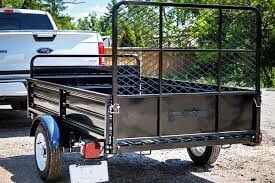
A pickup truck or sport utility vehicle can accommodate plenty of weekend equipment—until the lawn mower, building materials or camping gear leave no room for anything else. A compact utility trailer provides a relatively simple way to expand carrying space without moving up to a larger commercial vehicle.
A 5-by-7 utility trailer is small enough to store more easily than many full-size trailers, yet large enough to handle a range of household, recreational and light commercial jobs. Models equipped with a rear ramp are particularly useful for wheeled equipment that would otherwise need to be lifted into a truck bed.
That convenience should not be mistaken for simplicity, however. A trailer changes how a vehicle accelerates, turns and stops. Its safe operation depends on more than whether the cargo physically fits on the deck. The tow vehicle, hitch, trailer, tires, ramp and securing equipment must all be appropriate for the load.
Where a Compact Utility Trailer Proves Most Useful
The value of a 5-by-7 trailer lies in its versatility rather than its ability to carry exceptionally heavy equipment. Depending on the trailer’s manufacturer-rated capacity, it may be suitable for transporting lawn and garden equipment, home-improvement supplies, bicycles, camping equipment, boxed inventory or tools.
A rear ramp can make the trailer especially practical for equipment with wheels. Lawn mowers, snow blowers, pressure washers and rolling tool cabinets can be moved onto the deck with less lifting, provided the equipment falls within the stated capacities of both the ramp and trailer.
Landscapers, property-maintenance teams and mobile service businesses may also find the compact dimensions useful when working in residential areas or locations with restricted loading space.
Its size does impose clear limitations. A compact single-axle trailer should not be treated as a substitute for a dump trailer, equipment hauler or heavy-duty commercial trailer. Readers comparing trailer categories can review FINE’s guide to dump trailers versus utility trailers.
Size Alone Does Not Determine Carrying Capacity
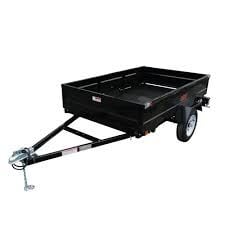
Two trailers with the same deck dimensions may have substantially different weight ratings. Frame construction, axle rating, tires, wheels, suspension and ramp design all influence what a particular model can safely carry.
Before loading anything, locate the trailer’s identification label or manufacturer documentation. The relevant rating is the trailer’s gross vehicle weight rating, often abbreviated as GVWR. This represents the maximum permitted weight of the trailer and everything loaded onto it.
To determine the available payload, subtract the trailer’s empty weight from its GVWR. Accessories added after purchase—including spare tires, storage boxes, side extensions and mounted equipment—also consume part of that payload allowance.
The tow vehicle introduces another set of limits. Its owner’s manual should identify the maximum trailer weight and other towing restrictions. The hitch, ball mount, hitch ball and coupler must also be rated for the intended load. The safe limit is always determined by the lowest-rated component in the complete towing system.
Visual impressions are unreliable. A dense load of stone, soil, tile or machinery can exceed a trailer’s rating long before the deck appears full.
How to Position the Load
Weight distribution determines whether a trailer follows the tow vehicle predictably or begins to sway. Cargo should be kept low, centred from side to side and positioned to maintain the tongue weight specified by the manufacturer.
Excessive rear loading can reduce tongue weight and destabilize the trailer, while too much weight at the front may overload the hitch or rear axle. Place the heaviest item near the axle area, then arrange smaller pieces around it without exceeding the trailer’s ratings.
Individual items should be arranged before they are secured. The heaviest object ordinarily belongs near the trailer’s axle area rather than at the extreme front, rear or one side of the deck. Smaller pieces can then be positioned around it without exceeding the trailer’s rating.
Drivers who are uncertain about the loaded weight should use an appropriate vehicle scale rather than estimate. Weight should be confirmed whenever the trailer is carrying an unfamiliar combination of equipment or dense materials.
Using the Ramp Without Creating Another Hazard
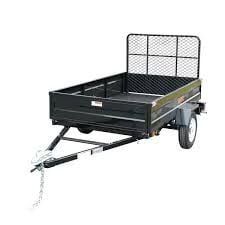
A ramp reduces lifting, but it introduces its own set of risks. Confirm that the ramp is fully deployed, locked into position and resting on firm, reasonably level ground. The ramp’s rated capacity must be sufficient for the equipment and the person operating or guiding it.
Before loading, connect the trailer securely to the tow vehicle and prevent unintended movement. Follow the trailer manufacturer’s instructions regarding the use of the tow vehicle’s parking brake, wheel chocks or stabilizing equipment.
Equipment should travel straight up the ramp whenever possible. Sudden turns near the edge can shift the combined weight to one side. Loose boards, improvised extensions and wet or icy ramp surfaces can create additional hazards.
Powered equipment should only be driven onto a trailer when the manufacturer permits it and the operator can maintain control. When visibility or traction is limited, a properly rated winch may offer a more controlled approach.
Securing Cargo Requires More Than One Strap
A load must remain controlled during acceleration, braking, cornering and travel over uneven roads.
Use tie-down points that are structurally designed for cargo securement and straps or chains with readable working-load ratings. The attachment points on the cargo must also be capable of handling the force placed on them.
Wheeled equipment should be restrained against rolling as well as side-to-side and forward movement. Wheel chocks can assist with positioning, but they do not normally replace a complete tie-down system. Loose tools, fuel cans, branches and building materials require their own containment or securement.
Straps should not run across sharp, unprotected edges that may cut or weaken the webbing. They should also be inspected for abrasion, damaged stitching, corrosion or distorted hardware before use. FINE’s guide to heavy-duty nylon webbing straps explains several factors to consider when evaluating tie-down equipment.
Stop after the first few miles or kilometres to check the load. Straps can settle or loosen as equipment shifts into position. Cargo should also be rechecked periodically during longer trips.
Complete a Pre-Trip Trailer Inspection
A brief inspection before departure can identify many of the problems that lead to roadside failures. Begin by confirming that the coupler is correctly seated and latched onto the proper hitch ball.
Safety chains or cables should be attached to the tow vehicle as required and arranged so they cannot drag on the road. The electrical connector should be secure, with the tail lamps, brake lamps and turn signals functioning correctly.
Inspect the tires for visible damage, unusual wear and proper inflation while they are cold. Trailer tires should be inflated according to the trailer or tire manufacturer’s specifications—not automatically matched to the tow vehicle’s tire pressure. Wheel fasteners, bearings and suspension components also require inspection and maintenance at the intervals stated by the manufacturer.
Confirm that the ramp, gate, jack, spare tire and any removable accessories are locked in their travel positions. A ramp that opens while driving can be as dangerous as unsecured cargo.
Adjust the Way You Drive
A trailer increases the length and weight of the vehicle combination. Even a compact model may require more distance to stop, more space to merge and a wider path through turns.
Accelerate progressively, maintain additional following distance and avoid abrupt steering corrections. Reduce speed before curves rather than braking heavily while turning. When travelling downhill, follow the tow vehicle manufacturer’s guidance on gear selection and braking.
Crosswinds, passing trucks, rutted pavement, snow and ice may all affect stability. If the trailer begins to sway, remain calm and avoid a sharp steering input. Gradually reduce speed while following the procedures recommended by the tow vehicle and trailer manufacturers.
Reversing also requires practice. Small trailers can respond quickly to steering input and may disappear from view sooner than longer models. An empty parking area provides a safer place to become familiar with the trailer before attempting to back into a narrow driveway or busy worksite.
Trailer-Brake Rules Differ Across Canada
Trailer requirements are set provincially, and the brake threshold is not the same throughout Canada. Rules may also address registration, lights, safety chains, breakaway systems, dimensions and commercial use.
In Ontario, a trailer with a gross trailer weight—including the trailer and its load—of 1,360 kilograms or more must have adequate brakes. Alberta requires a trailer weighing more than 910 kilograms to have its own brakes.
British Columbia’s rule is more conditional. Brakes are generally required when a trailer’s loaded weight exceeds 1,400 kilograms. A trailer weighing 1,400 kilograms or less may be exempt only when it also weighs less than 50 percent of the licensed weight of the tow vehicle.
Ontario operators can consult the Ministry of Transportation’s official towing guidance. Drivers in Alberta or British Columbia should review the corresponding provincial requirements before towing, particularly when crossing provincial boundaries.
Commercial operators should also determine whether additional inspection, insurance, licensing or recordkeeping requirements apply.
When a 5-by-7 Trailer Is the Wrong Choice
A compact trailer is useful only when its ratings and configuration match the work. Repeatedly carrying loads near the maximum rating, transporting unusually tall equipment or moving heavy machinery may justify a larger tandem-axle trailer with additional braking and securement capabilities.
A different trailer may also be preferable when the load must be protected from weather or theft. Enclosed trailers provide containment and security, while dump trailers are designed for unloading loose material. Readers researching recreational models can explore FINE’s overview of lightweight travel trailers.
A Compact Tool That Still Demands Care
A 5-by-7 single-axle utility trailer can make property maintenance, home projects and equipment transport considerably easier. Its modest footprint is part of its appeal, particularly for owners with limited storage space or towing needs that do not justify a larger trailer.
Safe operation begins with treating the trailer as part of a complete system rather than an accessory attached behind the vehicle. Confirm every weight rating, distribute the load correctly, secure each item, inspect the equipment and adjust driving habits accordingly.
Compact does not mean consequence-free. Used within its limits and maintained properly, however, a small utility trailer can become one of the most adaptable pieces of equipment a homeowner or small business owns.
Frequently Asked Questions
How much weight can a 5-by-7 utility trailer carry?
There is no universal capacity based solely on the trailer’s dimensions. Check the specific trailer’s GVWR and subtract its empty weight, along with the weight of any permanently installed accessories, to determine the available payload.
Does a small utility trailer need brakes?
Possibly. Brake requirements vary according to trailer weight and the province or territory in which it is operated. Verify the applicable regulations rather than relying on a general rule.
Can a riding mower be loaded onto a 5-by-7 trailer?
Only when the mower fits safely and its weight falls within the ratings of the trailer, axle, tires and ramp. The mower must also be positioned and secured correctly.
Should cargo be placed toward the front or rear?
The load should be positioned to achieve the tongue weight specified by the trailer manufacturer. Excessive rear loading can contribute to sway, while excessive forward loading can overload the hitch or tow vehicle.
(0) comments
We welcome your comments
Log In
Post a comment as Guest
Keep it Clean. Please avoid obscene, vulgar, lewd, racist or sexually-oriented language.
PLEASE TURN OFF YOUR CAPS LOCK.
Don't Threaten. Threats of harming another person will not be tolerated.
Be Truthful. Don't knowingly lie about anyone or anything.
Be Nice. No racism, sexism or any sort of -ism that is degrading to another person.
Be Proactive. Use the 'Report' link on each comment to let us know of abusive posts.
Share with Us. We'd love to hear eyewitness accounts, the history behind an article.