

If you are comparing a dump trailer vs. a utility trailer, you are not browsing. You are solving a work problem.
Both platforms move material. Both tow behind the right truck. But, they serve different production needs, and choosing the wrong one creates friction on every job that follows.
Understanding the difference between dump trailers and open utility platforms starts with how you load, unload, and how often you cycle material in a typical workday.
This is not about preference. It is about output.
Understanding The Core Structural Difference
At a glance, a dump trailer vs. utility trailer comparison seems simple:
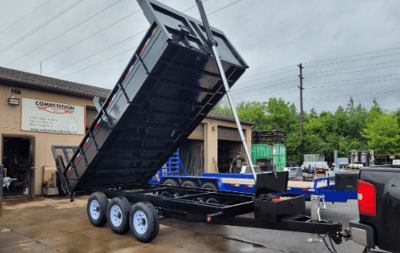
A dump trailer lifts and unloads hydraulically.
A utility trailer has a fixed deck and relies on manual or machine unloading.
That mechanical difference shapes everything from frame construction and weight rating to maintenance profile and jobsite role.
Dump trailers are built around reinforced beds, hydraulic hoists, scissor or telescoping lift systems, and enclosed sidewalls. Utility trailers are typically open deck platforms designed for equipment, pallets, or materials that can be unloaded without lifting the entire bed.
Federal safety standards outlined by the National Highway Traffic Safety Administration emphasize that compliant trailers must be properly equipped with critical safety components like brakes, lights, and structural features that match their intended use and load requirements, making the dump trailer vs. utility trailer decision equally important for safe operations.
The question becomes: What does your operation require every day?
When A Dump Trailer Makes Sense
If your work involves loose material like gravel, soil, mulch, demolition debris, roofing tear off, or storm cleanup, then the dump trailer vs. utility trailer decision often leans heavily toward hydraulic dumping.
Faster Cycle Times
Hydraulic lift systems significantly reduce unloading time. Instead of hand shoveling or repositioning equipment to clear a flat deck, the bed raises, and gravity does the work.
For contractors running multiple loads per day, those minutes add up to hours over a week.
Safer Material Discharge
Controlled dumping reduces worker exposure to shifting loads. Tailgate designs, spreader gates, and stable hoist geometry allow operators to unload with predictability.
Built For Weight Concentration
Dump trailers are engineered for dense, heavy material. Crossmember spacing, steel thickness, and axle ratings are matched to repeated loading cycles. If you routinely haul material that settles and compacts in transit, structural integrity matters.
If you are asking, “dump trailer vs. utility trailer for hauling aggregate?” the answer is usually clear.
When A Utility Trailer Is The Right Tool
There are jobs where hydraulic dumping adds cost without adding value.
Open utility trailers excel in equipment transport and general hauling, where the load remains intact from departure to arrival.
Equipment Transport
Landscaping crews, small construction teams, and service contractors often move:
skid steers
compact tractors
mowers
lifts
palletized materials
In these scenarios, a flat or low side open deck provides flexibility. You are not dumping material. You are delivering equipment and unloading with ramps.
Lower Weight, Simpler Maintenance
Utility trailers generally weigh less than dump platforms because they do not carry hydraulic systems. Fewer moving parts can mean simpler maintenance in the right use case.
However, lighter weight does not mean lighter duty. Professional-grade utility trailers still require reinforced frames and properly rated axles to hold up over time.
Cost Considerations Without Short-Term Thinking
When comparing a dump trailer vs. utility trailer, the first question should be what the job requires, not which option has the lower purchase price.
Once the use case is clear, total productivity becomes a more useful way to evaluate cost.
The better question is total productivity.
A dump trailer typically costs more upfront due to:
hydraulic systems
reinforced steel beds
heavier frames
electrical components
But if your workflow demands repeated unloading of loose material, the labor savings and cycle efficiency often justify the investment.
Conversely, buying a dump trailer for equipment-only transport adds unnecessary complexity.
The trailer should fit the work, not the other way around.
Durability and Long-Term Performance
Professional operators measure equipment in years, not months.
Dump trailers are subject to stress from shifting loads, hydraulic pressure, and torsional strain during lifting. Utility trailers absorb stress through deck loading, tie down tension, and ramp impact.
In both cases, durability comes down to:
frame construction
weld quality
axle selection
braking systems
corrosion resistance
If you are evaluating which dump trailer is best, reviewing lift geometry, steel thickness, and weight ratings is essential. The wrong build will show stress cracks and alignment issues much earlier than it should.
The same applies when reviewing different types of trailers for your industry. Not every platform is engineered for commercial repetition.
Real World Jobsite Examples
To make the dump trailer vs. utility trailer decision practical, consider these scenarios:
Roofing Contractor
Tear off debris must be removed quickly. A dump trailer reduces manual labor and speeds disposal.
Landscaping Crew
Daily equipment transport between properties favors a utility trailer. Occasional mulch hauling may still justify a small dump unit if volume is high.
Concrete Contractor
Hauling forms and tools? Utility trailer.
Removing broken slab and rubble? Dump trailer.
Municipal Maintenance Team
Storm cleanup and debris removal often demand hydraulic dumping.
The right answer is rarely theoretical. It reflects your load profile and cycle count.
Payload And Tow Vehicle Match
Both trailer types require proper matching to your truck.
Overloading either platform shortens service life and increases risk. Professionals specify capacity based on worst case loads, not average days.
In a dump trailer vs. utility trailer comparison, dumping capacity must account for the weight of wet material. Utility trailers must account for the equipment center of gravity and axle distribution.
Size is not just length. It is a structural capability.
Frequently Asked Questions
FAQ
Is A Dump Trailer More Versatile Than A Utility Trailer?
It depends on the material. Dump trailers handle loose material efficiently. Utility trailers excel at equipment transport. Versatility comes from matching the trailer to your primary work.
Which Trailer Type Requires More Maintenance?
Dump trailers have hydraulic components that require inspection and care. Utility trailers are mechanically simpler but still require regular maintenance of brakes, axles, and the structure.
Can A Utility Trailer Haul Loose Material?
Yes, but unloading requires manual labor or assistance from equipment. For frequent hauling of loose material, a dump platform is more efficient.
Is The Higher Cost Of A Dump Trailer Worth It?
If your operation depends on rapid unloading and repeated material cycles, the productivity gain often outweighs the initial price difference.
Choose Based On Work, Not Assumption
The dump trailer vs. utility trailer question is not about which one is better in general. It is about which one performs better for your operation.
If you move heavy, loose material daily, hydraulic dumping protects time and labor. If you transport equipment and structured loads, an open deck keeps things simple and efficient.
Evaluate your workload honestly. Spec for peak demand. Choose construction built to last.


(0) comments
We welcome your comments
Log In
Post a comment as Guest
Keep it Clean. Please avoid obscene, vulgar, lewd, racist or sexually-oriented language.
PLEASE TURN OFF YOUR CAPS LOCK.
Don't Threaten. Threats of harming another person will not be tolerated.
Be Truthful. Don't knowingly lie about anyone or anything.
Be Nice. No racism, sexism or any sort of -ism that is degrading to another person.
Be Proactive. Use the 'Report' link on each comment to let us know of abusive posts.
Share with Us. We'd love to hear eyewitness accounts, the history behind an article.