
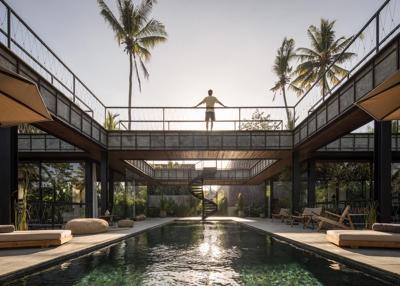

Set in Ubud, Bond House explores a contemporary approach to tropical residential design through structure, openness, and a close relationship with the landscape. Its impact comes from spatial clarity rather than excess, creating a home that feels calm, deliberate, and deeply connected to place.
Bali has become a destination for innovative tropical homes
Bali continues to attract attention for residential architecture that responds as carefully to climate and setting as it does to form. Many of the island’s most compelling homes are shaped less by spectacle than by how they handle light, airflow, openness, and movement through space. That is what gives Bali’s contemporary architecture its depth. It often feels rooted in lived experience rather than image alone.
In this context, good design is not simply about making a house look open. It is about shaping a way of living that remains connected to the outdoors. Rooms provide shade, privacy, and comfort while still allowing landscape, daylight, and air to remain present. When that balance is handled well, the result feels both refined and natural.
Bond House begins with a strong concept and a clear sense of place
Bond House, located in Ubud, is built around the intersection of horizontal and vertical elements, creating a residence where structure and openness are held in deliberate balance. It is a clear architectural idea, but one expressed with enough restraint that it never overwhelms the experience of the house itself.
That order is present in the approach. The arrival sequence leads directly towards the pool, which forms the main axis of the home and divides the principal living level into two separate living spaces. This does more than organise the plan. It establishes a strong centre, giving the house orientation and rhythm from the outset.
The project is substantial in scale, yet it does not rely on size for effect. Its character comes instead from how clearly its spaces are arranged and how consistently that arrangement supports the experience of living within the site.
Layout and openness shape the experience of the house
A large house that still feels light
One of the most striking aspects of Bond House is the way it avoids heaviness. The upper slab appears to hover above the main living spaces, while the opening above the pool creates a visual connection through the house and back from the roof terrace. These moves give the architecture a sense of lift, making it feel open and fluid rather than dense.
The project uses structure to guide movement rather than simply contain it. Views continue through the home, and the relationship between levels adds to that continuity. This gives the house generosity of space without losing control.
Spatial flow supports both gathering and privacy
The principal living areas are framed with curtain wall façades that keep the outside visually present. The landscape is not treated as something beyond the house, but as part of its overall spatial experience. Inside, a spiral staircase forms a sculptural focal point, linking the main living spaces to the roof terrace above.
That vertical movement adds another dimension to the design. From the terrace, views stretch across the rice fields and back towards the pool, widening the sense of outlook. Below, five bedrooms connect to the living spaces through stair-held voids while also allowing independent access from outside. This gives the plan a practical balance between communal life and retreat.
The design responds closely to the climate, light, and landscape
Bond House is especially effective in the way it works with its environment. The design frames the surrounding greenery and keeps the landscape visually present throughout the home. That openness is not only aesthetic. In a tropical climate, it shapes comfort, atmosphere, and the feeling of living within the site rather than apart from it.
Light plays a central role in that experience. Openings and voids allow it to move through the house, giving the interiors variation and depth across the day. Material choices reinforce this connection. Hard surfaces extend some of the outdoor character into the architecture, while timber introduces warmth and defines the more sheltered interior zones. The result is a house that feels grounded in place.
Bond House reflects a wider architectural sensibility
Bond House also reflects a clear architectural sensibility. Designed by Bali architecture studio Alexis Dornier, the project balances concept, climate response, and spatial clarity without losing its sense of ease. The studio’s role sits naturally within the story of the house itself.
Bond House reflects a broader direction in Bali
Bond House feels part of a broader movement in Bali towards homes that are more open, more refined, and more responsive to their surroundings. It shows how contemporary tropical architecture can be expressive without becoming overstated, and how structure can create freedom rather than rigidity.
That is what gives the project its lasting appeal. It is a feature on Bond House first and foremost: a house shaped by order, openness, and landscape, with the designer naturally present through the quality of the work itself.
(0) comments
We welcome your comments
Log In
Post a comment as Guest
Keep it Clean. Please avoid obscene, vulgar, lewd, racist or sexually-oriented language.
PLEASE TURN OFF YOUR CAPS LOCK.
Don't Threaten. Threats of harming another person will not be tolerated.
Be Truthful. Don't knowingly lie about anyone or anything.
Be Nice. No racism, sexism or any sort of -ism that is degrading to another person.
Be Proactive. Use the 'Report' link on each comment to let us know of abusive posts.
Share with Us. We'd love to hear eyewitness accounts, the history behind an article.