

There is a particular kind of courage required to look at one of America's largest abandoned military bases, with thousands of acres of decommissioned barracks, cracked tarmac, and coastal scrubland, and envision it as a beachcommunity waiting to be born.
Don Hofer has that kind of courage. As Vice President of Community Development for Shea Homes' Northern California Division, he has spent decades navigating the complex business of building communities that people actually want to live in. But nothing in his portfolio, not the 10,000-plus homes he has overseen since 1998, not the mixed-use master-planned communities that have become something of a Northern California signature for Shea, has been quite as ambitious as The Dunes on Monterey Bay.
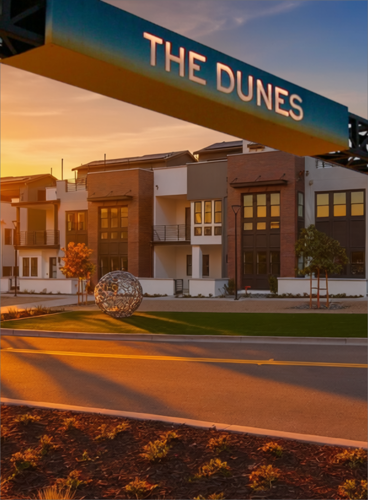
Built on the grounds of the former Fort Ord, a U.S. Army base that once housed hundreds of thousands of soldiers before its closure in 1994, The Dunes is a first-of-its-kind coastal community in Marina, California. It is, in the truest sense of the phrase, a beach town built from the ground up. And the story of how it came to be, and what it says about where residential development is heading, is one worth telling.
The Ground Beneath the Dream
Before a single home was designed or a single promenade stone laid, this stretch of California coastline had already lived several extraordinary lives.
The Monterey Peninsula's story begins long before the military arrived. When Scottish author Robert Louis Stevenson visited the region in 1879, he was so struck by the landscape that he remarked its beaches were "white with weathered whale bones" - a vivid reminder that this coastline has been capturing imaginations for well over a century.
The U.S. Army arrived decades later, and what followed was one of the most consequential chapters in American military training history. Between 1940 and 1975, when Fort Ord ceased operations as a basic training centre, an estimated 1.5 million young men and women passed through its grounds. At its peak, as many as 50,000 soldiers trained there in a single year. Generations of Americans came of age on this coastal land, shipped out from it, and carried memories of it for the rest of their lives.
Among them, improbably, was a young Clint Eastwood. Drafted during the Korean War, Eastwood was stationed at Fort Ord as a swimming instructor, spending his days on the very coastline that now anchors one of California's most sought-after new communities. In his off-hours, he worked as a bouncer at bars and clubs near the base, quietly building a reputation that would eventually reach Hollywood. After his honourable discharge in 1953, he used his GI Bill education benefit to enrol in acting classes, the opening chapter of a 70-year career.
It is the kind of history that most developers would treat as a footnote. At The Dunes, it is woven into the community's very identity.
The Land Nobody Wanted
Fort Ord's closure left behind one of the most complicated land-reuse challenges in American military history. The base had been one of the largest on the West Coast, spanning more than 28,000 acres of California coastal land, and it carried the weight of a community that had lost its primary economic engine almost overnight.
But the land also sat on the Monterey Peninsula, one of the most scenically extraordinary stretches of California coastline, flanked by the Pacific, adjacent to what would become Fort Ord National Monument, and within reach of Carmel-by-the-Sea, Pebble Beach, and the celebrated wine country of Carmel Valley. In the right hands, it was extraordinary raw material.
Together, Shea Homes and Hofer saw both the potential and the vision to bring it to life. What followed was more than two decades of patient, meticulous work, with entitlement processes, environmental remediation, infrastructure development, and community engagement that most developers would have found prohibitive.
"Building a coastal destination requires long-term vision and careful planning," Hofer has said of the project. "At The Dunes, every detail was designed to create an inviting environment.” And that attention to detail is evident at every turn.
A Community Designed for How People Actually Live

The Dunes is not a subdivision. That distinction matters enormously, and it is one Hofer is emphatic about. Where a subdivision offers homes and little else, leaving residents to drive elsewhere for every errand, meal, cultural experience, and social interaction, The Dunes was conceived as a fully self-sustaining coastal village. The kind of place where daily life unfolds on foot, where neighbors become a genuine community, and where the environment itself contributes to wellbeing in ways that floor plans and finishes alone cannot achieve.
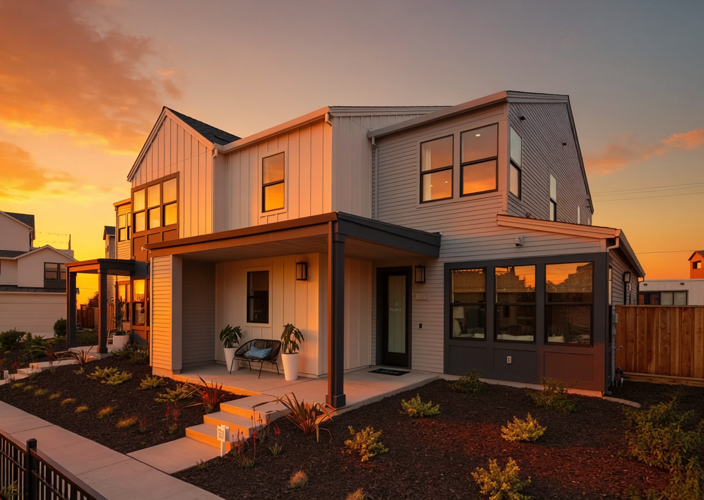
The residential offering is deliberately diverse. Upon completion, the community will span the full spectrum from affordable housing to multi-million-dollar estate homes, recognising that a genuinely vibrant neighborhood requires a mix of residents, not a monoculture of wealth. Currently, Shea Homes offers four distinct residential collections - Sky House, Light House, Bay House, and Rooftops - each designed to serve a different lifestyle, from young professionals seeking their first coastal address to growing families putting down roots for the long term. The Rooftops collection, with its townhome-style residences and private rooftop decks overlooking the bay, has become something of a signature offering.
But the homes are only part of the story.
The Promenade: Where Community Life Happens
At the heart of The Dunes is its Promenade, a curated retail and dining precinct that functions as the community's main street, and does so with considerably more intention than the average mixed-use development.
Anchor tenants like Trader Joe's provide the practical foundation, but the Promenade's appeal runs considerably deeper. The Brass Tap craft beer bar, Lalla Grill, Tous les Jours bakery, and Crust Deli create a dining culture that rewards regulars and draws visitors. Century Theatres brings cultural infrastructure that most master-planned communities overlook entirely. Bay Federal Credit Union and Monterey Bay Orthodontics ensure that the essentials of daily life, financial services, healthcare, are as walkable as the weekend brunch spot.
It is a deliberate rejection of the model in which residential communities treat retail as an afterthought. Here, the commercial precinct is part of the community's identity, and it shows.
Nature, History, and the Art of Placemaking
What elevates The Dunes from impressive development to genuine destination is its relationship with the landscape and history it inhabits, and the thoughtfulness with which both have been woven into the community's fabric.
The recreational offering alone is remarkable. Adjacent to Fort Ord National Monument and the future Fort Ord Dunes State Park, residents have direct access to an expansive network of hiking, biking, and equestrian trails that connect across the broader Central Coast region. Public parks, outdoor fitness installations with classes by Monterey Bay Moves, and miles of coastal trail mean that an active, outdoor-oriented lifestyle is not an aspiration here.
Then there is the History Wall and Art Walk - perhaps the most quietly powerful element of the entire development. Fort Ord's military legacy is not papered over or politely ignored in favour of a sanitised coastal aesthetic. It is celebrated. The art installations and historical features that run through the community give residents and visitors a genuine sense of place, a reminder that this ground has always mattered, and that the community being built on it carries that history forward with respect.
What The Dunes Tells Us About the Future of Fine Living

"Today's homebuyers aren't just choosing a home," Hofer observes. "They're choosing a lifestyle."
It is a simple statement, but it carries the weight of a fundamental shift in what the residential market demands and what the finest developments must now deliver. The era in which square footage, stone benchtops, and a good school district were sufficient to define premium living is, quietly but decisively, behind us.
What buyers at every price point are increasingly seeking and what the most discerning buyers are willing to pay significantly for, is integration. The integration of home and community. Of private space and public life. Of the natural environment and built environment. Of history and forward momentum. Of beauty and genuine function.
The Dunes on Monterey Bay delivers all of it, on one of the most extraordinary pieces of coastal California real estate to come to market in a generation.
That Don Hofer chose to live there himself is perhaps the most eloquent endorsement of all. In an industry not always known for its conviction, there is something deeply reassuring about a developer who buys into his own vision, literally.
The Dunes on Monterey Bay offers townhome-style homes with rooftop decks, single-family residences, and duet homes in Marina, California. For further information, visit DunesbyShea.com or call 866-OWN-SHEA. The Dunes Promenade retail and dining precinct information is available at DunesPromenade.com.
Shea Homes is one of the largest private homebuilders in the United States, with more than 100,000 homes built since 1968 across California, Arizona, Nevada, Colorado, Washington, Idaho, North Carolina, South Carolina, Florida, Virginia, and Texas.
(0) comments
We welcome your comments
Log In
Post a comment as Guest
Keep it Clean. Please avoid obscene, vulgar, lewd, racist or sexually-oriented language.
PLEASE TURN OFF YOUR CAPS LOCK.
Don't Threaten. Threats of harming another person will not be tolerated.
Be Truthful. Don't knowingly lie about anyone or anything.
Be Nice. No racism, sexism or any sort of -ism that is degrading to another person.
Be Proactive. Use the 'Report' link on each comment to let us know of abusive posts.
Share with Us. We'd love to hear eyewitness accounts, the history behind an article.