
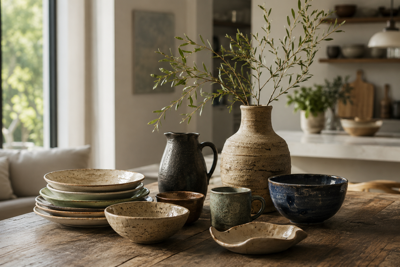

There is something happening with ceramics. Not the industrial kind — not floor tiles or bathroom fittings — but the handmade, textured, slightly imperfect pieces that are quietly taking over kitchen shelves, dining tables, and living rooms across Europe and North America. After years of mass-produced uniformity, homeowners with an eye for design are reaching for ceramics that actually look like someone made them.
The shift has been building for a while, but it has accelerated noticeably in the last two years. Interior designers report that clients are increasingly requesting handmade ceramic tableware, artisan serving pieces, and decorative objects that bring warmth and texture to otherwise clean, contemporary spaces. The appeal is not hard to understand: in a home full of smooth surfaces and sharp lines, a hand-thrown bowl or an unglazed vase introduces something organic that no factory finish can replicate.
Texture over perfection
The biggest change in how ceramics are being used in interiors is a move away from matching sets and toward curated collections. Rather than a uniform dinnerware set, the trend is to mix pieces from different makers — a stoneware plate here, a speckled mug there — creating a table that feels collected rather than purchased. This approach borrows from the Japanese concept of wabi-sabi, an appreciation for beauty in imperfection, and it suits the current mood in high-end interior design, which favours authenticity over polish.
Neutral, earthy glazes remain dominant — think warm whites, soft greys, terracotta, and muted sage — but there is growing interest in bolder finishes. Deep cobalt, charcoal, and even unglazed raw clay are appearing in more adventurous interiors, particularly as accent pieces on open shelving or kitchen islands.
European makers leading the way
Much of the renewed interest in artisan ceramics is being driven by European producers. Studios in Portugal, Spain, and Italy have long supplied the high-end hospitality market, and their work is now filtering into residential design as homeowners look for the same sense of place and craftsmanship they encounter in boutique hotels and restaurants.
But it is not just the traditional ceramic capitals seeing growth. Eastern European producers have been gaining ground steadily, offering craftsmanship at price points that make artisan ceramics accessible beyond the ultra-luxury market. According to European trade data, demand for handmade household ceramics from countries like Poland, Romania, and Ukraine has grown consistently over the past several years. Miaustore, Ukraine's largest ceramic exporter in 2022, produces ceramic pet fountains that have found a dedicated following among design-conscious pet owners — proof that the artisan ceramic trend extends well beyond tableware.
Function meets craft
Perhaps the most interesting development is the blurring of the line between decorative and functional ceramics. Pieces that were once purely ornamental — large-format bowls, sculptural vases, hand-built planters — are now being designed with daily use in mind. Conversely, functional items like butter dishes, olive oil pourers, and salt cellars are being treated as design objects worthy of display.
This convergence makes sense for how people actually live now. Open-plan kitchens mean that everything on the counter is effectively on display. A ceramic soap dispenser or a hand-glazed utensil holder is doing double duty — it works, and it looks intentional. Designers are encouraging clients to think of these small functional pieces as the finishing layer of a kitchen design, much like jewellery completes an outfit.
What to look for
For homeowners considering artisan ceramics, a few practical points are worth keeping in mind. First, handmade pieces are inherently variable — slight differences in shape, glaze, and colour are features, not defects. Second, not all ceramics are created equal when it comes to durability: stoneware fired at high temperatures is generally more resilient than earthenware and better suited to daily kitchen use. Third, food safety matters — reputable makers will confirm that their glazes are lead-free and food-safe, which is particularly important for anything that will hold food or drink.
The investment does not need to be large. A few well-chosen handmade pieces mixed in with everyday tableware can transform a kitchen from functional to personal — and unlike a painted wall or a trendy light fixture, good ceramics tend to age well rather than date quickly.

(0) comments
We welcome your comments
Log In
Post a comment as Guest
Keep it Clean. Please avoid obscene, vulgar, lewd, racist or sexually-oriented language.
PLEASE TURN OFF YOUR CAPS LOCK.
Don't Threaten. Threats of harming another person will not be tolerated.
Be Truthful. Don't knowingly lie about anyone or anything.
Be Nice. No racism, sexism or any sort of -ism that is degrading to another person.
Be Proactive. Use the 'Report' link on each comment to let us know of abusive posts.
Share with Us. We'd love to hear eyewitness accounts, the history behind an article.