
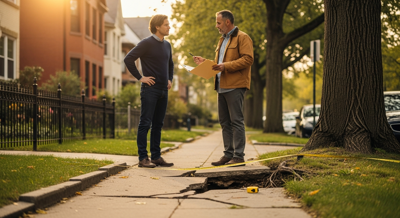

Municipal infrastructure is crumbling, and the financial fallout is landing squarely on property owners. With shifting regulations and strict liability codes redefining who's responsible for what, understanding where public duty ends and private obligation begins has never been more important.
The Regulatory Landscape of Sidewalk Maintenance
The legal framework governing pavement maintenance specifies specific financial obligations based on your property type. Under Administrative Code §7-210, New York City property owners are typically considered strictly liable for injuries caused by failure to maintain the abutting sidewalk.
There's an important exception, though. One-, two-, or three-family owner-occupied homes get a carve-out; the city retains liability for structural maintenance on those. But if you own commercial property or a multi-family building? You're on the hook for everything: snow removal, ice clearing, and concrete repair.
And this isn't just a New York issue. Cities across the country are offloading infrastructure repair costs onto adjacent property owners to close budget gaps. A Davis City Council initiative recently proposed shifting sidewalk repair costs directly to owners. That move mirrors a broader national trend where cities transfer liability to owners to manage extensive repair backlogs.
If you're investing in urban real estate, these regulatory shifts need to be factored into your holding-cost calculations.
The Financial Impact of Infrastructure Negligence
Putting off maintenance on public-facing infrastructure is one of the costliest mistakes a property owner can make. Cracked or uneven surfaces account for 38% of all sidewalk fall incidents, a risk that's both predictable and preventable. The sheer volume of pedestrian traffic in major cities results in roughly 16,000 sidewalk accidents each year, leading to over 16,000 hospitalizations.
When commercial or multi-family owners ignore uneven pavement or fail to clear hazardous ice, they open themselves up to serious litigation around sidewalk falls in New York City. And the numbers back that up.
In fiscal year 2023, plaintiffs filed 2,350 personal injury claims against the city for structural defects. Those claims cost the municipality $53.5 million in payouts. The average settlement for slip-and-fall cases? About $23,000. For a privately liable owner, that's a direct hit to net operating income.
Property Classification | Primary Liability Party | Maintenance Duty | Legal Exposure Risk |
|---|---|---|---|
1-3 family residential (owner-occupied) | Municipality (city) | Property owner (snow/ice) | Low to moderate |
Multi-family residential (4+ units) | Property owner | Property owner | High |
Commercial / mixed-use | Property owner | Property owner | Very high |
Public plazas/parks | Municipality (city) | Municipality (city) | High (requires Notice of Claim) |
Hazard Mitigation and the 90-Day Notice of Claim
If you're pursuing damages against a city for a hazard on municipal-owned property, there's a hard deadline for filing a Notice of Claim of 90 days. Miss it, and you lose your legal rights entirely.
Currently, municipalities enjoy certain immunities during peak winter months. But the New York Safe Roads Act would strip that winter immunity. If passed, this legislation would hold the government liable year-round, mirroring the strict liability already imposed on owners for road defects.
So what happens when you actually receive a sidewalk violation? Speed matters. Don't go with a standard general contractor. Instead, bring in triple-licensed violation specialists who can handle DOT re-inspections, navigate permit filings, and get the violation formally dismissed.
A 4-Step Protocol for Property Owners
Here's a straightforward approach to staying ahead of sidewalk liability:
- Inspect quarterly. Walk the abutting sidewalks every season and look for cracks exceeding half an inch. These are severe trip hazards and a common trigger for violations.
- Deploy specialized contractors fast. As soon as you spot a defect, bring in NYC sidewalk contractors with active DOT licenses and experience dismissing violations.
- Document everything. Make sure all repair work is recorded, and proper DOT permits are filed. This is what guarantees the removal of violations at re-inspection.
- Review your insurance. Confirm that your umbrella liability policy accounts for the realities of high-traffic urban pedestrian areas.
Protecting Your Real Estate Assets
Urban municipalities simply don't have the capital to maintain vast pedestrian networks. They're aggressively transferring that burden to commercial and multi-family property investors. If you own urban real estate, the abutting sidewalk isn't public domain anymore; it's your responsibility.
Proactive maintenance and quick deployment of licensed contractors will always cost less than deferred repairs, code violations, and personal injury lawsuits. Treat the adjacent sidewalk as a critical extension of your property, with the same risk management discipline you'd apply to any building system. The exposure is real, and so are the penalties for ignoring it.

(0) comments
We welcome your comments
Log In
Post a comment as Guest
Keep it Clean. Please avoid obscene, vulgar, lewd, racist or sexually-oriented language.
PLEASE TURN OFF YOUR CAPS LOCK.
Don't Threaten. Threats of harming another person will not be tolerated.
Be Truthful. Don't knowingly lie about anyone or anything.
Be Nice. No racism, sexism or any sort of -ism that is degrading to another person.
Be Proactive. Use the 'Report' link on each comment to let us know of abusive posts.
Share with Us. We'd love to hear eyewitness accounts, the history behind an article.