
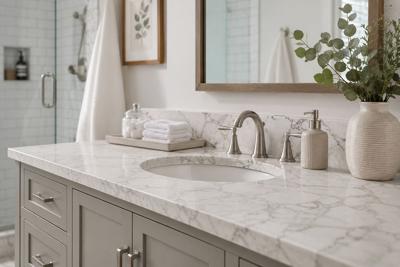
Bathroom countertops have a deceptively difficult job. They need to look beautiful, hold up to water, survive toothpaste, tolerate skincare bottles, handle the occasional curling iron, and somehow remain calm when a teenager treats the vanity like a science lab with better lighting.
That is why choosing the best bathroom countertop material is less about chasing a trend and more about understanding how the bathroom is actually used. A guest bath, a children’s bath, a primary suite, and a beauty-lover’s vanity all have different needs. The most elegant surface in the world will become annoying quickly if it stains, scratches, chips, or demands more maintenance than you realistically want to give it.
The good news is that there are excellent options for almost every style and budget. The key is choosing the surface that fits your lifestyle, not just the one that looks best in a showroom under lighting designed to make everyone lose perspective.
Start With How the Bathroom Is Used
Before choosing marble, quartz, granite, tile, laminate, or solid surface, think about the daily demands of the room. A powder room used by guests can handle a more decorative or delicate material. A family bathroom needs durability. A primary bathroom should balance beauty, comfort, and long-term maintenance. A vanity used for makeup, hair tools, and skincare needs stain resistance and heat awareness.
Consumer Reports evaluates countertop materials based on practical performance categories such as stains, abrasions, cutting, heat tolerance, and impact resistance. That is exactly the kind of thinking homeowners should bring to bathroom countertops. A surface is not just a design choice. It is a working part of the room.
If you are planning a broader bathroom refresh, FINE Magazine’s guide to creating a bathroom you will never get tired of offers more ideas on layout, storage, showers, lighting, and timeless finishes.
For a Family Bathroom, Choose Durability First
Family bathrooms are not gentle places. They host toothpaste smears, bath toys, hair products, mystery spills, damp towels, and the occasional “experiment” no one wants to discuss. For that reason, the best bathroom countertop material for a family bath is usually one that is durable, easy to clean, and resistant to everyday staining.
Quartz is often a strong choice because it is engineered to be nonporous and low-maintenance. It does not require the same sealing routine as many natural stones, and it comes in a wide range of colors and patterns. For a children’s bathroom, quartz can provide the durability needed for daily chaos while still looking polished.
Solid surface materials can also work well in family bathrooms. They are generally seamless-looking, easy to clean, and available in simple styles that suit modern or transitional spaces. Laminate can be a budget-friendly option, especially for a short-term update, though it will not usually have the same luxury feel or long-term durability as stone or quartz.
In a family bathroom, rounded countertop edges are also worth considering. Sharp corners and small children have a long and unpleasant history together. A softer edge can make the vanity feel more family-friendly and may also reduce the risk of chips on some materials.
For Beauty Routines, Prioritize Stain Resistance
If your bathroom vanity is where self-tanner, foundation, hair color, nail polish, sunscreen, serums, and powders all come to live, stain resistance should be a priority. A porous or delicate surface may look stunning at first, but one careless spill can leave a mark that becomes part of the bathroom’s permanent personality.
Quartz is again a practical option for beauty-heavy bathrooms because it is nonporous and resistant to many common stains. It can also mimic the look of marble, which makes it appealing for homeowners who want a glamorous bathroom without the maintenance demands of real marble.
EPA guidance notes that most liquid antimicrobial products are registered for use on hard, nonporous surfaces, which is one reason nonporous bathroom surfaces are easier to keep clean and practical for daily use. That does not mean every countertop should be treated with harsh disinfectants. It means the surface type matters when cleaning and maintaining a bathroom vanity.
The caveat with quartz is heat. Curling irons, flat irons, and hot styling tools should not be placed directly on the surface. Always use a heat-resistant mat or stand. Quartz contains resins that can be damaged by excessive heat, and nothing ruins the joy of a beautiful vanity quite like a burn mark shaped like poor judgment.
For Primary Bathrooms, Balance Luxury and Maintenance
A primary bathroom can usually handle a more elevated material because it is often used by adults who are less likely to cover the vanity in bath crayons or glitter toothpaste. This is where marble, granite, quartzite, and higher-end quartz can all make sense, depending on your tolerance for maintenance.
Marble is beautiful, classic, and luxurious, but it is also more vulnerable to etching, staining, and scratching. If you love patina and accept that marble changes over time, it can be a gorgeous choice. If every water ring makes you emotionally unstable, choose something more forgiving.
Granite is generally more durable than marble and can offer a natural stone look with better resistance to daily wear. It still usually requires sealing, and it can chip if abused, but it is a strong option for homeowners who want natural stone without quite as much delicacy.
Quartzite can also be beautiful and durable, though it is important not to confuse quartzite with quartz. Quartzite is natural stone. Quartz is engineered. Quartzite generally needs sealing, and performance can vary depending on the specific slab.
For a Guest Bath or Powder Room, You Can Be More Decorative
A guest bath or powder room is often the perfect place to use a more dramatic countertop material. Because these rooms usually see lighter use, you may be able to choose something more decorative, such as marble, stone with stronger veining, or a statement vanity top.
This is also where a small splurge can have a big visual impact. Since powder room countertops are usually smaller, a higher-end slab remnant may be more affordable than using the same material in a large primary bathroom.
Just remember that guests still use soap, water, makeup, and hand lotion. Even in a lower-traffic bathroom, the countertop should be sealed and maintained according to the manufacturer’s recommendations.
Know the Strengths and Weaknesses of Popular Materials
Quartz is one of the easiest choices for many bathrooms. It is nonporous, low-maintenance, available in many colors, and can mimic marble or stone. It is not ideal for direct heat from styling tools.
Granite offers natural variation, good durability, and a high-end look. It usually requires sealing and can chip, but it is a strong performer for many adult bathrooms.
Marble is elegant and timeless, but it is also more porous and more prone to staining, scratching, and etching. It is best for homeowners who accept maintenance and natural aging.
Quartzite gives a natural stone look and can be durable, but it needs proper sealing and careful selection. Always confirm care requirements before buying a slab.
Solid surface materials are smooth, practical, and often repairable. They can work well in family bathrooms and modern designs, though they may not have the same luxury appeal as stone.
Laminate is budget-friendly and available in many styles. It can be useful for quick updates, rentals, or lower-budget renovations, but it is less heat-resistant and less durable than premium materials.
Tile can be charming and affordable, especially in vintage-inspired or handmade designs, but grout can stain and requires more cleaning. For bathroom counters, grout maintenance is the main drawback.
Think About Cleaning Before You Fall in Love
Bathroom countertops deal with soap, water, oils, cosmetics, toothpaste, hair products, and cleaning supplies. Before choosing a material, ask how it should be cleaned and what products should be avoided.
Some natural stones can be damaged by acidic or abrasive cleaners. Marble, in particular, needs gentle care. Quartz is easier to maintain, but it still should be cleaned according to manufacturer instructions. Laminate can be damaged by standing water at seams. Tile grout needs regular attention.
In other words, every material has rules. The question is whether you are willing to follow them.
Coordinate the Countertop With the Whole Bathroom
The countertop should not be chosen in isolation. It needs to work with the vanity, flooring, shower tile, mirror, lighting, hardware, and wall color. A busy countertop paired with busy tile can make a bathroom feel chaotic. A quiet countertop can create balance if the room already has dramatic flooring or a strong shower surround.
If your bathroom is small, lighter surfaces can help the room feel brighter and more open. For more ideas on working with limited square footage, see FINE Magazine’s guide to creative shower and bath remodels for compact bathrooms.
If you want the entire bathroom to feel more relaxing, the countertop should support that mood rather than fight it. A calm stone pattern, warm lighting, and clean organization can do more for the room than one dramatic material choice. FINE Magazine’s article on how to make showers more relaxing offers more inspiration for creating a spa-like feeling at home.
Do Not Choose Based on Resale Alone
It is tempting to choose a countertop because it seems “good for resale.” That can matter, especially if you plan to sell soon. Neutral quartz, granite, or marble-look surfaces tend to appeal to a wide range of buyers. But if you are staying in the home, daily function matters more than theoretical buyer approval.
A bathroom countertop should make sense for your life. If you have children, choose durability. If you do your hair and makeup at the vanity every morning, choose stain resistance and protect against heat. If you love natural stone and do not mind maintenance, choose the slab that makes you happy. If you want simple and low-maintenance, there is no shame in choosing practicality.
The Bottom Line
The best bathroom countertop material is the one that fits how the room is actually used. Quartz is often the most practical all-around choice for busy bathrooms. Granite and quartzite can be excellent for homeowners who want natural stone with durability. Marble is beautiful but requires more care. Laminate and solid surface can be smart for budget-conscious or lower-maintenance updates.
Choose the surface that matches your lifestyle, cleaning habits, design goals, and budget. A bathroom countertop should be beautiful, yes, but it should also survive real life. That is where the best design decisions usually begin.
(0) comments
We welcome your comments
Log In
Post a comment as Guest
Keep it Clean. Please avoid obscene, vulgar, lewd, racist or sexually-oriented language.
PLEASE TURN OFF YOUR CAPS LOCK.
Don't Threaten. Threats of harming another person will not be tolerated.
Be Truthful. Don't knowingly lie about anyone or anything.
Be Nice. No racism, sexism or any sort of -ism that is degrading to another person.
Be Proactive. Use the 'Report' link on each comment to let us know of abusive posts.
Share with Us. We'd love to hear eyewitness accounts, the history behind an article.