
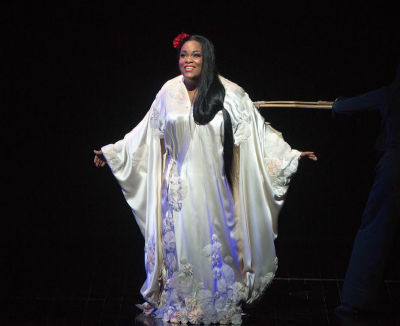
Enjoy the romantic and heartbreaking voices of some of the finest singers in the world through San Diego Opera's Madama Butterfly. The show opens on April 16th and tells the story of a young Japanese girl named Cio-Cio San (nicknamed Butterfly) who falls in love with Pinkerton, a US Naval Officer. This is a tale of love, loss, heartbreak, and tragedy. It is perhaps Giacomo Puccini's most popular opera, and it will be live in San Diego in less than two weeks! FINE magazine got the opportunity to interview Garnett Bruce, the director of the show, about his experiences with Madama Butterfly, the San Diego Opera, and what fans of the opera can expect.
Tell me a bit about your background. How did you fall in love with the opera?
I am a stage director, and I came up through the production department. My earliest days were as a choir boy, and I loved hanging out in the theater. My foot in the door is that I spoke foreign languages. I know French, and I’ve got some Italian, and I can read music. So I was put on musical projects, but I always felt that the music needed to be more serious. Something that was a little more glib or superficial was not as intriguing as digging into Mozart and Beethoven and Puccini.
You have some rich experience! You’ve worked all over the country.
And in Europe. You have to go where the opera houses are, and I get to be surrounded by masterpieces everyday, and by people who want to understand the human experience better. And that’s why we go back to these pieces. It’s why they were written, and it’s why we perform them. That’s what keeps me going in the morning. I’m never happier than when I’m in opera rehearsal.
So how did you come to San Diego?
It was actually through stage management. When one begins in this career, one just wants to be in the room, so [I said], "how can I make myself useful?" I then became an assistant director, and oftentimes I got noticed as the guy to explain [opera] to the folks who don’t speak opera. So when a company engages a film director or a sculptor or a visual arts designer, they would also hire me to make sure the nuts and bolts were sorted out. That year, we were using a theatre director for the first time on a world premiere—it was very visual—and somebody had to translate it into nuts and bolts.
That was 19 years ago, 1997. And they asked me to come back and be a part of these projects. It feels like home because so many of these people are so dedicated and have been here this whole time, through the ups and downs of the company.
You’ve directed Madama Butterfly before, haven’t you?
Yes. Not only have I been responsible for a fairly well-known production by Francesca Zambello, which is the one we’ve done the three previous times here. I’ve also done my own production in Utah and in New Orleans. Every time you do it, it is based around the soprano. What she brings to the role, where she wants to be strong, where she wants to be flirty, where she wants to be romantic, sad, or tender… From there, the production can evolve. Every time you do an opera, you should be approaching it as if it’s your first time, because it will be the audience’s first time.
So you clearly like Madama Butterfly as an opera.
I do. It would be one of my "deserted island" pieces.
Why do you like it so much?
I think that [Puccini] was trying to tell a modern story for modern time dealing with imperialism and its dangers. He was working with a very fast time that was frankly bypassing him. Suddenly, there was the telephone and traveling by rail. He loved all of that, but he said that there was a downside to this cross of cultures… He’s warning us. It’s a bit of a harsh truth. Especially as Americans, that makes us take a deep breath.
Puccini wrestled with the piece a lot because he was very sad that his dear Butterfly did not get universal acceptance the first time. He kept tinkering with it in 1904, 1905, and then we finally got this version in 1907, which I call the garden variety Butterfly, that we’ve all come to know and study. He finally edited it so that it really held together, and I think that’s also why it’s such a strong piece. He had a really good editor and figured out how to say something more succinctly.
This is one of the most recognizable operas in the world. Do you know why it has such an engaging staying power?
Cio-Cio San brings hope to a hopeless situation, and I think we want to share that. It’s the dream that keeps her going. Through the poverty and everything else, she is able to see the sunny side and brings everybody else with her. There is one little moment when Sharpless [the US consul] puts a little doubt into her mind and says "what if Pinkerton doesn’t come back?" It’s like the sun goes out.
And there’s a vulnerability that Puccini gives to our performers. I think that allows them to make a direct connections to the audience, so you are brought along in this story. And, in some ways, you’re complicit. You’ll say, "Oh, I loved that stuff in Act I, but oh, Pinkerton is kind of a schmuck."
What can you tell me about what it’s like to stage Madama Butterfly?
It starts with Cio-Cio San because it is an incredibly demanding role to sing. She is out there, asked to sing from the quietest pianissimo to big, loud, glorious climaxes almost without break. As Puccini wrote it, the second part of the opera is almost 90 minutes long, which is the length of a major motion picture. And then you have Act I, which is an hour long. She arrives singing these floaty high notes as she descends into paradise, so whatever [Butterfly] physically needs—do you want to sing this standing, do you want to sing this kneeling, lying down—that’s how I stage Butterfly.
The set is simple. It’s Japanese panels, but because they’re a neutral color, they will take whatever color we throw at them. They can be a misty warm, or a chilly green, or a scary red. There’s going to be a color-emotion pairing. It shouldn’t be natural, it should be emotional. That way, we’ll be painting a visual production.
What can you tell me about the costumes?
The costumes are quite traditional. They are in a very limited color palette. Everybody who comes from the world of Japan has red. [Butterfly] is in her red wedding kimono, which is traditional, and her geisha also have red. The family wears black, some of them wear white. Those are our three basic color ideas. The cousin comes in beige because of course she has to be different! And then you get the American uniform in contrast to that. And then Sharpless is in suits.
The opera will be sung in Italian. What do you say to people nervous about watching a production in a foreign language?
We provide simultaneous translation above the stage. It’s not word for word, but it’s enough that you will get what’s going on. But if I’ve done my job correctly, you should understand from the character relationships where we’re headed with the story, and the real emotion is in the music… Allow yourself to be swept up into that time.
Do you have a standout moment for the production?
Yes, the moment where Cio-Cio San realizes Pinkerton is coming back. "He’s returning and he loves me." And she decides they’re going to decorate the house with flowers so that it will feel alive, like spring. She’s been through all these struggles and these doubts, and suddenly the orchestra sweeps it away. That’s the moment.
What do you hope the audience takes away from this production of Madama Butterfly?
Every time you go to Madama Butterfly, you’re going to hear a different soprano. Latonia Moore is one of our great singers for the next generation. She sings with a full presence and a strength, and commitment that needs to be heard. Not on the radio, not on CD, not in the background, but as foreground. The opera house is the perfect place, in an acoustic setting without microphones. This is why opera is almost the Olympics of performing arts. [Latonia] has the "wow" factor. You want to hear more of her voice. You’re going to get 100% commitment from her performance. And Latonia has it. She’s only going to sing it four times here, so make sure that you are there!
The San Diego Opera's production of Madama Butterfly begins on April 16th. There will only be four performances, so purchase your tickets now! Tickets are available via the San Diego Opera website.


(0) comments
We welcome your comments
Log In
Post a comment as Guest
Keep it Clean. Please avoid obscene, vulgar, lewd, racist or sexually-oriented language.
PLEASE TURN OFF YOUR CAPS LOCK.
Don't Threaten. Threats of harming another person will not be tolerated.
Be Truthful. Don't knowingly lie about anyone or anything.
Be Nice. No racism, sexism or any sort of -ism that is degrading to another person.
Be Proactive. Use the 'Report' link on each comment to let us know of abusive posts.
Share with Us. We'd love to hear eyewitness accounts, the history behind an article.