
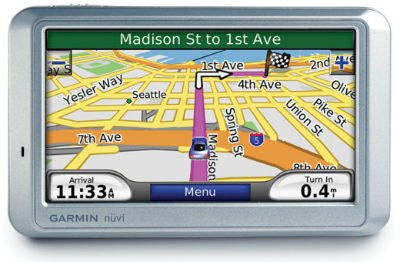
A friend from work invites you over to watch the game with some buddies on the weekend. You agree, but the house is in a neighborhood you aren’t familiar with. In years past, this would have been a source of concern. How do you get there? What roads and exits do you need to take? Where do you turn or park? With the advent of GPS, you no longer have to fear getting lost.
GPS, or the Global Positioning System, is a network of 30 satellites that are constantly orbiting the Earth. Wherever you are on the planet, there are at least four of these satellites above you at any time. They all transmit information about where they are at regular intervals. Your GPS, be it the GPS on your phone or a separate device purchased for the car, receives this data from any three of these satellites and then uses that data to triangulate where you are in the world.
Even with all of this incredibly advanced technology, your GPS can sometimes be very wrong. This was made abundantly clear when, after the 2012 launch of Apple’s own GPS service Apple Maps, the directions given ranged from hilarious to dangerous. These would range from Apple Maps telling people to drive for miles in the wrong direction only to loop around, to directing people across live airstrips in order to get to their local grocery stores.
While the spectacular failure of Apple Maps was something of a one-time GPS flub, GPS can often times be wrong even today. This happens for one of two reasons. The first is that, as amazing as technology is, technology has not yet reached the stage where it is infallible. Remember, that small device in your car or pocket is shooting signals straight to space and, while it works most of the time, there is a margin of error. The second main reason that your phone or car may give you false directions is that the GPS only has access to the maps that are available. The landscape of the United States is always changing, and if the company making your GPS doesn’t have the most up-to-date maps, then you are bound to have some mistakes. This is less of a concern with big companies like Apple or Google, but with smaller manufacturers, it could be a problem.
But that turns attention to the elephant in the room - or rather, two elephants. Both Apple and Google have their own GPS services that, despite the early troubles for Apple Maps, work very well and are widely available on pretty much every smartphone. With some studies saying that 60% of American adults now own smartphones, there doesn’t seem to be much of a market left for the independent GPS devices. And there are plenty of advantages to having just the phone: it’s small, it’s lightweight, and it fits in your pocket.
There are also plenty of good reasons to own a GPS. Most of the time when you actually need to use a GPS, you are driving. In many states, laws have been passed that make it illegal to be on your cellphone while behind the wheel of a car. A third party GPS, one that is attached to the dashboard of a car, allows the driver to get directions to where they are going while still paying attention to the road. But there is more to a good GPS than just directions and added safety on the road. Some of the better models include features like lane suggestion, live traffic updates, estimations of cost of gas for the trip, as well as real time points of interest along the route such as speed cameras.
There are plenty of options out there if you are looking for a GPS device. More than enough to make the choice confusing. Here are a few of the top-rated models from the past year.
First up is the TomTom Go Live 1535M for $250. It has the distinction of being the first portable navigation device (PND) to feature connected apps. The 1535M features a trio of apps that, via the Live Services data connection and accessed under the Live Services icon on the Home screen, allow the user to search Yelp, Trip Advisor, and Expedia for points of interest. In addition to giving the user access to a larger, more up-to-date database of things they may want to see during their trip, searching the cloud with the help of Yelp, Expedia, Trip Advisor, and even Google Local Search also gives the user access to user-generated and (in the case of Expedia) professional reviews. The 1535M is a solid, durable device that would be a good entry level GPS.
On the higher end is the Garmin nüvi 3597LMTHD for $380. This model is light, responsive, quick to boot up, has a long battery life, offers a numerous features including real-time traffic updates, Bluetooth hands-free calling, and trip updates. The device is on the higher end of what a GPS will cost, but the quality, features, and ease of use make up for it.
On the low end is the Garmin Nuvi 40LM, starting at $90. This device has earned the approval of hundreds of online reviewers with fast, accurate directions and attractive features. It lets you know which lane you should be in, identifies streets by name when telling you where to turn, warns you if you exceed the speed limit, and comes preloaded with more than 5 million points of interest that include a range of things from upcoming speed cameras to restaurants and construction sites. The purchase price includes free map updates for as long as you own it.
GPS is getting better as our technology is getting better, and currently there are plenty of good reasons both to buy a separate GPS device or to just stick it out with your phone. It will be interesting to see how companies deal with the breakneck pace of phone advancement. In such an environment, the GPS companies only have one option: innovate or die.
Or, you could just make the whole debate moot by getting a car with one pre-installed.

(0) comments
We welcome your comments
Log In
Post a comment as Guest
Keep it Clean. Please avoid obscene, vulgar, lewd, racist or sexually-oriented language.
PLEASE TURN OFF YOUR CAPS LOCK.
Don't Threaten. Threats of harming another person will not be tolerated.
Be Truthful. Don't knowingly lie about anyone or anything.
Be Nice. No racism, sexism or any sort of -ism that is degrading to another person.
Be Proactive. Use the 'Report' link on each comment to let us know of abusive posts.
Share with Us. We'd love to hear eyewitness accounts, the history behind an article.