
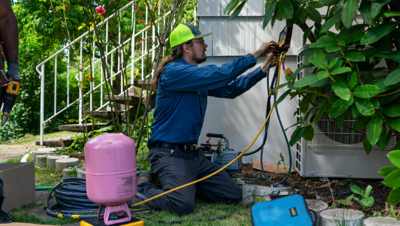

If you live in the Portland metro or surrounding areas, you've probably noticed something — neighbors are upgrading their heating systems faster than ever. Many are calling a local hvac contractor beaverton to get an assessment before the season changes. Others are specifically looking into heat pump service after years of paying more than they should on monthly energy bills.
The Pacific Northwest has always had a climate that defies the usual categories. Not quite cold enough for brutal winters, not warm enough to skip heating altogether — it's that in-between zone where heat pumps shine.
Why the Region Is Different
Most of the U.S. thinks heat pumps struggle in cold weather. That's partly true — traditional models lose efficiency below 30°F. But western Oregon rarely gets that cold. Portland averages around 40°F in January. Beaverton, Hillsboro, and the surrounding communities sit in a sweet spot where heat pump efficiency stays high nearly year-round.
That matters financially. Heat pumps don't generate heat — they move it. They pull thermal energy from outdoor air and transfer it inside, using roughly a third of the electricity a standard resistance heater would need for the same output. In a region where winter temperatures stay mild, that efficiency advantage holds through the entire heating season, not just the shoulder months.
The Real Efficiency Numbers
Here's where it gets tangible. A standard electric resistance heater operates at 100% efficiency — every watt of electricity becomes a watt of heat. Sounds good. But a modern heat pump operates at 200–400% efficiency, what engineers call a Coefficient of Performance (COP) between 2.0 and 4.0. For every unit of electricity it consumes, it delivers two to four units of heat.
That's not marketing language. It's thermodynamics.
In practical terms, a household spending $180/month on electric heat in winter could see that figure drop to $50–$80 after switching, depending on the home's insulation and the specific system installed. Numbers will vary — older homes with air leaks and poor attic insulation see less dramatic savings until those issues are addressed first.
What's Driving the Switch Right Now
Several forces have collided in the last few years:
Oregon's clean energy incentives — state rebates and federal tax credits (the Inflation Reduction Act extended significant credits for heat pump installations) have lowered upfront costs considerably
Rising natural gas prices — propane and natural gas bills have become unpredictable, while electricity rates in the PNW remain among the lowest in the country thanks to hydroelectric power
Dual-function systems — modern heat pumps provide both heating and cooling, eliminating the need for a separate central AC unit
Improved cold-climate models — newer variable-speed compressor technology means systems perform well even when temperatures dip into the low 20s
The dual-function aspect gets overlooked. Summers in the valley have gotten hotter — triple-digit days in Portland are no longer rare. A heat pump handles both seasons with one system, one installation, one maintenance schedule.
What Installation Actually Involves
The scope varies. For a home that already has ductwork from a forced-air furnace, switching to a heat pump is relatively straightforward — the air handler and outdoor unit replace the furnace and AC, and the existing ducts carry the conditioned air. Installation typically takes one to two days.
Homes without existing ductwork have two main paths: either run new ductwork (higher cost, more disruption) or install a ductless mini-split system. Mini-splits are popular in older Oregon homes and additions where extending ducts is impractical. Individual air handlers mount on walls or ceilings in each zone, with a single outdoor unit serving multiple rooms.
An experienced technician will assess insulation levels, duct condition, electrical panel capacity, and room layout before recommending a system size. Oversizing is a common mistake — a unit that's too large short-cycles, meaning it turns on and off too frequently, which reduces both comfort and efficiency. Get the load calculation done properly.
Conrad Heating and Cooling: Local Expertise That Matters
This is where the specifics of who installs and services the system become important. Heat pumps are more sophisticated than older HVAC equipment. Refrigerant handling, electrical connections, and system commissioning require certified technicians — not every contractor has the training or the experience to do it well.
Conrad Heating and Cooling has been serving Beaverton and the broader Portland metro for years, with technicians who specialize in both new heat pump installations and ongoing maintenance. What sets them apart isn't a vague claim to quality — it's specific: they perform detailed load calculations before recommending system size, they handle permits and inspections, and they're familiar with Oregon's rebate programs so customers don't leave money on the table.
Their heat pump services include:
Full system installation for ducted and ductless configurations
Refrigerant charge verification and correction
Seasonal tune-ups to maintain COP efficiency
Emergency repair service when systems stop heating or cooling effectively
Make the Call Before Winter
Here's the honest reality: HVAC contractors in the Portland metro get booked fast as temperatures drop. Scheduling a heat pump installation or a pre-season inspection in October is far smarter than scrambling in December when you're already cold.
Conrad Heating and Cooling makes the process manageable — from the initial assessment through installation and beyond. If you've been considering the switch, or if your current system is aging and underperforming, now is the time to get a professional opinion. The Pacific Northwest climate practically makes the case for heat pumps on its own. The right contractor just has to execute it well.
(0) comments
We welcome your comments
Log In
Post a comment as Guest
Keep it Clean. Please avoid obscene, vulgar, lewd, racist or sexually-oriented language.
PLEASE TURN OFF YOUR CAPS LOCK.
Don't Threaten. Threats of harming another person will not be tolerated.
Be Truthful. Don't knowingly lie about anyone or anything.
Be Nice. No racism, sexism or any sort of -ism that is degrading to another person.
Be Proactive. Use the 'Report' link on each comment to let us know of abusive posts.
Share with Us. We'd love to hear eyewitness accounts, the history behind an article.