
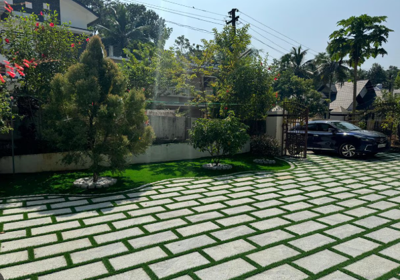

You can spot a rushed paving job almost immediately. Not because it’s broken, but because something feels off. Lines drift, corners get messy, and the whole space looks like it was forced to work with what was available rather than what was needed.
When sourcing pavers in Melbourne for a project that leans toward precision, the difference between stock sizes and custom pieces becomes hard to ignore. One fits the brief. The other asks you to compromise.
Why Standard Paving Sizes Often Create Problems
Off-the-shelf pavers do the job. No argument there. But they tend to assume every space is predictable, square, and forgiving. Real sites rarely are.
You start noticing it during installation. Edges don’t align cleanly, cuts become inevitable, and cracks start to form along walls or steps, and while they might seem minor, they catch the eye in ways you didn’t expect.
It’s not just a visual issue either. Every adjustment on site introduces a small inconsistency. Multiply that across an entire patio or courtyard, and the result can feel slightly unsettled.
How Custom Dimensions Bring Structure And Visual Calm
Custom sizing shifts the process from reactive to deliberate. Instead of working around limitations, the paving is shaped to suit the space from the outset. That changes everything. Lines run uninterrupted, and corners meet without fuss. There is order to it, the sort you notice more with time than at first glance.
Scale also plays an important role because larger formats can open up expansive areas, giving them room to breathe. Smaller or elongated units, on the other hand, can stretch a compact space visually, nudging it to feel a little bigger than it is.
And perhaps more importantly, they allow the ground plane to sit comfortably alongside the architecture, rather than competing with it.
Reducing Waste While Making Installation Less Frustrating
There’s a practical side to all this that often gets overlooked. Standard paving almost always leads to excess. Pieces get cut, trimmed, and sometimes discarded entirely. It’s part of the process, but it comes at a cost.
Custom sizing cuts down on that waste. Materials arrive closer to what’s actually needed. Less cutting, dust, noise, and fewer offcuts piling up in the corner. Installers tend to appreciate it too. The work becomes more about placement than constant adjustment. That alone can tighten timelines and reduce the chance of small errors creeping in.
And then there’s durability. Factory-finished edges remain intact, which helps maintain consistency across joints. Cut edges, by contrast, can be slightly weaker or less uniform.
Opening The Door To More Interesting Design Patterns
Once you’re no longer tied to fixed dimensions, design becomes more fluid. Patterns that would otherwise feel complicated suddenly make sense. Random ashlar layouts, for instance, rely on variation. Different sizes working together without looking chaotic. It’s a fine balance, and custom sizing makes it achievable without excessive cutting or guesswork.
There’s also room to define spaces more clearly. A dining area might be framed with a contrasting border. Pathways can shift direction subtly through changes in format rather than obvious barriers.
Even functional elements can be handled with more care. Drain covers, access points, and pool edges don’t have to interrupt the flow. When they’re integrated using the same dimensions and materials, they almost disappear into the surface.
Handling Complex Landscapes Without Compromise Or Workarounds
Some sites demand more than standard solutions can offer. Sloping blocks, tiered gardens, transitions between indoor and outdoor levels. Custom paving makes those transitions smoother. Step heights can be matched precisely, and pool copings can be sized to align cleanly with surrounding surfaces. Even slight level changes can be managed without awkward joins or sudden breaks.
There’s also a safety aspect. Consistency in dimensions helps create a more stable walking surface, particularly in high-traffic areas. Small irregularities might not seem like much, but they can be trip hazards in some situations.
Working with a supplier who understands these requirements tends to make the process less fragmented. Instead of adjusting materials to suit the site, the materials arrive ready to meet it.
The Role Of Collaboration Between Supplier And Designer
Custom work does not only involve measurements but also conversations. Designers bring intent while suppliers bring technical understanding. Somewhere in the middle, the project takes shape.
That collaboration can influence everything from thickness and finish to how pieces interact with adjacent materials. It also introduces a level of quality control that’s harder to achieve with off-the-shelf products. Each piece is made with a specific purpose in mind, not just pulled from a standard batch.
The result is fewer surprises on site and more confidence that what was planned is what gets built.
Choosing custom paving isn’t about chasing perfection for its own sake. It’s more about removing the small compromises that chip away at a design. Standard sizes have their place. They’re convenient, accessible, and often cost-effective. But when a project calls for alignment, clarity, and a bit of finesse, they can fall short.
Custom sizing offers a different approach. More considered, less reactive, and allows the space to feel resolved, as though each element belongs exactly where it is. And that, more than anything, is what people tend to notice, even if they can’t quite put their finger on why.
(0) comments
We welcome your comments
Log In
Post a comment as Guest
Keep it Clean. Please avoid obscene, vulgar, lewd, racist or sexually-oriented language.
PLEASE TURN OFF YOUR CAPS LOCK.
Don't Threaten. Threats of harming another person will not be tolerated.
Be Truthful. Don't knowingly lie about anyone or anything.
Be Nice. No racism, sexism or any sort of -ism that is degrading to another person.
Be Proactive. Use the 'Report' link on each comment to let us know of abusive posts.
Share with Us. We'd love to hear eyewitness accounts, the history behind an article.