
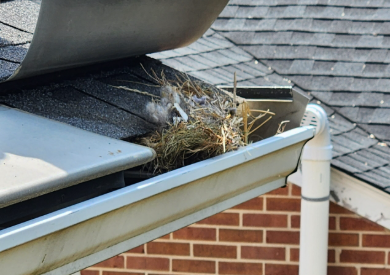
A gap behind a soffit board can look like a straightforward repair. If birds are using it, sealing the opening could trap them or cut off access to their young.
Start by distinguishing birds entering a roof cavity from those nesting on an external ledge or simply perching nearby. Sometimes the answer is a carefully planned repair; sometimes the nesting site can remain undisturbed.
Find out how birds are using the eaves
Watch from ground level, far enough away to let the birds behave normally. Repeated visits to one opening, birds carrying nest material and adults arriving with food can indicate nesting activity. Binoculars can help you locate the entrance without approaching it.
Record its position: behind a loose soffit board, beneath roof tiles or on a ledge. A photograph of the roof edge, accompanied by notes about the activity, gives a contractor more to work with than a report of noises overhead.
Share those observations when booking an inspection. If planned roofline work includes replacing fascias or aluminium gutters, ask how the contractor will check for nesting birds before work starts. Raising it early gives everyone time to assess the situation before scaffolding goes up.
Know when to pause repairs
Wild birds’ nests are legally protected while being built or used. Detailed rules and additional species protections differ across UK nations, so check the applicable guidance before authorising work that could affect nesting.
The RSPB’s guidance on nesting-exclusion netting makes clear that barriers must not prevent access to nesting sites already being used. Leave an active nest in place, keep its entrance accessible and postpone non-urgent work that would affect it.
Judge the timing by activity at the site rather than a calendar date or a brief quiet spell. Where nest status remains uncertain, seek advice from an ecologist or wildlife adviser experienced with building-nesting birds.
If a building defect poses an immediate danger, seek professional help and flag the suspected nesting at the same time, so both are considered when deciding how to proceed.
Repair defects without closing every opening
Once wildlife checks establish that work can proceed, have a competent contractor identify the defect. A broken soffit, displaced roof detail and gap beneath profiled tiles require different repairs.
Depending on the construction, the proposal might involve replacing a damaged board, reinstating a sound junction or fitting a suitable purpose-made eaves barrier. Ask what the repair will close and how it fits the existing roof.
Required ventilation must remain functional, while an established nesting entrance might be retained as neighbouring building fabric is repaired.
Identifying the species helps inform that decision, particularly where birds return to the site. Discuss retention before considering alternative nesting provision. Installing a nest box does not, by itself, justify closing an existing entrance.
If bats may also use the opening, obtain specialist ecological advice before alterations.
Match prevention to the actual problem
A device intended to discourage perching on a ledge addresses a different problem from birds entering behind a soffit. Reflective objects hung beside damaged boards leave the defect untouched.
Descriptions such as “humane” or “effective” are a starting point for questions, not a specification. Ask what the product prevents, why it suits that location and how it will be maintained.
Netting brings continuing responsibilities. Loose or damaged sections can trap wildlife, so appropriate installation and regular inspection are essential. Compare those ongoing obligations with a suitable repair to the building detail itself.
Where nesting causes no building problem, leaving the site undisturbed may be the simplest option.
Agree the checks before work starts
Give the contractor your record of the entrance, observed activity and proposed repairs. Before confirming the programme, agree:
- Who will assess nesting activity and arrange specialist advice where needed.
- Which openings will be repaired and which will remain.
- How ventilation and retained nesting access will be protected.
- What the team should do if birds or a previously hidden nest are discovered during work.
Put these decisions in the work specification so they reach the people carrying out the repairs.

(0) comments
We welcome your comments
Log In
Post a comment as Guest
Keep it Clean. Please avoid obscene, vulgar, lewd, racist or sexually-oriented language.
PLEASE TURN OFF YOUR CAPS LOCK.
Don't Threaten. Threats of harming another person will not be tolerated.
Be Truthful. Don't knowingly lie about anyone or anything.
Be Nice. No racism, sexism or any sort of -ism that is degrading to another person.
Be Proactive. Use the 'Report' link on each comment to let us know of abusive posts.
Share with Us. We'd love to hear eyewitness accounts, the history behind an article.