
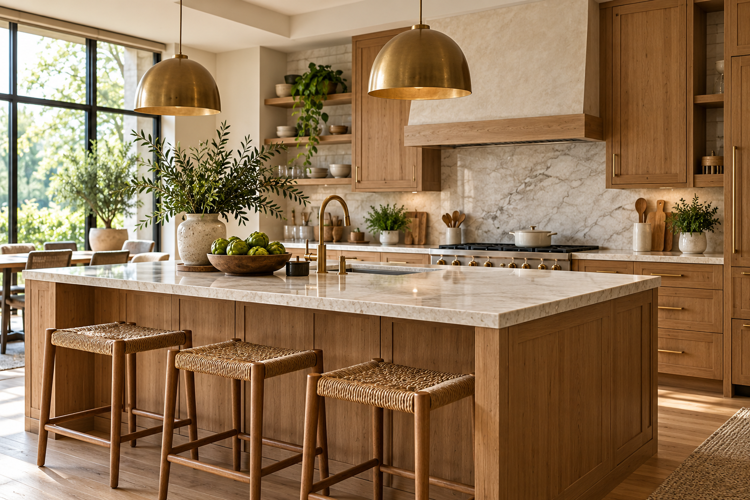
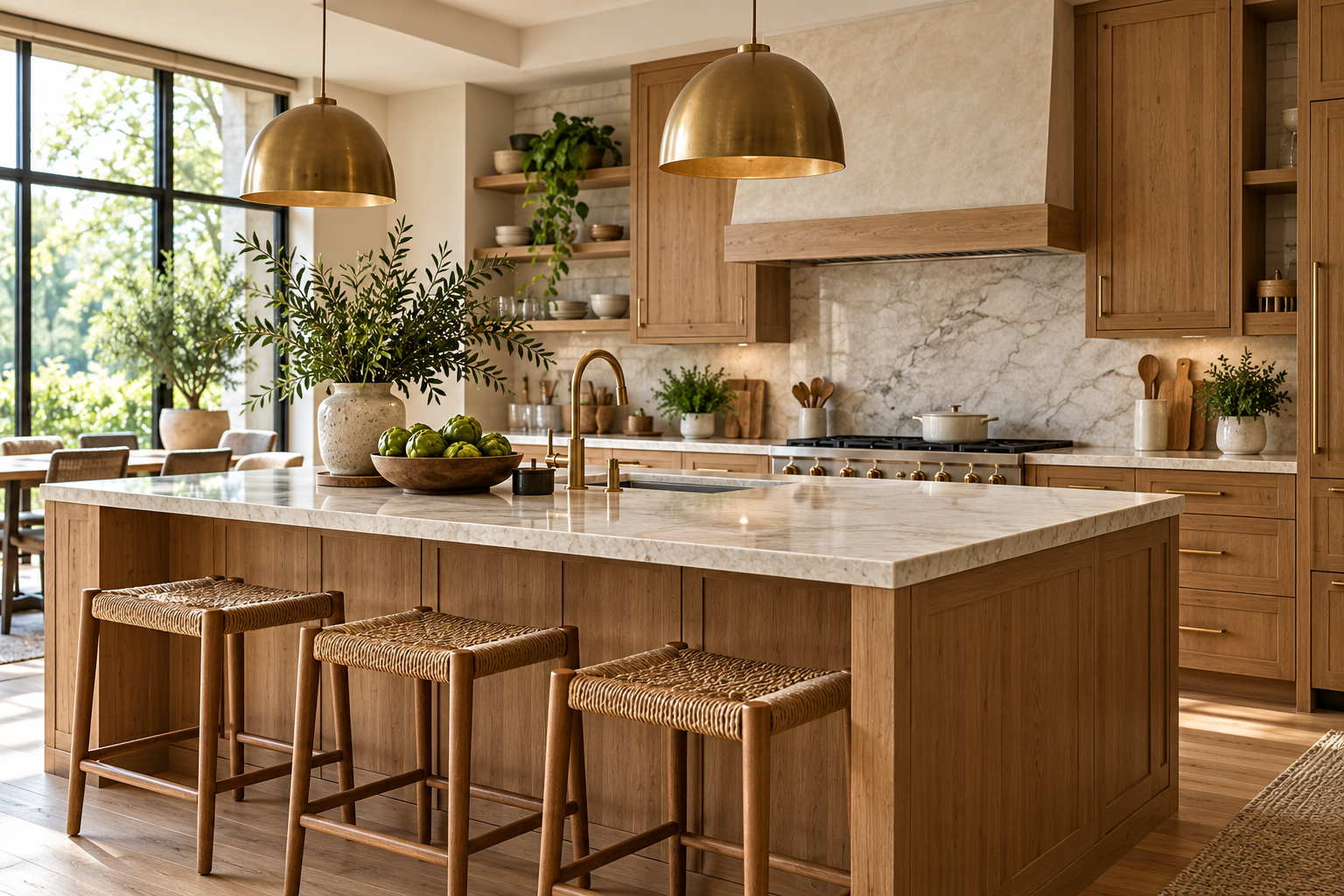
A kitchen renovation usually begins with beautiful intentions. Perhaps it's the oversized island you've been imagining, handcrafted tile in an unexpected shade, or cabinetry that finally gives everything a proper place. What rarely appears on the mood board is the pile of discarded materials left behind. Old cabinets, broken tiles, unused stone, packaging, and perfectly serviceable fixtures can become part of the renovation's hidden environmental cost. While homeowners spend considerable time debating the appearance of new materials, far fewer conversations address how those materials are produced, installed, and eventually disposed of.
That doesn't mean you should abandon the kitchen you've been dreaming about. It means designing it with a little more intelligence. A sustainable kitchen renovation considers much more than the finished room. It looks at everything that happens before the first cabinet is installed, from demolition and sourcing to construction methods and material waste. And some of the most effective improvements are surprisingly simple.
Your Old Kitchen Has Value Beyond Its Appearance
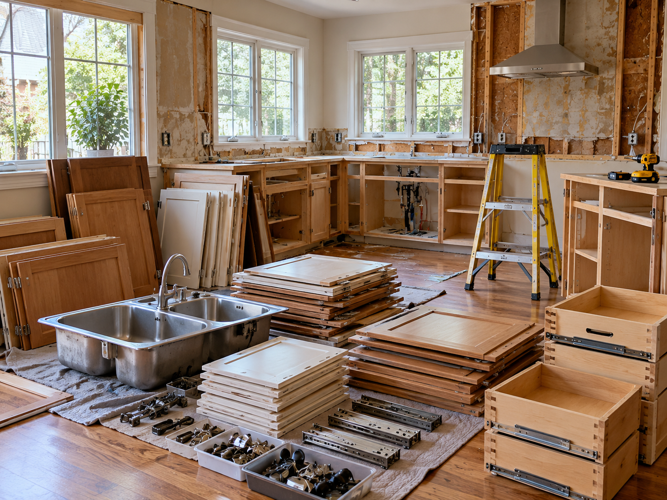
Picture a contractor removing an entire kitchen in a single afternoon. Cabinets are broken apart, fixtures are disconnected, and countertops are carried outside. By evening, the room is empty and the renovation can officially begin. It's efficient, but not necessarily resource-efficient. Some materials may be unsuitable for reuse, particularly when moisture damage or deterioration is involved. Others could have a second life with a little planning. Cabinet doors, drawer pulls, sinks, lighting fixtures, and certain countertops may be candidates for salvage. Even materials that won't fit into the new design might be useful to someone renovating another property.
This is where selective deconstruction becomes interesting. Unlike conventional demolition, which prioritizes removing materials quickly, deconstruction involves carefully dismantling components so that usable items can be recovered. The U.S. Environmental Protection Agency identifies salvage, reuse, and thoughtful deconstruction as ways to reduce construction and demolition waste. Before demolition begins, ask your contractor which items can be safely removed intact and whether local reuse organizations accept them. Not everything will be worth saving, but deciding what happens to the old kitchen before it comes apart is considerably more effective than trying to rescue materials from a dumpster afterward.
A Smarter Floor Plan Can Save More Than Space
One of the less obvious ways to reduce construction waste is to think carefully about dimensions. Consider a kitchen where the cabinetry, island, and backsplash have all been designed around unusual measurements. Custom cutting may be necessary at almost every stage, potentially creating discarded material that has already been manufactured, transported, and purchased. Now imagine the same space designed around thoughtfully coordinated dimensions. Standard cabinet widths can reduce the need for unnecessary customization, tile dimensions can be considered alongside the wall area they will cover, and countertop fabrication can be planned to make better use of available slabs.
None of this requires sacrificing the character of the room. A custom kitchen can still have elegant proportions, beautifully detailed cabinetry, and a distinctive layout. The difference is that material efficiency becomes part of the design conversation rather than a problem left for installers to solve. Planning is particularly important when relocating plumbing, electrical outlets, or major appliances, as these changes can introduce additional labor, construction materials, and potential waste. FINE's guide to cabinetry, countertops, and kitchen layout offers a useful starting point for understanding how these decisions influence one another. The lesson isn't to avoid customization, but to make every custom detail intentional.
Beautiful Materials Don't Have to Begin as Something New
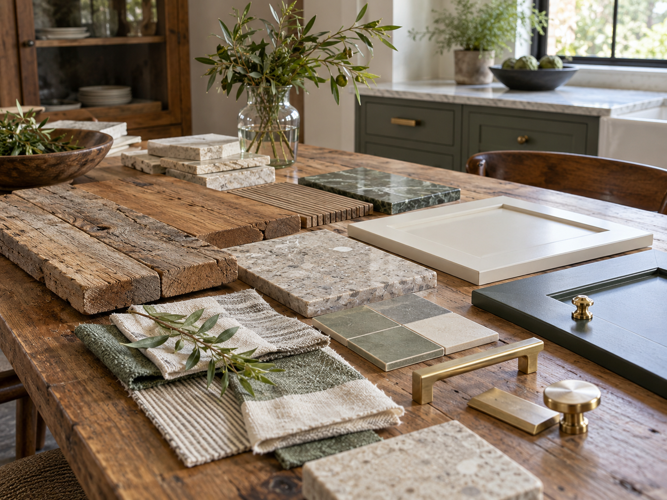
One of the pleasures of renovating a kitchen is discovering materials with unexpected character. A stone fabricator, for example, may have remnants left over from larger projects. Depending on their dimensions and condition, those pieces might be suitable for a compact breakfast counter, a small preparation station, or another carefully designed surface. Instead of selecting a new slab for every application, a designer can sometimes build an interesting feature around what is already available. Surplus tile offers similar possibilities. An end-of-line collection or unused stock from another project might become a beautiful backsplash, provided enough matching material is available for the installation and possible future repairs.
Recycled-content metal is another material worth exploring. Stainless steel and aluminum can create contemporary design details, from shelving and trim to selected work surfaces. However, the actual recycled content and environmental footprint depend on the specific product and manufacturing process. These alternatives shouldn't be treated as automatically superior to new materials, since quality, suitability, transportation, and durability still matter. What they offer is an opportunity to expand the design conversation beyond the usual showroom collections. Sometimes a material becomes more interesting precisely because it wasn't the obvious choice.
The Distance a Material Travels Is Only Part of Its Story

A beautiful piece of stone can travel thousands of miles before reaching a kitchen. Wood may pass through several stages of processing and distribution, while manufactured surfaces can involve multiple raw materials, factories, and transportation routes. That journey has an environmental impact, even if it isn't reflected in the finished product's appearance. Choosing locally or regionally produced materials can sometimes reduce transportation requirements. Working with nearby fabricators may also make it easier to inspect materials, discuss available remnants, and resolve problems without repeated long-distance shipping.
Still, local sourcing isn't a guarantee of a smaller environmental footprint. Manufacturing methods, energy sources, material extraction, and longevity can have significant effects. A responsibly produced material shipped from farther away may perform differently from a locally manufactured alternative made using more resource-intensive processes. For major purchases, ask suppliers what information they can provide about manufacturing, sourcing, and environmental performance. Some products have Environmental Product Declarations, which present standardized information about environmental impacts across defined life-cycle stages. They require careful interpretation and are most useful when comparing genuinely comparable products. You don't need to become a materials scientist to remodel responsibly, but asking where something comes from and how it was made is a meaningful improvement over choosing solely from a color sample.
Design the Kitchen So Its Parts Can Change
A kitchen may be intended to last for decades, but its individual components won't all age at the same rate. A cabinet hinge might fail, a drawer front could become damaged, or the backsplash may eventually need updating while the surrounding cabinetry remains in excellent condition. This is where designing for repair and replacement becomes valuable. Cabinet systems with accessible fittings, replaceable doors, and readily available hardware can be easier to maintain. Surfaces installed in ways that permit localized repairs may also avoid the need for unnecessarily extensive replacement.
Even the choice between a permanently integrated feature and a removable component deserves consideration. An elaborate built-in arrangement can look impressive, but it may become expensive to modify if household needs change. Flexible storage inserts, adjustable shelving, and accessible service areas allow a kitchen to evolve without rebuilding everything around them. FINE's feature on custom inset cabinetry and furniture-inspired kitchens offers inspiration for creating cabinetry with thoughtful proportions and craftsmanship. Good construction shouldn't make future maintenance unnecessarily difficult. A well-considered kitchen gives homeowners the freedom to change individual details without starting over.
Ask Your Contractor Where the Waste Goes
Homeowners regularly ask contractors about budgets, timelines, warranties, and material availability. Waste management deserves a place in that conversation, too. Who handles the discarded cabinets? Will metal components be separated for recycling? Can cardboard packaging be collected independently? Is there a plan for unused but serviceable materials? The answers depend on local facilities, project size, and the types of waste involved. Some materials can be recycled relatively easily where suitable facilities exist, while others require specialized handling or may not be accepted locally.
Older kitchens introduce additional considerations. Suspected asbestos-containing materials, lead-based paint, and other hazardous substances should be evaluated and handled by appropriately qualified professionals rather than included in an ordinary salvage effort. A contractor who has planned the removal and disposal process can help prevent unnecessary confusion once construction starts. For larger renovations, it may be worth requesting a simple written waste-management plan identifying what will be reused, donated, recycled, or discarded. This isn't glamorous work, and it won't generate the most exciting before-and-after photographs. But the environmental impact of a renovation shouldn't disappear from consideration simply because the debris has been hauled away.
A Sustainable Kitchen Should Make Everyday Life Less Wasteful
The renovation may end when the contractors leave, but the kitchen's environmental story continues. And this is where design can quietly encourage better habits. Consider a refrigerator that's difficult to organize. Food disappears behind other containers, leftovers are forgotten, and ingredients expire before anyone remembers buying them. Now consider a kitchen with thoughtfully arranged food storage, accessible pantry shelves, and refrigerator space that suits the household. The second kitchen doesn't need an elaborate technological system to work better. Its organization simply makes food easier to see and use.
Waste sorting can benefit from the same consideration. Rather than treating recycling and composting as awkward additions, space can be planned for appropriately sized, easy-to-clean containers near the preparation area. A convenient cleaning station, durable reusable storage, and enough room for daily food preparation can also make lower-waste routines easier to maintain. None of these improvements guarantees that a household will produce less waste, but design can remove some of the small frustrations that make good habits difficult. That's a meaningful form of sustainability, even if it doesn't arrive with a certification label.
The FINE Take

The most memorable kitchens have always been about more than expensive finishes. They have a sense of purpose. Their proportions feel right, their materials belong together, and the smallest details seem to have been considered. Environmental responsibility can be part of that same design philosophy. Perhaps it's a beautiful countertop created from an existing stone remnant, cabinetry designed around efficient material dimensions, hardware that can be replaced, or a thoughtful plan that keeps usable building materials out of the waste stream.
These decisions won't necessarily be obvious to anyone admiring the finished room. Nor should they have to be. A truly well-designed kitchen doesn't need to announce every responsible choice. Its sophistication comes from knowing that the beauty of the space extends beyond what you can see.

(0) comments
We welcome your comments
Log In
Post a comment as Guest
Keep it Clean. Please avoid obscene, vulgar, lewd, racist or sexually-oriented language.
PLEASE TURN OFF YOUR CAPS LOCK.
Don't Threaten. Threats of harming another person will not be tolerated.
Be Truthful. Don't knowingly lie about anyone or anything.
Be Nice. No racism, sexism or any sort of -ism that is degrading to another person.
Be Proactive. Use the 'Report' link on each comment to let us know of abusive posts.
Share with Us. We'd love to hear eyewitness accounts, the history behind an article.