
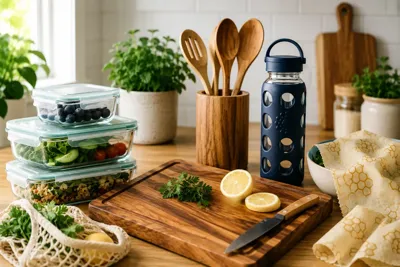
Plastic is everywhere in the kitchen. It holds our leftovers, covers our food, fills our utensil drawers, turns up in water bottles and, in many homes, provides the surface where dinner gets chopped every night.
Trying to eliminate every piece of plastic at once would be unrealistic—and probably expensive. A better approach is to look at the places where plastic comes into regular contact with food and drinks and make a few sensible changes as things wear out.
That approach has become more relevant as researchers continue examining microplastics and the ways plastic particles can make their way into food. A 2023 study published in Environmental Science & Technology, for example, found that plastic cutting boards can release microplastic particles during chopping.
I have to admit, that one got to me. I looked at my own plastic cutting board, saw all those knife marks and grooves, and immediately thought about where all that missing plastic had gone. That was enough for me. The board went straight into the trash, and plastic cutting boards are officially out of my kitchen.
Fortunately, replacing some of the plastic we use every day does not require turning the kitchen into an environmental science experiment. In many cases, the alternatives are materials we have been using for generations—glass, wood, ceramic and stainless steel—along with a few newer ideas that are making reusable and plant-based materials much more interesting.
Start With the Containers You Use Every Day
Food storage may be the easiest place to begin.
Glass does not absorb odors or stain the way some plastic containers eventually can, and being able to see what is inside makes refrigerator and pantry organization considerably easier. There is also something satisfying about opening a cabinet and finding matching glass containers instead of an avalanche of mystery lids.
The Caraway Glass Airtight Container Set is a particularly polished way to make the switch. Made with high-resistance borosilicate glass, the modular containers come in multiple sizes and are designed to stack neatly while creating an airtight seal.
For leftovers and meal prep, Caraway also makes a Food Storage Set built around glass containers.
That does not mean every usable plastic container in the house needs to be thrown away tonight. Use what you already own and replace pieces as they become scratched, stained, warped or otherwise ready for retirement. Reducing plastic can be a transition rather than a shopping spree.
The Cutting Board Swap That Got Personal
Of all the changes in this article, this is the one that changed my own kitchen first.
Once you start looking closely at an older plastic cutting board, it is hard not to notice how scarred the surface becomes. Every cut represents material that has been scraped, shaved or worn away somewhere.
The research backs up the reason for taking a closer look. The 2023 cutting-board study examined polyethylene and polypropylene boards and identified chopping as a source of microplastic particles.
That does not mean using a plastic board once is suddenly a health emergency. It does mean this is one of those swaps that makes sense to me because there is already an excellent alternative.
The Woodenhouse cutting-board collection includes solid-wood options such as its Acacia Wood Cutting Board Set of 3 with Holder. The three sizes handle everything from fruit and vegetables to larger prep jobs, and the matching holder lets the boards stand upright between uses.
They also happen to look good enough to leave out, which cannot be said for every plastic board after a few hundred encounters with a chef's knife.
Good care still matters. Wash wooden boards properly, dry them thoroughly and replace any cutting surface once it becomes badly damaged.
Take a Look Inside the Utensil Crock
Once the cutting board has your attention, the utensil drawer may be next.
Plastic spoons, spatulas and turners spend their lives around hot pans and food. There is no need to panic about every plastic spatula you have ever owned, but when worn tools need replacing, wood gives you an easy alternative.
The Woodenhouse Wooden Utensils Set with Holder, Spoon Rest and Hooks uses teak for the cooking tools and includes the pieces needed for everyday stirring, serving and sautéing.
Wooden utensils are also gentle on cookware and, with proper care, can last for years. Hand washing and thoroughly drying them takes slightly more effort than tossing everything into the dishwasher, but it is hardly a major lifestyle adjustment.
And there is something refreshingly simple about a cooking spoon being made from wood rather than another synthetic material.
Rethink the Water Bottle
Reusable bottles have already helped many people move away from single-use plastic water bottles, but reusable bottles themselves are available in many different materials.
For anyone who likes drinking from glass, Lifefactory offers a practical compromise between glass and everyday durability.
The 16-ounce Lifefactory Glass Water Bottle with Silicone Sleeve has a glass body surrounded by a protective silicone sleeve for grip and added protection against breakage.
It is important to be precise here. This is not a completely plastic-free bottle. The classic version uses a polypropylene cap, and the protective sleeve is silicone. The advantage is that the main vessel holding the drink is glass and the bottle is designed for repeated use.
For people who do not want to carry glass, stainless steel remains another durable option. The point is not finding some mythical product containing absolutely no synthetic material. It is reducing unnecessary reliance on disposable and short-lived plastic wherever it is easy to do so.
Give Plastic Wrap Some Competition
Plastic wrap is another kitchen habit that happens almost automatically. Half an avocado? Wrap it. Cheese? Wrap it. Leftover sandwich? Wrap that too.
But not everything needs a new piece of disposable plastic every time it goes into the refrigerator.
Bee's Wrap makes reusable food wraps from organic cotton coated with beeswax, plant oil and tree resin. The wraps soften with the warmth of your hands and can be shaped around foods or containers.
For people accustomed to pulling plastic wrap off a roll, the Bee's Wrap reusable roll is an easy transition because you simply cut the amount you need. With proper care, the company says its wraps can be reused for about a year.
There are limitations. Beeswax wraps should be kept away from heat and hot water, and they are not appropriate for every food. But for bread, cheese, produce, snacks and plenty of everyday refrigerator jobs, they offer another option before automatically reaching for something disposable.
Be Smarter About What Goes Into the Microwave
Reheating food is another moment when it is worth paying attention to the container.
The U.S. Food and Drug Administration notes that glass, ceramic and appropriate plastic containers can all be used in microwave cooking, but some plastic containers should not be microwaved because heat from the food can cause them to melt.
In other words, not every plastic takeout container belongs in the microwave simply because it survived the trip home.
I prefer the simplest approach: when in doubt, move the food to microwave-safe glass or ceramic.
That is one of those habits that requires almost no effort once it becomes routine.
The Most Interesting Alternatives May Still Be Coming
Glass and wood are hardly new inventions. What is new is the growing effort to develop packaging that performs some of the jobs traditionally handled by petroleum-based plastics without leaving the same long-term waste behind.
One company worth watching is Notpla, which develops packaging made with seaweed.
Its food containers use a natural seaweed-based coating rather than a conventional petroleum-based coating, while another Notpla technology encapsulates liquids inside an edible and naturally biodegradable membrane.
This is where the future of reducing plastic gets particularly interesting.
Consumers can replace a cutting board or water bottle themselves. Packaging is a much larger challenge because restaurants, manufacturers, grocery companies and retailers have to participate before alternatives become commonplace.
Seaweed is not the only material being explored. Cellulose, agricultural fibers, plant-based coatings and other biomaterials are all part of a broader effort to rethink what happens to packaging after we have used it for five minutes.
The most successful solution may eventually be one we hardly notice.
Do Not Throw Away Half the Kitchen
There is one part of the plastic-free movement that makes very little sense: throwing away a house full of perfectly functional products so we can immediately buy a house full of new environmentally friendly ones.
That misses the point.
If something works and is in good condition, use it. Then, as products wear out, think about what you want replacing them.
A scratched plastic cutting board can become a wooden one. Worn food containers can gradually give way to glass. Disposable plastic wrap can sometimes be replaced by reusable wrap or a container with a lid. A single-use water bottle can become a glass or stainless-steel bottle that gets filled hundreds of times.
Small decisions add up, especially when they become permanent habits.
I am not pretending plastic will disappear from my kitchen tomorrow. It will not. But that old scarred cutting board made me look at what I was using a little differently.
Sometimes that is how change starts—not with an entire lifestyle overhaul, but with one ordinary object that suddenly makes you think, Why am I still using this?

(0) comments
We welcome your comments
Log In
Post a comment as Guest
Keep it Clean. Please avoid obscene, vulgar, lewd, racist or sexually-oriented language.
PLEASE TURN OFF YOUR CAPS LOCK.
Don't Threaten. Threats of harming another person will not be tolerated.
Be Truthful. Don't knowingly lie about anyone or anything.
Be Nice. No racism, sexism or any sort of -ism that is degrading to another person.
Be Proactive. Use the 'Report' link on each comment to let us know of abusive posts.
Share with Us. We'd love to hear eyewitness accounts, the history behind an article.