
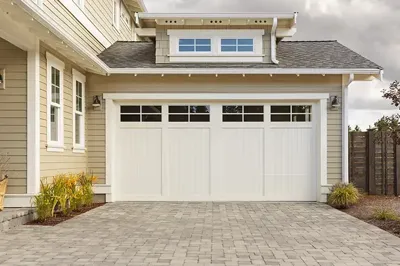

A garage door is easy to ignore until the day it stops working. Then it becomes the most urgent item on the list. You can't leave the car, you can't get to the tools, and the house feels open in a way you don't like.
If you are replacing one, a little planning before you call anyone saves a lot of trouble. Here is what is worth thinking about, with a Southern California angle where it matters.
First, ask if you really need a new door
Not every problem means a new door. A broken spring, a noisy roller or a sensor that is out of line can often be fixed for much less than the cost of a replacement. Door companies commonly say that when the repair cost gets close to half the price of a new door, replacing it makes more sense. That is a rule of thumb from the trade, not a law, but it is a useful way to compare two quotes.
Replacement tends to make sense when the door is dented or cracked across several panels, when it is hard to match parts for an older model, or when you have already paid for several repairs. Also ask yourself whether you simply dislike how it looks. A door takes up a large part of the front of many homes, and that is a fine reason on its own.
Whatever you decide, do not try to fix the springs yourself. Springs hold a lot of tension, and the industry group DASMA says only a trained door systems technician should repair or adjust them.
Pick a material for where you live
This matters more near the coast. Salt air and humidity can speed up corrosion, especially on metal parts. One major manufacturer's buying guide says to look for galvanized steel with a rust-resistant coating if you choose steel. It describes aluminum as rust-resistant and a good fit for coastal homes, and it says wood needs regular sealing to handle moisture. Keep in mind that this guide comes from a company that sells doors, and it doesn't give test data. It is a good starting point for questions, not a final answer.
The same guide suggests rinsing the door with fresh water now and then to wash off salt, and checking for rust after storms. If you live a few miles inland, you may care more about sun. UV light fades paint over time, so a lighter color or a UV-resistant finish is worth asking about.
Check the rules before you order
There are two kinds of rules to look at: the city's and your neighborhood's.
On permits, the City of San Diego says exterior door and window replacements are exempt when the wall and the rough opening stay the same. It also says permits are required in historic districts and environmentally sensitive areas. Its list does not mention garage doors by name, and every city is a little different, so call your city's building department and ask. A short phone call is cheaper than a stop-work notice.
If you are in an HOA, read the design rules first. Many HOAs have approved colors and styles for garage doors and want an application before work starts. The consequences of skipping it vary by community, but a violation notice or an order to change the door later would cost far more than waiting a couple of weeks for approval.
Choosing an installer
This is the part most people rush, and it has a big effect on how the door performs for years.
Start with the license. California's contractor licensing board (CSLB) lets you look up any contractor online. The record shows whether a license is active, what type of work it covers, and whether the contractor has the required bond and workers' compensation insurance. CSLB also notes that the database can lag behind real events, and that a clean record does not rule out complaints that have not been reported. So check it yourself, and do not rely only on a number printed on a truck.
Then ask practical questions. What exactly does the price include? Is old-door removal included? Are springs, cables and hardware new, or reused from the old door? Does the opener come with it, or is it a separate cost? What does the warranty cover and for how long? A good installer answers these without fuss, in writing.
For readers in the San Diego area, one company to look at is ProShield Garage Doors. Based on what the company says on its own website, it is a San Diego business that has been operating since 2010. It lists a California contractor license number that homeowners can check on the CSLB site. It says it installs and services Clopay, Chamberlain and LiftMaster products, and it lists a Heritage Collection of custom designs. For replacements, it says the job includes taking out the old door and installing the new one with new springs, cables and hardware, and that replacement doors come with a warranty. It also lists service pages for 25 communities across San Diego County, from La Jolla and Del Mar to Chula Vista and Escondido.
None of that replaces your own checking. The warranty terms are not spelled out on the page, for example, so ask to see them. The same goes for any company you are considering, and it is smart to get at least two quotes so you can compare what is included, not only the total.
Think about the opener and the extras
A new door is a good time to look at the opener. If the opener is old, ask the installer to check its safety features. The DASMA checklist for home inspectors notes that openers built after 1992 must have photo-eyes or an equivalent reverse feature, and it describes a simple test: the door should reverse when something crosses the beam or touches an object on the floor. If your opener does not do that, it should be replaced.
Smart openers with phone control are common now, and some come with battery backup for power cuts. That is useful in areas where outages can happen, but check that the model works with the door you are buying before you pay for it.
A quick checklist
Before you sign anything, make sure you have:
Confirmed the repair is not the cheaper and better choice.
Chosen a material that suits your location, coastal or inland.
Checked with your city and your HOA about any approval you need.
Looked up the contractor's license on the CSLB site.
Got a written quote that lists what is included.
Asked how long the warranty lasts and what it covers.
A garage door is one of the most used parts of a house. It opens and closes many times a week for years, so a few hours of checking now is easy to justify.



(0) comments
We welcome your comments
Log In
Post a comment as Guest
Keep it Clean. Please avoid obscene, vulgar, lewd, racist or sexually-oriented language.
PLEASE TURN OFF YOUR CAPS LOCK.
Don't Threaten. Threats of harming another person will not be tolerated.
Be Truthful. Don't knowingly lie about anyone or anything.
Be Nice. No racism, sexism or any sort of -ism that is degrading to another person.
Be Proactive. Use the 'Report' link on each comment to let us know of abusive posts.
Share with Us. We'd love to hear eyewitness accounts, the history behind an article.