
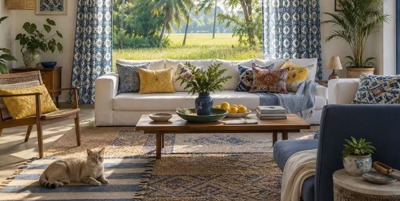

It could be argued that ever since the events of 2020, the idea of home and what it represents has changed rather dramatically. For many, home has become a sanctuary, a haven of peace, a place to nurture one’s physical and mental well-being, rather than just a place to rest after work. Home is also the place to share a family’s story… its travels, memories, and personal sense of style. Within this zeitgeist, there is little room for soulless perfection. As such, design lovers are embracing “collected” interiors comprising inherited pieces, vintage finds, statement pieces, and mismatched furniture items. Industry forecasts reveal, for instance, that the second-hand furniture market is expected to surpass $56 billion by 2030. It is as though homeowners had woken up to the wonder of a home filled with character, rather than one that looks harmonious but is a little too perfect to be meaningful.
The Rising Popularity of Collected Homes
The new interest in non-catalog-style interiors prioritizes coziness, warmth, and happiness. It embraces the values espoused by movements such as wabi-sabi, which finds beauty in imperfection, and eclectica, which involves mixing different patterns, styles, and cultural influences to create interiors that look layered, lived-in, and personal. As stated by the highly acclaimed designer Sean Symington, modern designs are “mixing patterns in a softer, more considered way to create depth without overwhelming, and mismatched furniture to bring character and individuality, favoring collected pieces over perfectly matched sets.” Collected homes usually feature layered furnishings, carefully mixed patterns, and decorative pieces that exude personality.
Making the Most of Mismatched Furniture
To incorporate the collected home trend in your dwelling, avoid purchasing an entire living room suite or choosing matching couch and armchair sets. Instead, match your chosen couch with furniture created in a different style or material, or with pieces from another era. For instance, pair a modern couch with vintage armchairs, upholster your chairs in different fabrics, or embrace contrasting wood finishes within the same space. Try combining contrasting furniture shapes, varied styles, and a mix of straight lines and curved forms. For instance, you can pair a slim mid-century chair with a deep, oversized sectional, or a curved armchair with a boxy modern sofa. Mixing different shapes, finishes, and fabrics lends your living space depth and visual interest without adding a chaotic feel. The key lies in moderation and experimentation.
Layering Vintage and Antique Pieces
Age and history lend spaces character, creating the kind of visual depth that lends a living space greater visual appeal. To add a vintage feel to your space, look for items with patina and natural aging, as well as vintage mirrors, Art Deco paintings, antique rugs, distressed leather, burnished metals, and rough-hewn wooden pieces. Go through any inherited or collected pieces you may have, including candelabra, sculptures, and old pottery. Old, hard-bound books, meanwhile, make a beautiful addition to floating or standing shelves, especially when arranged by color or period.
Embracing Sustainability
For today’s environmentally conscious consumers, the collected home movement is a perfect way to create a stunning yet sustainable home. Many are buying fewer new pieces, restoring quality furniture, or shopping for vintage, antique, and second-hand items at yard sales and markets. Ideas that may resonate with you include restoring solid timber furniture, reupholstering inherited armchairs, or searching for one-of-a-kind pieces at estate sales. If you are looking for a couple of chairs to frame your sofa setting, don’t worry if both chairs aren’t identical. So long as they share a key feature (such as scale, color palette, or material), they will feel cohesive. Many would say they add more visual interest than matching sets. Aim to see your living room as an evolving space rather than a static one. Add meaningful pieces as you discover them, slowly but surely creating a home that reflects your personality, tells your story, and is less likely to feel dated in a few years’ time. Moreover, older furniture was often made from high-quality materials, such as solid timber, which makes it long-lasting and worthy of restoration.
When it comes to creating a living space that reflects who you are, the collected home concept fits like a glove. This movement prioritizes curated collections, heirlooms, and vintage finds. and shuns overly matched or new, store-bought looks. To make the most of this movement, aim to combine different lines, shapes, and fabrics. Instead of buying new items, use inherited or antique pieces, and take time to restore quality furniture if you have an interest in DIY projects.

(0) comments
We welcome your comments
Log In
Post a comment as Guest
Keep it Clean. Please avoid obscene, vulgar, lewd, racist or sexually-oriented language.
PLEASE TURN OFF YOUR CAPS LOCK.
Don't Threaten. Threats of harming another person will not be tolerated.
Be Truthful. Don't knowingly lie about anyone or anything.
Be Nice. No racism, sexism or any sort of -ism that is degrading to another person.
Be Proactive. Use the 'Report' link on each comment to let us know of abusive posts.
Share with Us. We'd love to hear eyewitness accounts, the history behind an article.