
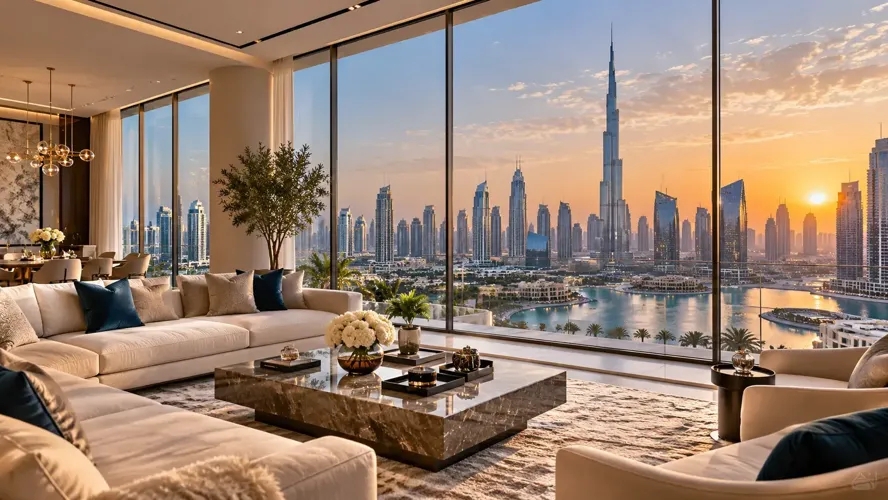

Dubai has never been particularly interested in understatement. For decades, the city built its reputation on scale, ambition and the ability to turn improbable ideas into recognizable landmarks. But inside its newest luxury residences, something more nuanced is happening.
The definition of Dubai luxury living is moving beyond marble foyers, spectacular views and record-breaking square footage. The most compelling homes are increasingly being designed around how residents actually live, with privacy, wellness, seamless technology, hospitality-level service and a stronger relationship between indoor and outdoor space taking precedence over ornament for ornament’s sake.
That evolution comes as Dubai’s high-end residential market continues to attract considerable global attention. The Dubai Land Department reported that luxury real-estate investment reached AED 87.71 billion during the first quarter of 2026, a 26 percent increase. Yet the more interesting story may be what buyers expect once they step through the front door.
Luxury Is Becoming More Personal
Dubai helped perfect the idea of real estate as spectacle. Panoramic glass walls, private elevators, double-height living rooms and dramatic pools remain very much part of the landscape. What is changing is the assumption that more automatically means better.
Affluent homeowners increasingly want spaces that work around their daily lives. That means primary suites with genuine privacy, kitchens designed for both entertaining and everyday use, quiet workspaces, discreet staff circulation and outdoor areas that function as extensions of the interior rather than decorative terraces.
The shift mirrors a broader change in luxury housing. Craftsmanship and functionality are beginning to carry as much weight as obvious displays of expense. FINE explored a similar idea in Daniel Shamoon on Why Luxury Is Becoming Less, Not More, where privacy, simplicity and precisely considered experiences emerge as a different kind of status.
Branded Residences Are Turning Homes Into Hospitality
One of Dubai’s most influential contributions to global luxury housing is the rise of the branded residence. The concept combines private ownership with some of the service standards traditionally associated with a five-star hotel.
According to Knight Frank, Dubai is now the world’s largest city market for branded residences. Hospitality names are part of that story, but fashion houses and automotive marques have also entered residential development.
The appeal goes beyond having a recognizable name above the entrance. Concierge services, housekeeping, property management, wellness facilities and highly managed common spaces reduce the friction of owning a residence, particularly for international homeowners who may divide their time among several cities.
That points toward a larger idea about luxury. Increasingly, the ultimate amenity is not another room. It is having fewer things to manage.
Wellness Is Moving Into the Floor Plan

The private gym tucked into a spare bedroom has evolved considerably. New luxury housing is placing greater emphasis on spaces devoted to recovery, fitness and everyday well-being.
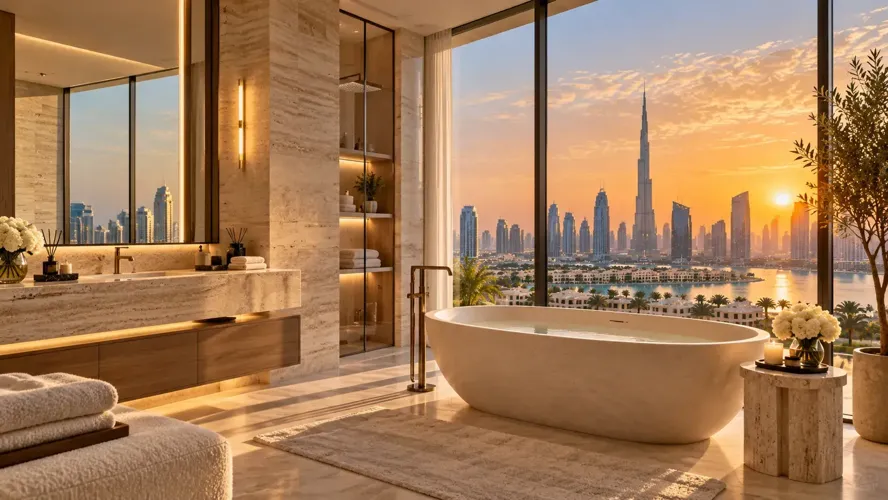
Spa-style bathrooms, saunas, steam rooms, cold-plunge areas, treatment rooms and dedicated fitness spaces are moving deeper into residential design. Natural light, air quality, acoustics and sleep environments are also receiving greater attention.
This does not necessarily require turning a home into a private wellness resort. Some of the best ideas are quieter. A bathroom designed around calm rather than excess, a shaded courtyard, filtered water, lighting that changes throughout the day and a bedroom protected from household noise can have more influence on daily life than an extravagant amenity that is rarely used.
It is a trend FINE has been watching closely. Luxury Wellness at Home looks at how high-end residential design is increasingly being judged by how effectively a home supports restoration as well as appearance.
Technology Is Most Luxurious When It Disappears
Dubai is an obvious testing ground for connected homes, but the best technology is becoming less visible rather than more.
Lighting, climate, shading, access control, security and entertainment can increasingly be coordinated through centralized systems. In a well-designed residence, however, the homeowner should not feel surrounded by control panels, blinking devices and competing apps.
Motorized shades can respond to the intensity of the sun. Climate systems can prepare rooms before they are occupied. Lighting scenes can shift from bright daytime use to evening entertaining without requiring a tour through five different switches.
The emphasis is moving from owning smart devices to creating a home that behaves intelligently. That same philosophy is explored in FINE’s guide to smart-home automation and luxury living.
Indoor and Outdoor Living Has a Different Meaning in the Desert
Dubai’s climate creates an interesting design problem. Residents want expansive views and a close connection to outdoor space, but intense heat and sun require those spaces to be thoughtfully controlled.
The result is a more sophisticated version of indoor-outdoor design. Deep overhangs, shaded terraces, courtyards, screened outdoor rooms, carefully positioned pools and landscape architecture can create usable transitions between the house and its surroundings.
Large expanses of glass may deliver dramatic views, but orientation, shading and high-performance glazing matter just as much as the view itself. A successful home responds to climate rather than pretending it does not exist.
That lesson travels well beyond Dubai. Whether the challenge is desert heat, Southern California sun or a humid coastal climate, genuinely luxurious architecture works with its environment instead of relying entirely on mechanical systems to overcome it.
Materials Are Becoming Quieter
There will always be room for dramatic stone in Dubai, but the most interesting interiors are not necessarily the ones using the greatest number of expensive finishes.
Natural stone, warm woods, textured plaster, bronze, leather and handcrafted surfaces are increasingly effective when allowed to stand on their own. Instead of combining every luxury material in one room, designers can create more impact by giving one or two exceptional materials space to breathe.
This restrained approach reflects what sophisticated buyers elsewhere are looking for as well. FINE’s guide to the interior elements luxury buyers value examines the growing emphasis on tactile materials, precise workmanship and integrated systems rather than obvious decoration.
Privacy May Be Dubai’s Most Important Luxury
In a city known for visibility, privacy has become surprisingly valuable.
That can mean a private elevator opening directly into a residence, separate guest and family zones, concealed service entrances, landscaped courtyards or a villa positioned so neighboring properties do not dominate the view.
It also extends to technology. Integrated access systems and discreet security allow homeowners to protect a residence without making it resemble a fortress.
For international owners, privacy also means arriving at a property and having it ready. Climate, housekeeping, maintenance and security may all be handled before the resident walks through the door. Service becomes part of the architecture of daily life.
What Dubai Can Teach the Rest of the Luxury Market
Dubai’s housing market operates at a scale few cities can replicate. In the first half of 2026 alone, Knight Frank recorded 296 sales of homes priced above $10 million, including 26 transactions above $25 million. But the significance of Dubai is not simply how much buyers are willing to spend.
It is how quickly the city experiments with what residential luxury can include.
Some ideas will remain distinctly Dubai. Others are already appearing in high-end homes around the world: hotel-caliber service, integrated wellness, disappearing technology, stronger privacy and architecture that makes everyday routines feel easier.
The lesson is not that every home needs a private spa, concierge or skyline view. It is that luxury is becoming less about accumulating features and more about removing inconveniences.
Dubai may still know how to make an entrance. Increasingly, though, its most interesting homes are revealing that what happens after the front door closes matters even more.

(0) comments
We welcome your comments
Log In
Post a comment as Guest
Keep it Clean. Please avoid obscene, vulgar, lewd, racist or sexually-oriented language.
PLEASE TURN OFF YOUR CAPS LOCK.
Don't Threaten. Threats of harming another person will not be tolerated.
Be Truthful. Don't knowingly lie about anyone or anything.
Be Nice. No racism, sexism or any sort of -ism that is degrading to another person.
Be Proactive. Use the 'Report' link on each comment to let us know of abusive posts.
Share with Us. We'd love to hear eyewitness accounts, the history behind an article.