
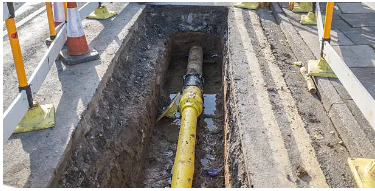
Underground infrastructure across North America continues to age, with many municipal and private sewer systems now operating beyond their intended service life. As deterioration accelerates, contractors face increasingly complex decisions about how to address failing pipe systems. Where excavation and full replacement once dominated the rehabilitation landscape, today’s contractors evaluate multiple methodologies before breaking ground.
American Pipelining Solutions sees this shift firsthand. As trenchless technology becomes more widely adopted, trenchless pipe lining has evolved from a specialized alternative into a mainstream rehabilitation solution used across municipal, commercial, and residential projects.
Trenchless Pipe Lining: How It Fits into Modern Rehabilitation
Trenchless pipe lining, most commonly referred to as CIPP sewer lining, involves installing a resin-saturated pipe liner inside an existing pipe, forming a new structural pipe within the original host system. This process typically requires minimal excavation, often limited to access points such as manholes or cleanouts.
Contractors evaluate trenchless pipe lining for applications ranging from residential laterals to large-diameter municipal mains. The method offers clear advantages, particularly in projects where surface disruption must be minimized.
Reduced excavation eliminates damage to roadways, landscaping, and surrounding infrastructure. Project timelines are often shortened significantly, with many trenchless installations completed in hours rather than days. Restoration requirements are also reduced, lowering overall project complexity and cost.
American Pipelining Solutions emphasizes that trenchless pipe lining is not universally applicable. Contractors must evaluate whether the existing pipe can structurally support the pipe liner and whether internal obstructions or severe deformation would prevent proper installation and curing.
Full Pipe Replacement: When Excavation Is Still Necessary
Despite advancements in trenchless technology, full pipe replacement remains essential in certain conditions. Replacement involves excavating to expose deteriorated pipes, removing existing materials, and installing new replacement pipe systems before backfilling and restoring surfaces.
American Pipelining Solutions notes that severe structural failure, including collapsed sections, major separations, or extreme misalignment, often exceeds the rehabilitative limits of CIPP sewer lining. In these cases, excavation and replacement provide the most reliable long-term solution.
Replacement projects also introduce added logistical challenges. Urban environments may restrict access and require extensive traffic management, while restoration frequently extends beyond the trench itself to include pavement, sidewalks, and landscaping. These factors significantly increase both cost and community impact.
Cost Evaluation: Trenchless Pipe Lining Cost vs. Replacement Pipe
When comparing trenchless pipe lining cost to replacement pipe projects, contractors increasingly recognize that upfront pricing alone does not tell the full story. American Pipelining Solutions advocates for evaluating total project cost rather than installation cost in isolation.
Labor, equipment, and restoration requirements differ significantly between methods. Trenchless projects often require specialized crews but smaller overall labor forces. Excavation projects, by contrast, involve heavy machinery, hauling, disposal, and extensive surface restoration.
American Pipelining Solutions frequently sees restoration costs account for a substantial portion of replacement pipe budgets, often exceeding the cost of the pipe installation itself. Additional expenses such as traffic control, road closures, and extended timelines further impact total project cost.
A comprehensive cost comparison allows contractors and property owners to make informed decisions based on lifecycle value rather than surface-level estimates.
Pipe Condition, Inspection, and Structural Requirements
Accurate inspection is central to methodology selection. American Pipelining Solutions recommends video inspection and condition assessment to evaluate cracks, corrosion, root intrusion, and overall structural integrity before recommending trenchless pipe lining or full replacement.
Pipe material, diameter, and degree of deterioration all influence feasibility. CIPP sewer lining and pipe liner systems perform well in pipes with moderate structural damage, restoring strength and hydraulic capacity without excavation.
When pipes exhibit advanced collapse or complete structural failure, American Pipelining Solutions confirms that replacement pipe installation can be required to ensure long-term performance.
Site Constraints and Environmental Considerations
Site conditions often drive decision-making as much as pipe condition. Trenchless contractors regularly work in environments where excavation would disrupt traffic, businesses, or residential access. In these settings, trenchless pipe lining minimizes disruption and reduces environmental impact.
Historic districts, high-traffic commercial corridors, and environmentally sensitive areas frequently limit excavation options, making trenchless solutions more viable from both logistical and regulatory perspectives.
Industry Perspective: How Contractor Decision-Making Has Evolved
The rehabilitation industry has shifted away from default excavation toward data-driven evaluation. American Pipelining Solutions observes that contractors now assess trenchless pipe lining and replacement pipe options based on inspection data, site constraints, cost analysis, and long-term performance.
As trenchless technology has proven reliable across diverse applications, contractor confidence has grown. Access to multiple rehabilitation methods allows solutions to be matched to project conditions rather than constrained by habit or equipment availability.
Choosing the Right Method for Each Project
Neither trenchless pipe lining nor full replacement represents a universal solution. Effective rehabilitation planning aligns methodology selection with pipe condition, site constraints, budget parameters, and performance expectations.
From the perspective of American Pipelining Solutions, informed evaluation leads to better outcomes. As infrastructure rehabilitation demands continue to rise, projects benefit most when decisions are based on comprehensive analysis, ensuring durable performance, controlled costs, and minimal disruption.
(0) comments
We welcome your comments
Log In
Post a comment as Guest
Keep it Clean. Please avoid obscene, vulgar, lewd, racist or sexually-oriented language.
PLEASE TURN OFF YOUR CAPS LOCK.
Don't Threaten. Threats of harming another person will not be tolerated.
Be Truthful. Don't knowingly lie about anyone or anything.
Be Nice. No racism, sexism or any sort of -ism that is degrading to another person.
Be Proactive. Use the 'Report' link on each comment to let us know of abusive posts.
Share with Us. We'd love to hear eyewitness accounts, the history behind an article.