

Adventure does not come with an expiration date. From tandem skydiving and scuba diving to whitewater rafting and alpine adventures, adults over 60 are proving that retirement can be the beginning of a far more adventurous chapter. The key is choosing the right challenge, preparing properly, and knowing when experience matters more than bravado.
There was a time when the stereotypical retirement itinerary involved golf, gardening, and perhaps a leisurely cruise.
That stereotype is increasingly outdated.
Travelers in their 60s, 70s, and beyond are hiking mountains, diving reefs, skiing challenging terrain, and signing up for experiences they may have postponed for decades. The more interesting question is no longer whether older adults should pursue adventure. It is which adventures offer the right combination of adrenaline, physical challenge, and manageable risk.
Here are eight worth considering.
Tandem Skydiving Delivers Maximum Adrenaline With Minimal Training

Few activities redefine a birthday quite like jumping from an airplane.
For someone who wants the emotional impact of an extreme sport without spending months learning one, tandem skydiving is difficult to beat. A certified instructor manages the parachute system while the passenger experiences the climb, exit, freefall, and canopy descent.
Older skydivers are hardly unheard of. People continue participating well into their 60s, 70s, and beyond when their health and physical condition allow it.
That does not mean every healthy-looking 70-year-old should immediately book a jump. Individual operators may have their own requirements, and anyone with cardiovascular, neurological, orthopedic, or other relevant medical concerns should discuss participation with a healthcare professional beforehand.
Best for: The bucket-list adventurer who wants an intense experience without learning an entire sport first.
Scuba Diving Opens an Entirely Different World
Scuba offers something unusual among adventure sports. It can feel extraordinarily adventurous while also being remarkably serene.
Rather than relying on speed or impact, diving rewards controlled movement, awareness, and technique. Once underwater, the attraction becomes exploration: coral gardens, marine life, underwater walls, and wrecks that most travelers will never see from the surface.
Many divers continue the sport into their 70s and 80s. Physical fitness and individual medical circumstances generally matter far more than simply reaching a particular age.
For travelers returning after a long absence, a refresher course can be more sensible than immediately heading out on an ambitious dive. Beginners should start with professional instruction and relatively uncomplicated conditions.
Carrying heavy tanks across a rocking boat deck can sometimes be more demanding than the dive itself, so choosing an operator willing to assist with equipment also deserves consideration.
Best for: Travelers who want exploration, wildlife, and adventure without the pounding associated with high-impact sports.
Whitewater Rafting Lets Someone Else Help Navigate the Chaos
Whitewater rafting earns its place on an adventure list because it can be tailored dramatically to experience level.
A relatively gentle guided river trip and an aggressive run through powerful Class IV rapids may both technically be called rafting, but they are completely different experiences.
That flexibility makes rafting particularly attractive for active older adults. A reputable outfitter can match participants to appropriate river conditions, provide safety equipment, and put an experienced guide in command of the raft.
Beginners do not need to prove anything by booking the hardest water available. Moderate rapids can still deliver splashing waves, fast currents, sharp turns, and plenty of excitement without turning an afternoon on the river into an endurance contest.
Best for: Couples, families, or groups who want an adrenaline experience they can share.
Kayaking Can Be As Peaceful or Wild As You Want It

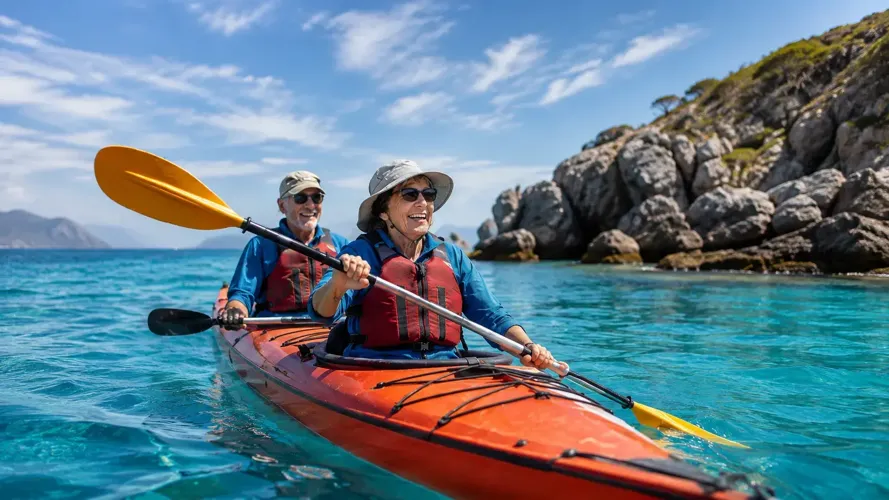
Kayaking deserves special mention because the same basic sport can range from an effortless paddle across a glassy lake to technical whitewater and demanding open-ocean expeditions.
For adults new to paddling, flatwater or protected coastal kayaking offers an excellent entry point. More experienced paddlers can gradually move toward longer sea-kayaking routes or increasingly technical water.
Upper-body endurance, torso rotation, coordination, and balance all matter, which is another reason to progress gradually rather than judging ability solely by cardiovascular fitness.
Kayaking also offers something many extreme sports cannot: complete control over how adventurous the day becomes.
One morning might mean gliding quietly along a protected coastline. Another might involve navigating swells, currents, caves, or remote stretches of open water.
Best for: Someone who wants an adventure sport with an unusually wide range of difficulty levels.
Skiing Is One Sport You Do Not Necessarily Have to Retire From
Ski resorts are full of evidence that skiing does not automatically end at 60 or 70.
Experienced skiers often adapt rather than quit. That may mean choosing groomed terrain instead of moguls, reducing the number of runs in a day, avoiding poor visibility, or allowing more recovery time between sessions.
The smartest strategy is not pretending the body has remained unchanged. It is using decades of judgment to compensate for those changes.
Beginners entering skiing later in life have another advantage: professional instruction allows them to learn proper technique from the beginning rather than trying to correct decades of bad habits.
Private lessons can be particularly valuable because an instructor can control pace, terrain, and rest periods based on the skier's comfort and ability.
Best for: Active travelers who enjoy winter destinations and want a sport they can continually refine.
Via Ferrata Offers the Thrill of Climbing Without Becoming a Mountaineer
One of the most interesting adventure options for older travelers barely appears on most extreme-sports lists.
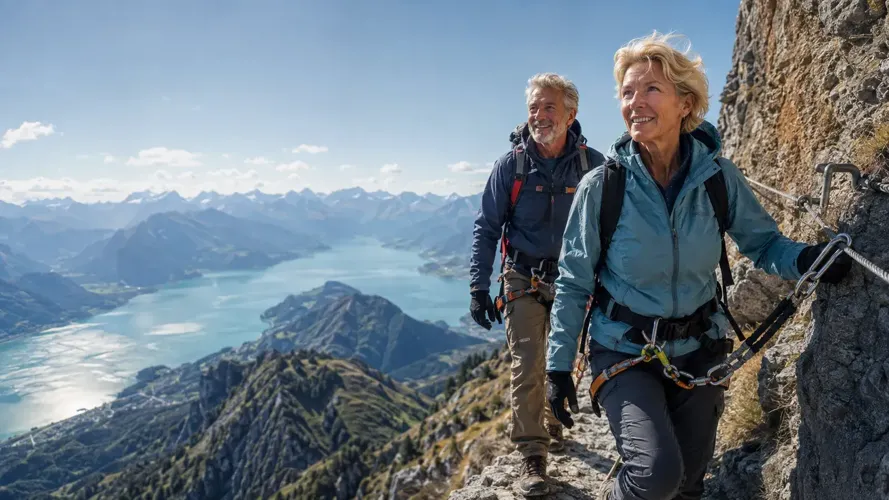
Via ferrata, Italian for “iron path,” uses fixed cables, ladders, bridges, footholds, and other protected climbing infrastructure to create routes across steep mountain terrain.
Participants wear climbing equipment and remain connected to the protection system as they progress.
The experience can provide dramatic exposure and extraordinary alpine scenery without requiring the technical climbing ability needed for traditional rock climbing.
That does not make it effortless. Via ferrata routes can require balance, mobility, upper-body strength, comfort with heights, and enough stamina to complete several hours of climbing and hiking.
For newcomers, a professionally guided beginner route is the place to start.
Best for: Fit hikers who want to graduate from walking through the mountains to moving across them.
Paragliding Turns the Landscape Into the Adventure
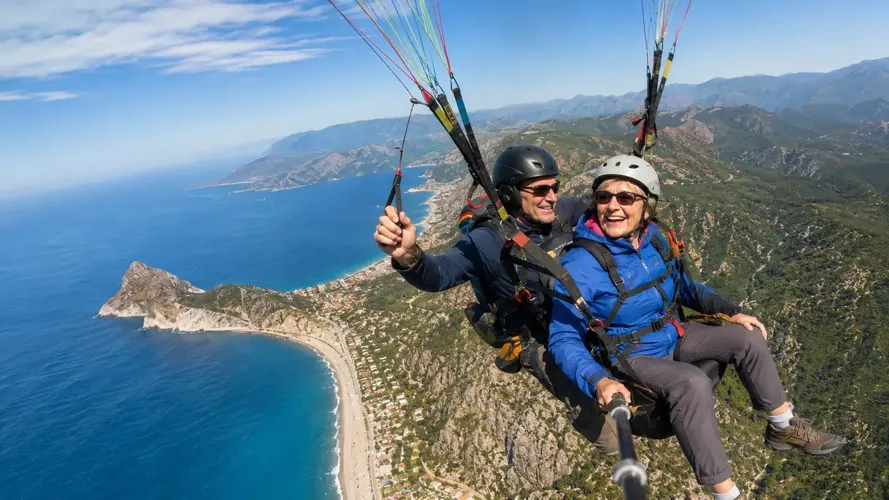
Paragliding provides another compelling option for someone more interested in sensation than athletic competition.
On a tandem flight, the pilot controls the wing while the passenger experiences the landscape from above. Coastal cliffs, valleys, and mountain regions become radically different when viewed without an aircraft cabin surrounding you.
It delivers the sensation of flight without requiring someone to become a pilot or commit to extensive training.
For Southern Californians, this type of adventure does not necessarily require an international trip. San Diego has a long-established aerial-adventure culture, including opportunities to paraglide along its dramatic coastline.
For more unusual ways to experience the region from above, explore FINE Magazine's guide to The Most Memorable Flying Experiences in San Diego.
Best for: Travelers fascinated by flight who want something more visceral than a helicopter tour but less technical than learning to fly.
Mountain Trekking May Be the Ultimate Test of Endurance
Extreme does not always mean fast.
A strenuous trek at elevation can demand more determination than a 60-second freefall.
Routes through the Alps, Patagonia, the Andes, and other mountain regions combine hours of sustained activity with elevation changes, unpredictable weather, and terrain that requires concentration. Multi-day trips add another challenge: recovering sufficiently to do it again the following morning.
The advantage is scalability.
An adventurous traveler might begin with challenging day hikes before progressing toward hut-to-hut trekking or professionally guided high-altitude itineraries.
The accomplishment also unfolds gradually. There is no single explosion of adrenaline. Instead, the reward is arriving somewhere that could only be reached through effort.
Best for: Endurance-minded travelers who would rather earn a spectacular view than simply arrive at it.
The Most Important Skill Is Knowing Your Current Ability
There is one significant difference between adventure at 25 and adventure several decades later.
Recovery deserves more respect.
That does not require treating older adventurers as fragile. It means being realistic about balance, joint mobility, cardiovascular conditioning, reaction time, previous injuries, and the amount of recovery an activity requires.
Outdoor adventurers should also pay particular attention to footwear, weather, hydration, communication, emergency planning, and changing temperatures.
Heat deserves additional consideration because the body's ability to regulate temperature can change with age, and some medical conditions or medications can further affect heat tolerance.
Before attempting a genuinely strenuous or high-risk activity, especially following a lengthy period of inactivity, medical clearance may also be appropriate.
The goal is not to eliminate risk. An adventure with no uncertainty would hardly qualify as an adventure.
The goal is to make better decisions about which risks are worth taking.
Adventure After 60 Should Not Look Like Adventure at 30
Perhaps this is the part most adventure lists miss.
There is no prize for trying to recreate the way you traveled three decades ago.
Adventure later in life can actually become more interesting because experience changes the way people approach it.
A younger traveler may choose the biggest rapid, highest cliff, or fastest descent simply because it is there. A more experienced traveler may care just as much about the spectacular route, exceptional guide, extraordinary landscape, or story that will still be told ten years later.
That might mean choosing a tandem flight instead of learning to paraglide solo. It might mean hiring a private ski instructor, using porters on a mountain trek, selecting Class III rather than Class IV rapids, or taking an additional recovery day between adventures.
Those decisions do not diminish the experience.
They can make it possible to keep having those experiences for many more years.
That may be the better definition of adventurous aging.
Not proving that you can still do everything you once did.
Choosing the experiences that still make you wonder why you waited so long to try them.

(0) comments
We welcome your comments
Log In
Post a comment as Guest
Keep it Clean. Please avoid obscene, vulgar, lewd, racist or sexually-oriented language.
PLEASE TURN OFF YOUR CAPS LOCK.
Don't Threaten. Threats of harming another person will not be tolerated.
Be Truthful. Don't knowingly lie about anyone or anything.
Be Nice. No racism, sexism or any sort of -ism that is degrading to another person.
Be Proactive. Use the 'Report' link on each comment to let us know of abusive posts.
Share with Us. We'd love to hear eyewitness accounts, the history behind an article.