
Comfort, when done well, often goes unnoticed. It doesn’t announce itself or demand attention; it simply allows the body to move, sit, and travel with greater ease.
In recent years, one category of everyday wear has quietly evolved to meet this standard: cotton compression socks. Once associated primarily with clinical settings or recovery, they are now increasingly recognised as a practical, science-backed solution for modern life.
As lifestyles become more sedentary yet paradoxically more demanding; long hours at desks, extended travel, and constant movement between environments. The need for proactive support has become part of everyday wellbeing rather than a niche concern.
Understanding compression: what 20–30 mmHg really means
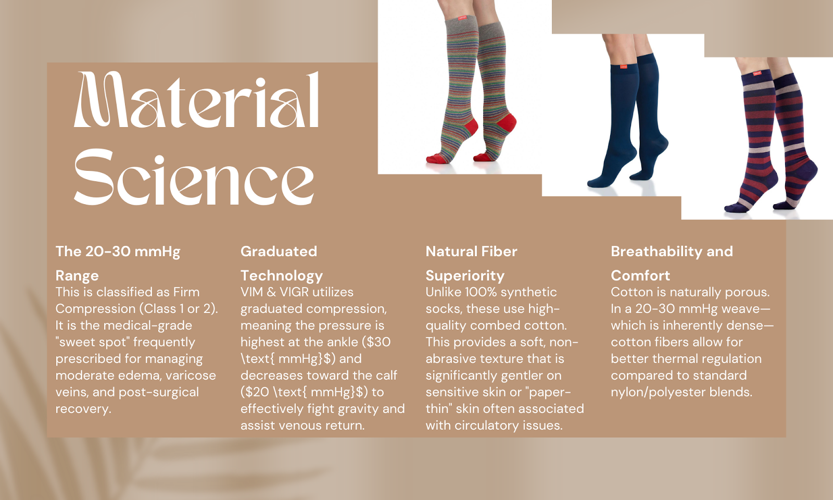
Compression socks work by applying graduated pressure to the lower legs, with the strongest compression at the ankle that gradually decreases upward. This design supports venous blood flow back toward the heart, helping reduce pooling in the legs.
The measurement “mmHg” (millimetres of mercury) refers to the level of pressure applied. A 20–30 mmHg range is widely regarded as moderate to firm compression, often recommended for daily wear by individuals who spend long periods sitting or standing, travel frequently, or want preventative circulatory support.
In the current market, brands including VIM & VIGR illustrate this shift toward everyday wearability, pairing reliable cotton 20–30 mmHg compression socks with design options that feel intentional rather than medical.

Unlike lighter compression levels intended primarily for mild fatigue, the 20–30 mmHg range offers meaningful physiological benefits without requiring medical supervision for most healthy adults. It represents a balance point; effective enough to support circulation, yet comfortable enough for extended, all-day use.
Science behind everyday circulation support
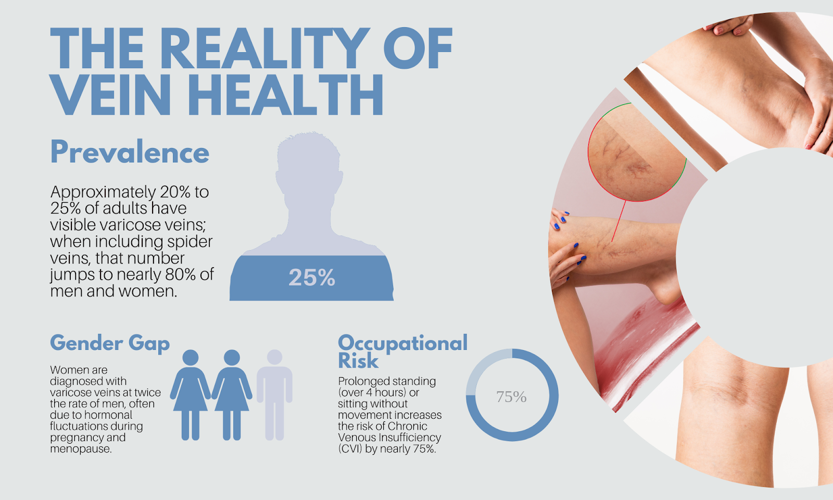
To understand why compression matters, it helps to look at how circulation works in daily life. The veins in the legs rely heavily on muscle movement to help push blood upward against gravity. When movement is limited, during long flights, desk work, or extended standing; this system becomes less efficient.

Over time, this can lead to symptoms such as leg heaviness, swelling, fatigue, or general discomfort. Compression supports the vein walls and valves, improving efficiency and reducing strain on the circulatory system.
Numerous clinical studies have shown that graduated compression in the 20–30 mmHg range can:
Improve venous blood flow
Reduce lower-leg swelling
Decrease feelings of fatigue and heaviness
Support comfort during prolonged sitting or standing
Importantly, this level of compression is often recommended not only for symptom management but also for prevention, addressing circulatory stress before discomfort becomes chronic.
Why cotton matters in compression wear
While compression level is critical, material choice plays an equally important role in comfort. Cotton remains one of the most trusted fibres for everyday wear, particularly in garments worn for extended periods.
In compression socks, cotton offers several advantages:
Breathability: Helps regulate temperature and moisture
Softness: Reduces irritation during long wear
Natural comfort: Feels familiar against the skin
When engineered correctly, cotton blends can deliver firm compression without the stiffness often associated with purely synthetic materials. This is especially important for socks intended to be worn throughout the day; at work, while travelling, or during daily routines.
The result is support that feels natural rather than restrictive, allowing compression to integrate seamlessly into everyday life.
Everyday use: beyond recovery and medical need
One of the most significant shifts in recent years has been the repositioning of compression socks from reactive to proactive wear. No longer reserved solely for recovery or medical use, cotton 20–30 mmHg compression socks are now widely adopted for everyday scenarios.
Common use cases include:
Workdays spent sitting or standing for long hours
Long-haul flights and frequent travel
Extended walking or city exploration
Daily routines that involve prolonged time on one’s feet
For many people, the benefit is subtle but cumulative. Legs feel lighter at the end of the day, swelling is reduced, and overall comfort improves, not through dramatic intervention, but through consistent support.
Travel and compression: a practical necessity
Travel is one of the clearest examples of why compression has become an everyday essential. Long periods of immobility, cabin pressure changes, and dehydration during flights place additional strain on the circulatory system.
Medical professionals frequently recommend compression socks in the 20–30 mmHg range for long-haul travel, particularly for individuals who fly often. The goal is not only comfort, but also circulation efficiency during extended sitting.
Cotton compression socks designed for travel offer an added advantage: they look and feel like everyday wardrobe pieces, not medical equipment. This subtlety matters, especially for travellers who value comfort without compromising personal style.
For travellers who value purpose and intentional comfort, compression socks align with broader lifestyle trends like those explored in Fine Homes & Living’s Luxury Travel With Purpose in 2026.
Comfort without compromise: function meets design
Historically, function and style have existed in opposition; particularly in wellness products. Compression wear was often effective but visually utilitarian, limiting its appeal for everyday use.
That divide has narrowed significantly. Today’s cotton 20–30 mmHg compression socks are designed to integrate into modern wardrobes with clean lines, neutral tones, and refined patterns. The focus is on understated design that complements daily wear rather than drawing attention to itself.
Brands such as Vim & Vigr have played a role in this evolution by approaching compression through the lens of intelligent design, balancing medical understanding with wearability and aesthetic restraint. The result is support that feels intentional rather than intrusive.
Who benefits most from 20–30 mmHg compression?
While compression socks can benefit a wide range of people, the 20–30 mmHg level is particularly well suited for:
Professionals with long workdays at desks or on their feet
Frequent travellers and flyers
Individuals seeking preventative circulatory support
Those experiencing regular leg fatigue or swelling
As with any wellness product, individual needs vary, and those with underlying medical conditions should consult a healthcare professional. For many healthy adults, however, this level of compression offers a practical balance between support and comfort.
A long-term approach to wellbeing
Perhaps the most compelling argument for everyday compression lies in its alignment with long-term well-being. Rather than addressing discomfort after it appears, cotton 20–30 mmHg compression socks support the body proactively; day after day.
This approach mirrors a broader shift in lifestyle and wellness thinking: prioritising consistency over intensity, prevention over reaction. Comfort becomes something designed into daily life, not reserved for moments of recovery.
In this context, compression is not a statement or a trend. It is a quiet investment in how the body moves through modern life.
Redefining the gold standard
The phrase “gold standard” is often overused, but in the case of cotton 20–30 mmHg compression socks, it reflects a genuine convergence of science, material choice, and everyday practicality.
They offer:
Clinically recognised levels of support
Natural comfort through cotton-based construction
Versatility across work, travel, and daily routines
Design that integrates seamlessly into modern wardrobes
As expectations around everyday comfort continue to rise, products that deliver real benefit without excess will define the future of lifestyle essentials.
In a world that rarely slows down, the true luxury lies in support that works quietly, consistently, and intelligently, allowing everyday life to feel just a little lighter, one step at a time.

(0) comments
We welcome your comments
Log In
Post a comment as Guest
Keep it Clean. Please avoid obscene, vulgar, lewd, racist or sexually-oriented language.
PLEASE TURN OFF YOUR CAPS LOCK.
Don't Threaten. Threats of harming another person will not be tolerated.
Be Truthful. Don't knowingly lie about anyone or anything.
Be Nice. No racism, sexism or any sort of -ism that is degrading to another person.
Be Proactive. Use the 'Report' link on each comment to let us know of abusive posts.
Share with Us. We'd love to hear eyewitness accounts, the history behind an article.