

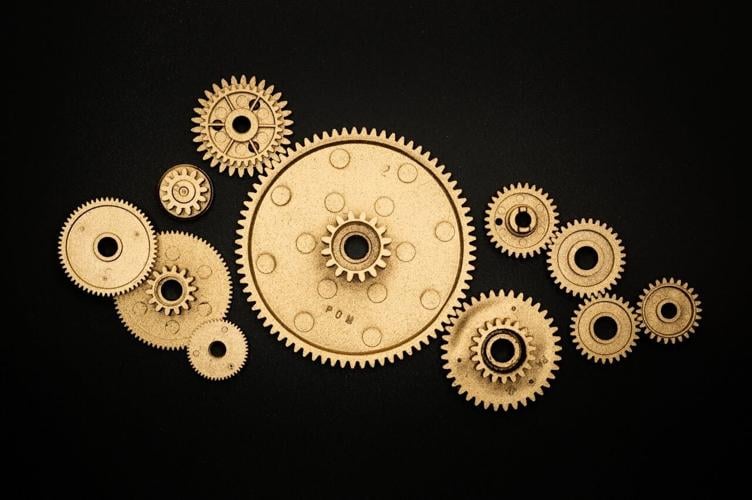

Switzerland built its global reputation on precision long before the digital age. For generations, Swiss watchmaking stood as the clearest expression of that reputation, combining microscopic tolerances, patient assembly, and a deep respect for mechanical perfection. At first glance, that world may seem far removed from semiconductor packaging and microelectronics. One belongs to heritage craftsmanship, the other to cutting-edge industry.
In reality, the connection is much stronger than it appears.
The same mindset that once made it possible to manufacture tiny gears, springs, and escapements with remarkable consistency is now highly relevant in modern electronics production. As components become smaller, more delicate, and more valuable, manufacturers face a familiar challenge: how to maintain absolute precision while scaling output to industrial levels. In that sense, the journey from watchmaking to microchips is not a break from Swiss tradition. It is a continuation of it.
Today, Swiss micro mechanic heritage lives on not only in luxury timepieces, but also in the technologies that support semiconductor packaging, micro component handling, and high precision counting. It is proof that artisan level accuracy still matters, especially when it can be delivered at industrial speed.
Swiss Precision Was Never Just About Watches
When people think of Swiss watchmaking, they often focus on craftsmanship, prestige, and heritage. But behind that image lies something even more important: a long-standing industrial discipline built around the control of very small parts.
Watchmaking demanded far more than aesthetic quality. It required the ability to machine miniature components with consistency, assemble them reliably, and ensure that every piece worked as part of a larger, highly sensitive system. The tolerances were unforgiving. A minor deviation could affect performance, durability, or complete functionality. Over time, this created an engineering culture where precision was not treated as a finishing touch, but as the foundation of the entire process.
That culture did not disappear when Swiss industry expanded into other sectors. It evolved. The skills, habits, and expectations developed in micro mechanical manufacturing became transferable across industries where small scale accuracy defines success. Medical devices, advanced sensors, automation systems, and electronics all benefit from the same disciplined approach.
This is why Swiss precision still carries weight in modern manufacturing. It is not just a story about legacy. It is a story about the kind of industrial thinking that remains essential when products become smaller, faster, and more complex.
What Watchmaking Taught Swiss Industry About Micro Scale Engineering
Swiss watchmaking helped shape more than a famous national identity. It taught industry how to operate at the smallest scales without sacrificing consistency.
One of the most important lessons was that tiny parts demand total process control. It is not enough to design a miniature component. You must also handle it, count it, position it, inspect it, and integrate it into a repeatable production flow. At micro scale, every weakness in the process becomes visible. Slight inaccuracies are magnified. Small inefficiencies turn into costly defects. Manual estimation quickly reaches its limits.
This is where Swiss micro mechanic expertise became so valuable. It combined meticulous engineering with a practical understanding of repeatability. Precision was never only about making one perfect part. It was about creating systems that could reproduce that level of quality again and again.
That same principle now applies directly to modern electronics production. Semiconductor packaging and micro electronics are full of parts and processes that leave very little room for error. Manufacturers need exact handling, stable throughput, and dependable outcomes. In many ways, the industrial challenge is very similar to the one Swiss watchmakers mastered decades ago. The product has changed, but the demand for disciplined precision has not.
From Gears and Springs to Dies and Micro Components
The bridge between traditional Swiss watchmaking and modern semiconductor packaging becomes clear once you look at the manufacturing reality. Both operate in worlds where dimensions are small, tolerances are tight, and mistakes are expensive.
In watchmaking, the challenge was to make miniature mechanical parts function together with perfect reliability. In semiconductor packaging and micro electronics, the challenge is to manage tiny dies, miniature components, and sensitive materials in a way that supports yield, traceability, and production efficiency. While the technologies are different, the core requirement is strikingly similar: small parts must be handled with exceptional control.
This is one reason micro electronics manufacturing places such a high value on accurate counting, feeding, and inspection. At larger scales, minor variation can sometimes be absorbed by the process. At smaller scales, that margin disappears. A counting error, a handling issue, or inconsistent flow can create waste, disrupt downstream operations, and reduce confidence in the system.
That is why modern tech manufacturing increasingly depends on solutions built for precision from the ground up. Not approximate precision. Not manual workarounds. Real, measurable, repeatable accuracy designed for industrial environments.
In that context, Swiss micro mechanic heritage is not a nostalgic reference point. It is a highly relevant advantage.

Why Modern Electronics Need More Than Craftsmanship Alone
As powerful as traditional craftsmanship is, modern manufacturing demands more than human skill by itself. Semiconductor packaging and micro electronics operate at a scale and speed where manual methods can no longer meet production requirements on their own.
This is where the next stage of Swiss precision comes into focus.
The goal today is not simply to preserve artisan standards. It is to translate those standards into automated, scalable systems that can perform with consistency under industrial conditions. That means combining mechanical accuracy with software, sensors, control logic, and process engineering. It means building machines and technologies that can do what skilled hands once did, but at higher volumes, with greater traceability, and with less variation.
This shift is especially important in industries where parts are valuable and processes are tightly controlled. A system that is fast but imprecise creates waste. A system that is accurate but too slow becomes a bottleneck. Manufacturers need both. They need the confidence of craftsmanship and the efficiency of industrial automation.
That is where the phrase becomes more than a slogan. In advanced manufacturing, artisan level accuracy at industrial speed is not a branding exercise. It is a real operational requirement.
How Elmor Reflects a Modern Swiss Engineering Tradition
Elmor fits naturally into this story because it represents a modern expression of the same Swiss precision mindset.
Rather than applying micro mechanical expertise to traditional horology, Elmor brings it into fields where exact handling and counting of extremely small parts are critical to performance. This is a direct continuation of a Swiss engineering tradition that values control, repeatability, and mechanical intelligence at the smallest scale.
What makes this positioning especially compelling is that Elmor is not borrowing the language of Swiss precision as a marketing shortcut. The connection is embedded in the nature of the work itself. In environments such as semiconductor packaging and micro electronics, the need for precise counting and controlled part flow is real, measurable, and economically significant. These are not symbolic qualities. They affect throughput, waste reduction, reliability, and process trust.
That is why Elmor can be positioned so effectively through its Swiss roots. The company stands at the meeting point of heritage and advanced manufacturing. It reflects a broader truth about Swiss industry: the country’s legacy in micro mechanics did not end with watchmaking. It evolved into new technologies designed for the demands of modern production.
In that sense, Elmor is not just part of a Swiss tradition. It is part of the next chapter of that tradition.
Precision Is Now a Strategic Advantage in High Tech Manufacturing
In industries like semiconductor packaging, precision is often discussed as a technical necessity. That is true, but it is also something more. Precision has become a strategic advantage.
When manufacturers can count and handle micro components accurately, they reduce material loss, improve process stability, and create more confidence across the production chain. They are better equipped to support quality standards, traceability requirements, and tighter margins. In a market where every component may carry significant value, precision directly affects efficiency and profitability.
This is one reason the old distinction between craftsmanship and industrial technology no longer holds. The most competitive systems today are often the ones that preserve the discipline of traditional precision while applying it through modern automation. In other words, the future belongs to companies that can industrialize accuracy without diluting it.
Swiss micro-mechanic heritage remains relevant because it offers exactly that way of thinking. It starts with the belief that small details matter, then builds entire systems around controlling those details. That mindset served watchmaking extraordinarily well. Today, it serves some of the most advanced areas of manufacturing just as effectively.
The journey from watchmaking to microchips is not as unlikely as it first sounds. Both worlds depend on the same underlying principle: when working at very small scales, precision is everything.
Swiss industry learned that lesson through centuries of micro mechanical excellence. What began in the world of gears, escapements, and springs now continues in semiconductor packaging, micro electronics, and other advanced manufacturing fields where tiny components must be managed with extraordinary accuracy. The tools may be different, but the engineering philosophy remains remarkably consistent.
For companies operating in these demanding sectors, this heritage still matters. Not because it sounds prestigious, but because it reflects a proven way of solving difficult manufacturing problems. Precision, repeatability, and process discipline are just as valuable in modern tech as they were in traditional horology.
That is why the Swiss story still resonates. And that is why companies like Elmor are so well-positioned within it. They bring artisan level accuracy into industrial reality, showing that the values behind Swiss micro mechanics are not relics of the past, but a powerful foundation for the future of technology.

(0) comments
We welcome your comments
Log In
Post a comment as Guest
Keep it Clean. Please avoid obscene, vulgar, lewd, racist or sexually-oriented language.
PLEASE TURN OFF YOUR CAPS LOCK.
Don't Threaten. Threats of harming another person will not be tolerated.
Be Truthful. Don't knowingly lie about anyone or anything.
Be Nice. No racism, sexism or any sort of -ism that is degrading to another person.
Be Proactive. Use the 'Report' link on each comment to let us know of abusive posts.
Share with Us. We'd love to hear eyewitness accounts, the history behind an article.