
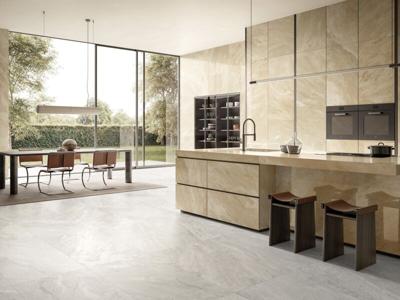

Selecting the right tiles for a minimalist kitchen, therefore, requires discipline. Simplicity does not tolerate inconsistency. Proportion, finish and technical quality must work in harmony to create an environment that feels calm, coherent and enduring.
Defining minimalism in contemporary kitchen design
Minimalism in the kitchen is not about austerity, but about refinement. Clean lines, handleless cabinetry and restrained colour palettes establish a sense of order. Visual clutter is reduced, allowing materials and proportions to speak for themselves.
Within this framework, surfaces become highly visible. Without decorative distractions, even subtle variations in tone or texture stand out. This makes the selection of kitchen tiles particularly significant. Their scale, finish and colour must support the overall concept rather than compete with it.
The role of kitchen tiles in creating visual continuity
Kitchen tiles contribute directly to visual coherence. Large format ones are especially effective in minimalist settings, as they reduce grout lines and create uninterrupted expanses. Fewer joints translate into a cleaner aesthetic and a more expansive feel, particularly in open plan layouts.
Continuity does not require identical finishes on every surface. Instead, harmony can be achieved through tonal consistency and complementary textures. A floor tile in a soft concrete-inspired finish may be paired with wall tiles in a related shade, maintaining unity while introducing subtle depth.
Neutral palettes and material textures
Colour in minimalist kitchens tends towards the restrained: off-white, warm beige, soft grey and muted earth tones. These hues enhance natural light and create an atmosphere of understated sophistication. Kitchen tiles in neutral shades provide a versatile foundation that adapts to changing furnishings or lighting schemes.
Texture plays a crucial role in preventing monotony. In the absence of bold patterns, tactile quality becomes the defining feature. Stone and concrete inspired surfaces are particularly suited to minimalist interiors, offering depth without excess decoration.
Precision in detail: grout lines, edges and finishes
In minimalist design, precision is not optional. Rectified tiles with clean, sharp edges enable narrow grout lines and accurate alignment. This technical refinement reinforces the clarity of the space.
Transitions between floor and wall surfaces should feel deliberate and controlled. Consistency in thickness and careful installation prevent visual disruption. Even minor irregularities can undermine the intended simplicity.
Edge profiles, trims and junctions deserve equal attention. Concealed or minimal detailing supports the overall concept, ensuring that nothing distracts from the essential geometry of the room.
Performance as an invisible design element
Behind the visual simplicity of a minimalist kitchen lies a strong technical foundation. Kitchen tiles must withstand daily use without losing their integrity. Resistance to stains, scratches and moisture is indispensable in such a demanding environment.
Ease of maintenance aligns perfectly with the minimalist philosophy. Surfaces that remain pristine with minimal effort contribute to the sense of order and calm that defines this style. Compatibility with underfloor heating can further enhance comfort while preserving visual purity.
True refinement is often silent. High quality ceramic surfaces deliver durability and reliability without drawing attention to themselves, allowing design to remain the focal point.
Timeless refinement through essential surfaces
Minimalism endures because it is rooted in proportion and material honesty rather than fleeting trends. By choosing kitchen tiles that balance technical performance with restrained aesthetics, it is possible to create interiors that remain relevant over time.
Essential surfaces, carefully selected and precisely installed, define the character of the space. In a minimalist kitchen, tiles do not simply cover floors and walls: they establish the rhythm, clarity and quiet sophistication that make the room feel complete.
Ceramiche Refin: industrial culture and design vision in Italian porcelain stoneware
In contemporary architecture, surfaces shape identity. Materials no longer serve as simple finishes: they define proportion, influence light, and establish atmosphere. Porcelain stoneware has evolved into a structural component of spatial language, balancing aesthetics with performance.
Ceramiche Refin operates within this vision. Founded in 1962 and part of the Concorde Group, the company is one of the most established names in Italian ceramic manufacturing. For more than six decades, it has combined industrial expertise, aesthetic research, and environmental responsibility into a coherent production philosophy.
A defining strength is its fully integrated manufacturing model. Every phase – from creative concept to technical development and quality control – takes place in house. This structure ensures stylistic consistency, high performance standards, and continuity between design intent and final product.
Here, made in Italy represents more than origin – it reflects manufacturing culture, innovation, and long-term reliability. Each collection, from kitchen tiles to bathroom wall surfaces, results from a structured process in which technology and design sensitivity work together to create durable, distinctive materials.
Environmental responsibility is embedded in operations. Low impact technologies, waste recovery, emission reduction, and resource optimization support a certified production system focused on efficiency and transparency.
The collections express diverse yet complementary design languages. INK explores gesture as narrative expression, featuring fluid patterns in 80×80 formats that shift visually depending on light and viewing distance.
OSMOS highlights controlled imperfection, inspired by post-industrial textures. Its tones range from light Calce to deeper Ruggine, with varied formats that allow visual continuity between indoor and outdoor spaces.
PRESTIGIO KALEIDOS offers a dramatic interpretation of material, animated by shifting reflections and layered chromatic nuances. Available in 120×120, 60×120, and 120×278 slab formats, in Matt and Glossy finishes, it expands compositional possibilities through coordinated decorative elements.
Finally, the project RELIEFS represents the brand’s most three-dimensional research, with six sculptural textures that transform walls into dynamic surfaces, generating evolving light and shadow effects.
Through strategic consistency and ongoing innovation, Ceramiche Refin maintains a strong international presence, providing architects and designers with refined, reliable surfaces for contemporary environments.


(0) comments
We welcome your comments
Log In
Post a comment as Guest
Keep it Clean. Please avoid obscene, vulgar, lewd, racist or sexually-oriented language.
PLEASE TURN OFF YOUR CAPS LOCK.
Don't Threaten. Threats of harming another person will not be tolerated.
Be Truthful. Don't knowingly lie about anyone or anything.
Be Nice. No racism, sexism or any sort of -ism that is degrading to another person.
Be Proactive. Use the 'Report' link on each comment to let us know of abusive posts.
Share with Us. We'd love to hear eyewitness accounts, the history behind an article.