
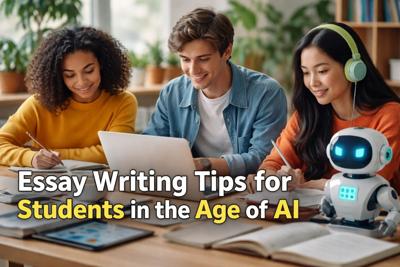
There was a time when essay writing advice sounded charmingly simple: make an outline, avoid procrastination, and please, for the love of your GPA, proofread. That advice still matters. But students are no longer writing in a world of just blank documents, library databases, and mild panic. They are writing in the age of AI, where a chatbot can produce a passable five-paragraph essay in seconds and still leave the student with a paper that sounds polished, generic, and suspiciously like it was written by a very confident toaster. Institutions are rapidly revising guidance around AI because the real issue is no longer whether students have access to it, but whether they are using it in ways that strengthen learning or quietly replace it. According to UNESCO’s work on AI in education, the conversation is increasingly focused on human judgment, learner protection, and responsible use.
The next generation of essay writing will not reward students simply for producing words on a page. It will reward those who can think clearly, organize ideas well, fact-check what technology gives them, and show their own reasoning. That is the new standard. In other words, the future belongs to students who know how to use AI as a tool without turning themselves into unpaid interns for it. These essay writing tips for students are not about pretending AI does not exist. They are about writing better because it does.
Start With Thinking Before Technology
The best essays still begin where they always have: with a point of view. Before opening any AI tool, students should ask what they actually think about the topic, what question they are answering, and what evidence they plan to use. If you skip that step, AI will gladly fill the silence with neat little sentences and suspiciously tidy confidence. The problem is that neat little sentences are not the same thing as real thought. A polished paragraph that says nothing is still, academically speaking, nothing in heels.
This is where strong prewriting becomes more important, not less. Brainstorm first. Jot down your argument in plain language. List three to five supporting ideas before you ask for any digital help. When students can explain their thesis out loud before drafting, they are far less likely to lean on filler, fluff, or borrowed logic. That foundational step also makes AI easier to use responsibly later, because the machine is responding to your ideas instead of inventing the whole intellectual structure for you.
Use AI Like a Tutor, Not a Ghostwriter
This is the line students need tattooed on their frontal lobe. AI can be helpful when it acts like a brainstorming partner, a structure checker, or a revision assistant. It becomes a problem when it writes the assignment for you and you pass it off as your own. That is not efficiency. That is academic roulette. Many schools now permit some AI use for ideation, outlining, or feedback, while still treating undisclosed AI-generated submission text as misconduct or at least as a violation of course policy. Students need to check the exact policy for each class because the rules are not universal. Guidance such as Stanford’s teaching guidance on AI policies makes that especially clear.
The smartest way to use AI is to ask it for help with process rather than product. Ask for possible counterarguments. Ask whether your thesis is too broad. Ask for a cleaner outline based on your own notes. Ask it to point out where your transitions are weak. That keeps the student in charge of the argument while using the tool to sharpen execution. It is the same logic behind making your study process more effective in the first place: systems matter, but the student still has to do the real thinking.
Build a Real Thesis Instead of a Fancy One
A lot of student essays fail for one glamorous reason: the thesis sounds advanced but says almost nothing. AI can make this worse by producing statements that seem polished yet stay frustratingly vague. A strong thesis should make a clear claim, take a position, and point toward how the argument will unfold. If a sentence sounds like it belongs on an inspirational poster in a guidance office, it probably needs work.
One useful test is whether the thesis could spark disagreement. “Technology has changed education” is true, obvious, and about as exciting as beige carpeting. “AI can improve student writing only when it is used to support revision rather than replace original thinking” is more specific and gives the essay somewhere to go. The next generation of writing will reward precision over puffery. Students who can state a clean, defensible argument will have a major advantage over those hiding behind broad, machine-polished generalities. That is one of the most important essay writing tips for students today.
Research With Skepticism, Not Blind Trust
AI can help students find angles, summarize broad topics, and surface questions to investigate, but it is not a reliable source on its own. It can invent citations, flatten nuance, and present errors with unnerving confidence. That means students should never treat AI output as evidence. Use it to accelerate the early stages of thinking, perhaps, but verify every factual claim with credible sources such as academic journals, official reports, university resources, and reputable publications.
This is especially important now because students are being asked not just to gather information, but to evaluate it. That skill matters in school and far beyond it. Students should click through to original sources, confirm quotes, double-check dates, and make sure cited material actually exists. Nothing ruins an otherwise decent essay faster than a beautifully formatted fake citation. For a practical model of responsible use, Purdue’s guidance on generative AI offers useful advice on best practices and academic awareness.
Keep Your Voice Because That Is the Whole Point
One downside of overusing AI is that it sands off personality. Everything starts to sound polished, balanced, and oddly bloodless. Technically correct, spiritually deceased. Good student writing does not need to sound chaotic, but it should sound human. Teachers are not only grading grammar and structure. They are also looking for judgment, interpretation, emphasis, and voice. Those qualities are much harder to fake than people think.
Students should draft in their own natural language first, then refine. That is where style grows. It also makes revision more effective because you are improving something you actually wrote. If you use AI to edit, compare its suggestions against your intent rather than accepting every change. Sometimes the cleaner sentence is not the better sentence. Sometimes the better sentence is the one that sounds like you thought it.
Understand the Real Pluses of AI
To be fair, AI does offer real benefits when used well. It can help students who struggle with organization break a large assignment into manageable pieces. It can generate sample outlines, explain confusing concepts in simpler language, help identify grammar issues, and offer revision prompts that move a rough draft forward. For multilingual students or students who need help getting started, that kind of support can reduce intimidation and make the writing process feel more accessible.
AI can also save time during revision. A student can ask for feedback on clarity, repetition, sentence variety, or paragraph flow. That is a far better use case than asking it to write an entire paper on a novel you barely opened. The strongest students will likely use AI the way strong professionals use assistants: to streamline process, not outsource thinking. It can help you get unstuck. It cannot replace the mental muscle required to develop ideas worth reading.
Be Honest About the Downsides
Now for the less glamorous truth. AI can make students lazier if they let it. That is not an insult; it is a design reality. When a tool makes work faster and easier, people are tempted to skip the uncomfortable parts. Unfortunately, the uncomfortable parts of writing are often where learning lives. Wrestling with a paragraph, refining a thesis, and figuring out how evidence supports a claim are not annoying side chores. They are the exercise.
There are practical risks too. AI may produce incorrect facts, biased framings, fabricated references, or language that sounds polished but empty. There are also privacy concerns when students paste sensitive work, personal data, or proprietary material into third-party systems. So yes, AI can save time. It can also erode judgment, flatten originality, and tempt students into decisions that look efficient until they become embarrassing. These are essential essay writing tips for students because the tool is powerful, but it is not neutral.
Learn the New Academic Etiquette
One major shift in the next generation of essay writing is that disclosure matters. In some courses, using AI for brainstorming may be allowed. In others, even light use may need to be disclosed. In some cases, the professor may prohibit it entirely for a specific assignment. Students cannot rely on vibes here. “I thought it was probably okay” is not a policy. It is a future uncomfortable email exchange.
The smarter move is simple: read the syllabus, look for the AI policy, and ask when the rules are unclear. Students who navigate this well will be the ones who treat AI use the same way they treat citation rules: not glamorous, but absolutely necessary if you would like to avoid academic disaster. Just as creating an effective learning nook at home can support better focus, having a clear understanding of class expectations supports better writing decisions.
Edit Like a Human Being
Even in an AI-heavy world, revision remains where real writing improves. Students should still read essays aloud, trim repetition, strengthen topic sentences, and make sure each paragraph advances the argument. AI can help spot clunky sentences, but it cannot reliably judge whether your paper actually says something meaningful. That call still belongs to the writer.
A good revision checklist now includes both old-school and next-gen questions. Is the thesis clear? Is the evidence credible? Do the paragraphs flow logically? Did I verify every factual claim? Does this sound like me? Could I explain this argument without looking at the screen? That last question matters more than ever. If a student cannot explain what the paper argues, the technology probably did too much of the work. Students looking to speed up their workflow should remember that faster is only better when the ideas stay their own.
The Future of Student Writing Will Be More Human, Not Less
The irony of AI is that it may force education to value human thinking more clearly. If a machine can generate a generic essay in seconds, then originality, analysis, lived perspective, and authentic reasoning become even more valuable. That is not bad news for students. It is actually clarifying. The essays that stand out in the next generation will not just be technically clean. They will be insightful, specific, and grounded in genuine thought.
So yes, students should adapt. They should learn the tools, understand the risks, and use new technology with discipline. But the heart of good writing has not changed. Strong essays still come from clear ideas, credible support, honest revision, and a voice that sounds alive on the page. AI may be the new classmate sitting next to everyone, but it should not be the one turning in the paper. That distinction is where the future of good writing lives. In a world full of shortcuts, the best essay writing tips for students still come down to this: think clearly, write honestly, and use technology without handing over your brain.


(0) comments
We welcome your comments
Log In
Post a comment as Guest
Keep it Clean. Please avoid obscene, vulgar, lewd, racist or sexually-oriented language.
PLEASE TURN OFF YOUR CAPS LOCK.
Don't Threaten. Threats of harming another person will not be tolerated.
Be Truthful. Don't knowingly lie about anyone or anything.
Be Nice. No racism, sexism or any sort of -ism that is degrading to another person.
Be Proactive. Use the 'Report' link on each comment to let us know of abusive posts.
Share with Us. We'd love to hear eyewitness accounts, the history behind an article.