
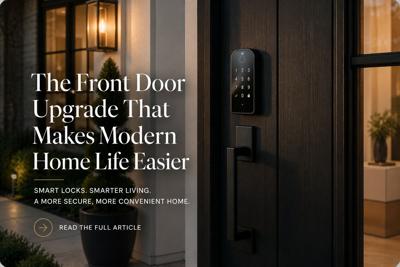

A smart lock may not be the flashiest home upgrade, but it is one of the most useful. It touches daily life in a way many larger smart-home systems do not. You use the front door every day. You leave through it, return through it, welcome guests through it, and rely on it to protect the people and belongings inside.
That is why smart locks have become such a practical entry point into home automation. They add convenience, control, and a more polished sense of security to something every home already needs. For luxury homeowners, frequent travelers, vacation rental owners, and busy families, the appeal is not just technology. It is ease.
The best smart locks in 2026 are no longer awkward gadgets attached to the door. Many are sleek, discreet, and designed to work with today’s connected-home systems. Some offer keypad access, fingerprint entry, app control, voice-assistant compatibility, remote locking, guest codes, and smart-home compatibility. Others keep the exterior of the door looking almost unchanged while adding smart features from the inside.
In other words, a smart lock is no longer just about getting rid of keys. It is about making the home feel more responsive, more secure, and better suited to the way people actually live.
Why Smart Locks Make Sense in 2026
Smart-home technology can feel overwhelming when it starts with full automation systems, cameras, hubs, speakers, and endless apps. A smart lock is different because the benefit is immediate. It solves a problem almost everyone understands: getting in, locking up, and managing access without relying on a physical key every time.
For a household with children, guests, housekeepers, pet sitters, contractors, or visiting family, that can make a noticeable difference. Instead of making extra keys, hiding a spare under a planter, or arranging your day around someone else’s arrival, you can create individual access codes and adjust them as needed.
This also fits into the larger movement toward more intuitive connected homes. The Connectivity Standards Alliance describes Matter as a unifying, IP-based connectivity protocol designed to support more reliable and secure smart-home ecosystems. For homeowners, that matters because the goal is not to collect more apps. The goal is to make devices work together more smoothly.
That same shift is why many homeowners are now looking at broader smart home upgrades to consider as we head into 2026, from lighting and climate control to security and entry access.
No More Searching for Keys
The most obvious reason to install a smart lock is keyless entry. Depending on the model, homeowners can unlock the door with a phone, keypad, fingerprint, card, smartwatch, app, or traditional key backup.
This sounds simple, but it changes everyday routines. You can come home with groceries, luggage, beach bags, or packages and get inside without digging through a purse or pocket. A teenager can enter after school without carrying a key. A guest can arrive before you are home. A trusted neighbor can check on a pet while you are out of town.
For anyone who has ever misplaced a house key, copied too many spares, or wondered who still has access to an old key, the convenience becomes clear quickly. A smart lock helps reduce that loose-key problem by moving access into a system you can manage.
Remote Access Adds Real Peace of Mind
Remote access is one of the strongest reasons to upgrade. When a smart lock is connected through Wi-Fi, a compatible bridge, or a smart-home hub, many models allow you to check the lock status from your phone. You can see whether the door is locked, receive alerts, and in many cases lock or unlock the door from wherever you are.
That feature is useful for travelers, working parents, vacation rental owners, and anyone who has left home in a rush. If you are already on the freeway or at the airport and suddenly wonder whether the front door is locked, you can check instead of worry.
Remote control can also help in practical situations. A contractor arrives early. A family member forgot something. A neighbor needs to get inside during an emergency. Instead of handing out a spare key, you can unlock the door remotely or issue a temporary code.
A Smart Lock Can Still Look Beautiful
One of the biggest changes in smart locks is design. Early versions often looked bulky or overly technical. Today, there are options for modern, traditional, minimalist, and transitional homes.
Some smart locks replace the entire deadbolt with a keypad, touchscreen, lever, fingerprint reader, or more contemporary hardware. Others are retrofit models that attach to the interior side of the door and allow the exterior hardware to remain the same. That can be ideal for homeowners who like their existing door style or live in a home where curb appeal matters.
For luxury homes, this detail is important. The front entry is part of the first impression. The door, hardware, lighting, house numbers, landscaping, and walkway all work together. A smart lock should not feel like a piece of technology randomly placed on the home. It should feel intentional.
The right smart lock can add function without disrupting the look of a carefully designed entry. It can also complement a larger approach to modern expectations of entry points in homes, where access, design, and protection all need to work together.
Guest Codes Are Better Than Spare Keys
A spare key may seem harmless, but it creates problems over time. Keys get lost. Guests forget to return them. Service providers change. Rental guests leave. Former roommates move out. Eventually, it becomes difficult to know who actually has access.
Smart locks help solve that problem with digital access. You can create different codes for different people and remove them when they are no longer needed. Some systems also allow you to see entry activity, which can be helpful for homeowners who want a clearer record of when a door was used.
This is especially useful for people who own vacation rentals or second homes. A guest can receive a code before arrival and lose access after checkout. A housekeeper can have a code that works only on certain days. A dog walker can be limited to a specific time window.
That level of control is much cleaner than hiding a key outside or asking someone to meet every visitor in person.
Package Delivery Has Changed Since the Early Smart Lock Days
Older smart-lock articles often focused on letting delivery drivers place packages just inside the front door. That idea received a lot of attention years ago, but it is not the most comfortable fit for every homeowner today.<a href="https://csa-iot.org/all-solutions/matter/" target="_blank" rel="noopener">Connectivity Standards Alliance</a>
For luxury homeowners, this distinction matters. Convenience should not come at the expense of comfort. The goal is to protect packages while keeping the main living space private.
Security Still Requires Smart Habits
A smart lock can improve convenience, but it should be used responsibly. Connected devices need the same kind of digital care as phones, laptops, and online accounts.
The Federal Trade Commission recommends changing default usernames and passwords, avoiding reused passwords, and using two-factor authentication when available for internet-connected devices. That guidance applies directly to smart locks and other connected-home products.
Homeowners should also keep the lock’s app and firmware updated, buy from reputable brands with clear support policies, and avoid sharing account access casually. If a lock connects to a larger smart-home platform, that platform should be secured as carefully as the lock itself.
Voice control should be handled carefully. Locking a door by voice may be convenient, but unlocking should require extra protection, such as a PIN, when supported. No one wants a front door that responds too easily to the wrong command.
Physical installation matters too. A smart lock cannot compensate for a weak door, loose frame, poor strike plate, or worn-out deadbolt. Before upgrading, check the condition of the door and hardware. In some cases, reinforcing the door frame or improving the deadbolt installation may be just as important as choosing the lock itself.
For homeowners thinking beyond the front door, smart locks can also work alongside cameras, lighting, alarms, and other smart home security systems that are redefining luxury living.
Auto Locking Helps Busy Households
Auto-locking is one of the most practical smart lock features. Depending on the model, the door can lock after a set amount of time or when the system senses that the door has been closed.
This is helpful in homes where people are constantly coming and going. Parents, children, guests, roommates, and service providers may all use the same door throughout the day. Auto-locking can reduce the chance that someone forgets to secure it.
Some smart locks also include door-sensing features that can tell whether the door is actually closed. That matters because a deadbolt turning while the door is open does not protect anything. Door status alerts can let you know if a door has been left ajar, which is useful for side doors, garage entries, guest suites, and vacation homes.
What to Look for Before Buying
Before choosing a smart lock, start with how you actually use the door. Do you want to keep your existing keys? Do you need a keypad for guests? Do you want fingerprint access? Is remote access important? Are you using Apple Home, Google Home, Amazon Alexa, Samsung SmartThings, or another platform?
Compatibility is one of the biggest buying factors in 2026. Matter support is becoming more important because it is designed to help smart-home devices work across different ecosystems. That can make a smart lock easier to integrate into a home that already uses multiple devices.
Current models also show how the category is moving toward more flexible front-door access. The Kwikset Halo Select Plus Wi-Fi and Matter Enabled Smart Lock is one example of a newer smart lock that combines app-based remote access, guest access sharing, activity history, door-status monitoring, Wi-Fi connectivity, and Matter support. For homeowners, the point is not to choose the most complicated lock. It is to choose a lock that fits the door, the household routine, and the smart-home system already in place.
Battery life is another key consideration. Smart locks run on batteries, so homeowners should understand how low-battery alerts work and whether the lock has emergency power options. Many models provide warnings well before the battery dies, but it is still worth knowing the backup plan before installation.
Weather exposure also matters. A lock on a covered entry may have different needs than one exposed to direct sun, coastal air, rain, or heavy temperature changes. For homes near the ocean, finish quality and durability should be part of the decision.
Where a Smart Lock Works Best
The front door is the most obvious place for a smart lock, but it is not the only option. Many homeowners use smart locks on garage entry doors, guest houses, casitas, home offices, wine rooms, pool houses, and short-term rental entrances.
A smart lock can be especially useful on the door people use most often. In some homes, that is not the front door at all. It may be the garage-to-house entry, side door, or back entrance near the driveway. The best upgrade is the one that matches the household’s real routine.
For larger properties, smart locks can also be part of a broader security plan that includes cameras, lighting, gate access, alarm systems, and smart-home automation. The lock should not be treated as the entire system. It should be one strong part of a thoughtful entry strategy.
A smart lock is not about making the home feel more complicated. Done well, it does the opposite. It removes small daily frustrations, improves access control, and helps homeowners feel more confident about who can enter and when.
For modern luxury living, that kind of quiet convenience matters. The best smart-home upgrades are not always the ones guests notice immediately. Sometimes, they are the ones that make leaving, arriving, hosting, traveling, and managing a household feel easier.
If your front door still relies entirely on spare keys and memory, a smart lock may be one of the most practical upgrades to consider in 2026. Choose one that fits your door, your design style, your smart-home system, and your comfort level. The right lock should feel secure, attractive, and effortless every time you come home.
(0) comments
We welcome your comments
Log In
Post a comment as Guest
Keep it Clean. Please avoid obscene, vulgar, lewd, racist or sexually-oriented language.
PLEASE TURN OFF YOUR CAPS LOCK.
Don't Threaten. Threats of harming another person will not be tolerated.
Be Truthful. Don't knowingly lie about anyone or anything.
Be Nice. No racism, sexism or any sort of -ism that is degrading to another person.
Be Proactive. Use the 'Report' link on each comment to let us know of abusive posts.
Share with Us. We'd love to hear eyewitness accounts, the history behind an article.