
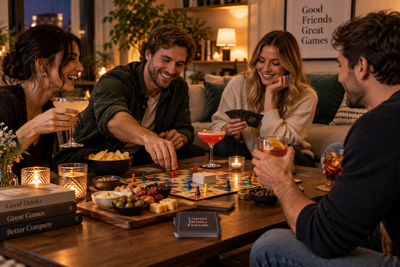
A good game night should feel relaxed, social, and slightly more polished than pizza boxes around a coffee table. Add cocktails, a little structure, and a room that invites people to stay, and an ordinary evening can become the kind of gathering guests are still talking about a few days later.

Give the Night One Clear Shape
The easiest way to ruin a casual gathering is to plan six different parties at once. A host does not need a tournament bracket, a tasting menu, three cocktail stations, and a playlist that took two working days to build. Pick a mood first. Everything else gets easier.
Games should suit both the room and the group. Cards and trivia leave plenty of space for conversation, while a board game can carry a smaller gathering for much longer. Digital play can sit alongside those choices too, from console games to browser-based options such as Kendoo slots, particularly when guests prefer shorter rounds rather than committing the whole table to one game.
A loose sequence keeps the evening moving without making it feel scheduled:
- Start with drinks and conversation while everyone arrives.
- Move into one main game once the group settles.
- Bring out food before attention begins drifting.
- Change the activity only if the room actually wants something new.
That last part matters. Hosts usually notice the mood before anyone says anything. If six people are laughing over the same card game, there is no prize for interrupting them because another activity appeared on the plan.
Build a Bar That Does Not Trap the Host
A cocktail menu works better when it stays short. Two alcoholic choices and one alcohol-free drink give guests some freedom without turning the person hosting into unpaid bar staff. One drink can even come ready to pour before the doorbell rings.
Batch cocktails that tolerate advance mixing, then add sparkling ingredients close to serving time. Spritzes, simple punches, and highballs suit a game night because they require little attention once guests arrive. A six ingredient cocktail that needs individual shaking may taste wonderful. It also has excellent potential to make its creator disappear into the kitchen.
Set up the bar so guests can understand it without asking for directions:
- Keep glassware and ice together.
- Place water where people will actually notice it.
- Prepare one easy garnish instead of several fiddly ones.
- Give the alcohol-free drink its own clear spot.
- Leave enough counter space to put a glass down safely.
The aim is not to recreate a cocktail bar at home. It is to stop every refill from becoming an interruption.
Let the Room Do Some of the Hosting
Bright overhead lighting can make even a beautiful room feel strangely administrative. Lamps, table lights, and candles create a softer setting while leaving enough visibility for cards, food, and drinks. Nobody should need a flashlight to read the rules either. There is a middle ground.
Seating deserves more attention than decoration. Guests need to see one another, reach the game, and stand up without negotiating a maze of side tables. For a larger group, several small seating points often feel more natural than forcing everyone into one perfect circle.
Food should follow the same logic. Small sandwiches, cheese, olives, spiced nuts, flatbread slices, and skewers can be eaten between turns without requiring a formal pause. Saucy wings beside a deck of cards are technically possible. They are also a decision the cards may remember.
Before people arrive, check the surfaces they will actually use:
- Put napkins in more than one location.
- Move drinks away from laptops and game consoles.
- Keep one table clear for the main game.
- Place snacks close enough to reach without crowding the playing area.
Small adjustments save an impressive amount of shuffling later.
Keep the Evening Loose
A polished game night rarely comes from adding more. One or two good drinks, a couple of games, comfortable lighting, and food that works without ceremony already give the evening plenty of shape. The host provides the framework, then lets the group decide how closely to follow it.
Music should sit underneath the conversation rather than fight for attention. Phones can appear when a game needs them or someone wants to change the playlist, but every quiet second does not require filling with scrolling. Sometimes the room simply needs ten minutes to find its own rhythm.
By dessert, nobody should feel as though they have completed an itinerary. The best evenings seem casual because someone removed the awkward bits before the first guest arrived. Drinks are easy to reach, games are ready, chairs are in the right places, and nobody has spent half the night looking for a bottle opener.


(0) comments
We welcome your comments
Log In
Post a comment as Guest
Keep it Clean. Please avoid obscene, vulgar, lewd, racist or sexually-oriented language.
PLEASE TURN OFF YOUR CAPS LOCK.
Don't Threaten. Threats of harming another person will not be tolerated.
Be Truthful. Don't knowingly lie about anyone or anything.
Be Nice. No racism, sexism or any sort of -ism that is degrading to another person.
Be Proactive. Use the 'Report' link on each comment to let us know of abusive posts.
Share with Us. We'd love to hear eyewitness accounts, the history behind an article.