
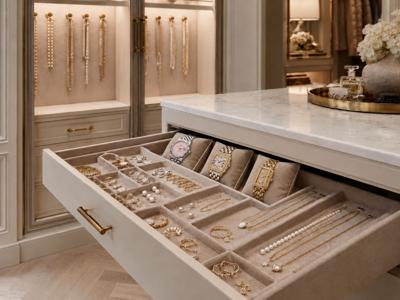

A jewelry organizer should do more than make a collection look attractive. It should prevent necklaces from tangling, keep gemstones from scratching one another, make everyday pieces easy to reach, and protect valuable jewelry from dust, moisture, light, and unnecessary handling.
That is why the prettiest organizer is not automatically the right one. A glass-topped drawer may be perfect for someone with a carefully edited collection of rings and watches, while a wall-mounted cabinet may be far more useful for someone who owns dozens of necklaces. An impressive freestanding armoire, meanwhile, can become an expensive piece of empty furniture when the collection would have fit comfortably into two lined trays.
The right choice begins with what you own, how you get dressed, and where the organizer will live. Readers planning a larger wardrobe overhaul can begin with FINE Magazine’s guide to organizing a luxury closet from shoes to jewelry. Once the broader closet is under control, use this guide to create a jewelry system tailored to the collection itself.
Begin With the Jewelry Rather Than the Organizer
Before buying anything, place the collection on a clean, soft surface and sort it into categories:
- Rings
- Stud and drop earrings
- Short and long necklaces
- Bracelets and bangles
- Watches
- Brooches
- Pearls
- Silver jewelry
- Costume jewelry
- Heirloom or especially valuable pieces
The proportions matter more than the total number of items. A collection of 30 rings requires a very different organizer from a collection of 30 long necklaces.
Also notice which pieces you wear regularly. Everyday jewelry should be visible and convenient. Special-occasion pieces can occupy less accessible drawers, while valuable or sentimental items may need concealed or lockable storage.
This initial edit prevents the familiar mistake of buying an organizer filled with tiny earring compartments when most of your collection consists of bracelets, watches, and statement necklaces.
Choose Drawer Inserts for a Polished Built-In Look
Velvet- or suede-lined drawer inserts are often the strongest choice for a custom closet, dressing room, or closet island. They keep the collection concealed when the drawer is closed while allowing everything to be viewed at once when it is open.
Look for a mixture of compartment shapes rather than a tray divided into identical squares. Padded rolls secure rings. Small sections separate earrings. Wide compartments accommodate watches and rigid bracelets, while long channels hold brooches or shorter necklaces.
The Gemological Institute of America’s jewelry-care guidance emphasizes protecting pieces from scratching and impact damage. Because gemstones vary considerably in hardness and durability, placing an entire collection into one open drawer is not enough. Harder stones and exposed metal edges can damage more delicate materials when pieces slide against one another.
A custom insert should fit the drawer closely so it does not shift every time the drawer opens. Before ordering, measure the drawer’s interior width, depth, and usable height—not the exterior cabinetry.
Use Stackable Trays When the Collection Is Growing
Stackable jewelry trays offer much of the elegance of a built-in drawer without requiring permanent cabinetry. They work inside deep drawers, on closet shelving, or behind cabinet doors.
Their greatest advantage is flexibility. One tray can be assigned to rings and earrings, another to bracelets and watches, and a third to special-occasion pieces. Additional layers can be added as the collection grows.
Choose a modular system that offers several tray layouts within the same dimensions. A collection rarely grows in perfectly equal categories, so a system consisting only of small square compartments can become frustrating.
Place the most frequently used tray on top. Jewelry storage should make dressing easier, not turn the morning into a small archaeological excavation.
Select Necklace Storage Based on Length
Necklaces should generally hang individually or rest in separate elongated compartments. Hooks are usually more practical for long chains, pendants, and layered necklaces because they allow each piece to remain visible and extended.
Before installing hooks, measure the longest necklace. There should be enough vertical clearance for it to hang without pooling on a shelf or countertop. Space the hooks far enough apart to prevent pendants and chains from overlapping.
Short chains and delicate necklaces may be safer in lined drawer channels, especially when the closet is open to dust or strong sunlight. A shallow cabinet with rows of hooks provides a useful compromise by keeping necklaces vertical while allowing the doors to close.
Avoid hanging several delicate chains from one hook. It saves space only until the first knot appears.
Consider a Wall-Mounted Cabinet for a Smaller Closet
A wall-mounted jewelry cabinet makes use of vertical space and can hold an impressive collection without consuming a drawer or countertop. Many versions include necklace hooks, bracelet bars, ring channels, earring panels, and small shelves.
Mirrored cabinet doors are especially useful in compact closets because the same installation provides storage and a dressing mirror. For a more built-in appearance, select a cabinet finish that relates to the closet’s cabinetry and hardware.
Check the cabinet depth carefully. Some shallow designs accommodate chains and earrings but do not provide enough clearance for wide bangles, watches, or statement pieces.
A locking cabinet can add privacy, although a basic furniture lock should not be mistaken for high-security storage. Particularly valuable jewelry may still belong in a properly installed home safe.
Choose an Armoire Only When the Collection Justifies It
A freestanding jewelry armoire can be beautiful in a large dressing room, but it requires both floor space and a collection substantial enough to use it.
Armoires work best for varied wardrobes containing necklaces, watches, rings, brooches, and larger pieces. They are less compelling for someone who owns a small rotation of delicate jewelry, since many of the drawers may go unused.
Inspect the interior rather than choosing solely by the exterior finish. Useful features include full-extension drawers, soft lining, sturdy necklace hooks, compartments deep enough for bangles, and doors that close without pressing against the jewelry.
The armoire should also be stable. A tall, narrow cabinet filled with jewelry should be anchored when appropriate, particularly in homes with children or in earthquake-prone areas.
Reserve Clear and Open Storage for Everyday Pieces
Clear acrylic drawers, glass-topped trays, and open display stands make it easier to see the collection. This can encourage people to wear pieces they might otherwise forget.
However, visibility comes with trade-offs. Open stands collect dust, expose jewelry to environmental conditions, and provide no concealment. Clear acrylic can also scratch, and its hard surfaces should be lined before delicate jewelry is placed inside.
Use open display storage for lower-risk pieces worn frequently, such as a daily watch, a few pairs of earrings, or a small necklace rotation. Keep the rest of the collection in covered compartments.
The result can feel more like a curated dressing area and less like the accessories counter at a department store closing sale.
Give Watches and Bracelets Their Own Compartments
Watches, rigid bracelets, and bangles consume more room than their owners often expect. They should not be squeezed into narrow sections designed for earrings or rings.
Watch cushions can help preserve the shape of bands while preventing cases from knocking together. Make sure the cushion is not so large that it stretches a smaller bracelet or watchband.
Open bracelet bars are convenient for costume jewelry and everyday bangles, but padded individual compartments offer better separation for fine watches and delicate pieces.
Smartwatches also require a practical charging location. A discreet outlet or cable opening near the organizer can prevent the charger from becoming a permanent tangle across an otherwise elegant closet.
Store Pearls and Delicate Gemstones Thoughtfully
Not every gemstone should be stored in exactly the same environment. Pearls, opals, and other delicate materials require more thoughtful handling than ordinary fashion jewelry.
GIA notes that pearls and opals draw moisture from the air, meaning that excessively dry storage can sometimes be harmful. Pearls should also be kept separately from harder gemstones and metal jewelry to reduce scratching.
Use breathable, soft storage rather than sealing every delicate piece inside plastic. Keep pearls away from cosmetics, perfume, hairspray, and household chemicals, and allow recently worn jewelry to dry before returning it to the organizer.
When uncertain about a valuable or treated gemstone, ask a qualified jeweler for storage and cleaning guidance specific to that piece.
Protect Silver From Moisture and Air Exposure
Sterling silver is more vulnerable to tarnishing than many other jewelry materials. GIA explains that exposure to air and moisture can dull silver over time, making careful storage particularly important.
Covered compartments, anti-tarnish cloths, and properly designed storage pouches can help. Avoid storing silver in a humid bathroom or beside a closet humidifier.
Do not place unverified materials directly against valuable jewelry. Some decorative fabrics, glues, plastics, and unfinished wood interiors may release substances that contribute to discoloration or deterioration.
A beautiful organizer is of limited value when its lining is working against the collection.
Keep Fine Jewelry Away From Environmental Extremes
The closet’s location matters. Jewelry should not be stored next to a heating vent, air-conditioning outlet, radiator, humidifier, or area prone to condensation.
Jewelers of America recommends keeping fine jewelry in an organized, clean box in a dry, reasonably temperature-controlled location.
Museum conservation guidance also helps explain why enclosed storage can be beneficial. The Smithsonian Museum Conservation Institute notes that protective enclosures can reduce exposure to dust, abrasion, handling, and light while buffering environmental changes. A residential jewelry drawer is not a museum case, but the underlying principle remains useful: a stable, clean enclosure is generally more protective than an open countertop display.
Avoid placing the primary jewelry organizer in direct sunlight. Light can affect some materials, while repeated temperature changes can create an unnecessarily unstable storage environment.
Decide How Much Security You Actually Need
A concealed drawer may provide privacy, but it does not offer meaningful protection from theft. A small cabinet lock may discourage casual access but can often be defeated quickly.
For valuable jewelry, consider dividing the collection by use. Everyday pieces can remain in the closet organizer, while irreplaceable heirlooms and rarely worn high-value items are kept in a secured safe.
The organizer should not advertise the location of every valuable item. A mirrored cabinet full of jewelry may be attractive, but it is also rather informative to anyone who should not be browsing the closet.
Keep photographs, appraisals, purchase records, grading reports, and insurance information separately from the jewelry itself.
Measure the Closet and the Dressing Routine
Before making a final decision, measure more than the available wall or drawer. Consider door swings, drawer clearance, lighting, electrical outlets, mirrors, seating, and the path used while getting dressed.
A jewelry drawer placed across the room from the mirror may look good in a rendering but become irritating in daily life. Similarly, hooks installed behind hanging clothing will technically fit while remaining nearly impossible to use.
FINE Magazine’s guide to designing a dressing room that combines luxury and function offers additional guidance on coordinating storage, lighting, mirrors, seating, and circulation within the larger space.
The right jewelry organizer should support the natural sequence of getting dressed. Place daily pieces near the mirror or wardrobe area, special-occasion jewelry farther away, and cleaning supplies in a separate nearby compartment.
Leave Space for the Collection to Evolve
Do not buy an organizer that is completely full on the day it arrives. Leave approximately one-fifth of the system available for future pieces, category changes, and gifts.
Expansion does not necessarily require more furniture. Modular trays, adjustable dividers, removable watch cushions, and additional hooks can allow one organizer to change with the collection.
A successful system should also be easy to reset. If returning a pair of earrings requires opening four boxes and lifting three trays, those earrings will eventually live on the countertop.
Choose Protection Before Decoration
The strongest jewelry organizer is not necessarily the largest, most expensive, or most photogenic. It is the one that matches the collection, fits the closet, protects the materials, and makes frequently worn pieces easy to use.
For many homes, the best solution is a combination: a lined drawer for fine jewelry, hooks inside a closed cabinet for necklaces, watch compartments for larger accessories, and a small valet tray for the pieces worn that day.
When every item has a logical home, the collection becomes easier to see and more enjoyable to wear. More importantly, choosing an earring no longer involves searching three drawers, two handbags, and the mysterious little dish beside the bed.
(0) comments
We welcome your comments
Log In
Post a comment as Guest
Keep it Clean. Please avoid obscene, vulgar, lewd, racist or sexually-oriented language.
PLEASE TURN OFF YOUR CAPS LOCK.
Don't Threaten. Threats of harming another person will not be tolerated.
Be Truthful. Don't knowingly lie about anyone or anything.
Be Nice. No racism, sexism or any sort of -ism that is degrading to another person.
Be Proactive. Use the 'Report' link on each comment to let us know of abusive posts.
Share with Us. We'd love to hear eyewitness accounts, the history behind an article.