
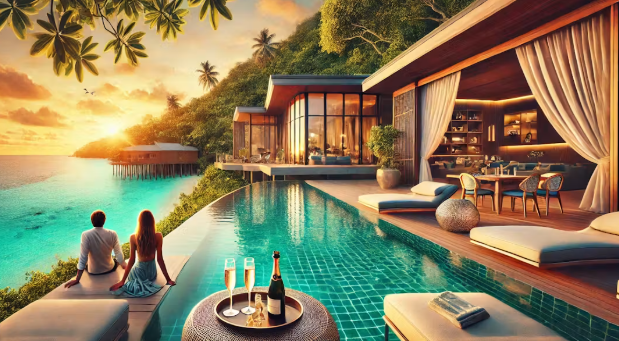
Picture the standard luxury vacation. A lobby with a marble desk. A bellhop. Three restaurants on the property and a spa menu printed on heavy stock. It’s lovely — and it’s also exactly what everyone you know just booked. For a growing share of well-traveled people, that’s the problem. The new flex isn’t a five-star resort with a recognizable name above the door. It’s somewhere quieter, smaller, and considerably harder to reach: a remote lodge, often off-grid, where the staff know your name because there are only twelve of you on the property.
What “Off-Grid Luxury” Actually Means Now
The phrase “off-grid” used to imply a sacrifice. Composting toilets. Bucket showers. A weekend of pretending to enjoy not having coffee. That version still exists, but it isn’t what’s pulling affluent travelers away from resort destinations. Today’s off-grid luxury is something narrower and more interesting — properties that opt out of the standard infrastructure of branded hospitality while keeping the parts guests actually use. Private bathrooms. Radiant heat. Real beds. Hot water. Wi-Fi when you want it, and a polite invitation to leave the phone in a drawer when you don’t. The grid the property gives up is the resort grid — the chains, the rate cards, the predictable menu of activities. What stays is comfort. What goes is the noise.
Why Affluent Travelers Are Making the Switch
A few things are happening at once. First, there’s the saturation problem — the major resort destinations are full of people who travel the same way you do, and they’re posting the same lobby photos to the same group chats. Second, privacy has quietly become a status good. A resort can promise discretion, but it can’t promise solitude; a remote lodge with eight rooms can. Third, the wellness conversation has shifted from spa treatments to actual rest, and rest is harder to find in a resort that’s also a restaurant cluster, a pool deck, and a wedding venue. And finally, there’s a generational tilt — well-off travelers under fifty are increasingly drawn to stays that read like a story rather than a brochure. They want to be somewhere their peers haven’t already been, doing something specific to the place rather than something portable from any beach to any other beach.
What the Best Remote Lodges Quietly Get Right
Strip the marketing away, and the lodges that work share a short list of operational habits. They cap guest capacity low enough that the experience stays personal. They build the price as a single all-inclusive figure — meals, drinks, ground transfers, and most excursions — so guests aren’t pricing add-ons over breakfast. They write the itinerary around the guest, not around a posted schedule on a corkboard, which lets the trip flex to weather, energy, and curiosity. They hire people who know the land they’re working in, not seasonal staff hired to read a script. And they hold the line on the modern comforts that matter — Wi-Fi, hot water, heat — without letting those comforts compromise the dark sky outside the window. A good current example is akcastle.com, an off-grid castle in the Talkeetna Mountains of Alaska, about ninety minutes from Anchorage. The format is the new template in miniature: one booking covers lodging, food, transport, and guided excursions; rooms are positioned to face the aurora when it’s in season; and the property is small enough that “personalized” is a fact about the operation rather than a line of copy. It is not a resort with a forest around it. It is a building in a wilderness that happens to be very comfortable to be in.
How to Choose One — and What to Ask Before You Book
A few questions sort the genuinely good from the merely remote. First, ask what “all-inclusive” actually covers — meals are easy; ground transfers from the nearest airport are the part that separates serious operators from the rest. Second, ask the property’s maximum guest count. If the answer is north of twenty, the experience will be closer to a small hotel than a private lodge. Third, ask whether excursions are off-the-shelf or built around your group; the better lodges will let you change the day. Fourth, pay attention to season. Properties oriented around the northern lights, glacier work, or wildlife viewing have real off-seasons, and the marketing photos rarely make that obvious. And finally, look at who actually owns and runs the place. Owner-operated lodges tend to behave like the people who own them. That can be exactly the appeal — or, occasionally, exactly the problem.
The Quiet Status Symbol
The shift here isn’t about minimalism, and it isn’t about giving anything up. The new luxury looks a lot like the old luxury, with one quiet edit — the resort that everyone recognizes has been replaced by the place no one can find. In 2026, the flex isn’t being seen at the right hotel. It’s being unreachable, in a place that still has stars, in a room you can’t book six months later because someone else has it. The branded resort isn’t going anywhere. It’s just no longer the most interesting choice in the suitcase.


(0) comments
We welcome your comments
Log In
Post a comment as Guest
Keep it Clean. Please avoid obscene, vulgar, lewd, racist or sexually-oriented language.
PLEASE TURN OFF YOUR CAPS LOCK.
Don't Threaten. Threats of harming another person will not be tolerated.
Be Truthful. Don't knowingly lie about anyone or anything.
Be Nice. No racism, sexism or any sort of -ism that is degrading to another person.
Be Proactive. Use the 'Report' link on each comment to let us know of abusive posts.
Share with Us. We'd love to hear eyewitness accounts, the history behind an article.