
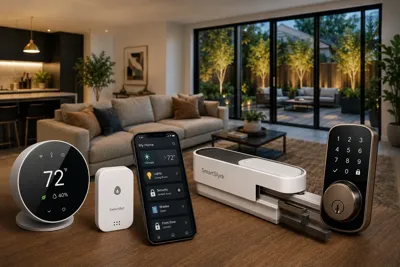

Technology in the home has changed considerably since smart speakers and app-controlled light bulbs first started appearing on every must-have gadget list. In 2026, the more interesting question is not whether a device connects to your phone. It is whether that connection actually makes your home easier, safer, more comfortable, or more efficient.
The most useful smart-home technology has also become considerably less obvious. Instead of filling rooms with screens and gadgets, newer systems tend to work quietly in the background, adjusting the temperature, managing access, detecting problems, cleaning floors, controlling light, and helping homeowners keep tabs on the property when they are away.
Here are some of the home technology upgrades that make the strongest case for earning a place in your house.
A Thermostat That Does More Than Change the Temperature
The thermostat may not be the most glamorous piece of technology in the house, but it controls something homeowners notice constantly: comfort.
Today's smart thermostats have moved well beyond simply allowing you to change the temperature from an app. The Aqara Thermostat Hub W200 is a good example of how much this category has evolved. It combines climate control with a broader smart-home hub, including a built-in Matter Controller and Thread Border Router.
It can also work with compatible temperature and presence sensors elsewhere in the home. Instead of relying only on the temperature measured in the hallway where the thermostat happens to be mounted, the system can respond to conditions in the spaces people are actually using.
That is where smart climate control starts becoming genuinely useful. Aqara says the W200 can use presence information to move into an energy-saving mode when a room is empty and respond again when someone returns.
Rather than asking homeowners to constantly manage another device, the better goal is to make temperature control something they barely have to think about.
Smart Locks That Eliminate the Spare-Key Problem
A key under the flowerpot was never exactly sophisticated security.
Smart locks have become one of the most useful everyday home upgrades because they solve several small problems at once. Homeowners can provide temporary access to guests, housekeepers, contractors, pet sitters, or family members without handing out permanent keys. Depending on the system, they can also check lock status remotely and receive notifications when someone enters.
The newest generation is making the experience even less intrusive. Some systems support fingerprint recognition, phones and smartwatches as digital keys, and proximity-based unlocking.
For homeowners considering this upgrade, FINE's guide to keyless entry for homes looks more closely at how smart locks can fit into a broader home-security plan.
The important point is not how many ways you can unlock a door. It is being able to control access without turning everyday arrivals and departures into a project.
Lighting That Changes With the Way You Use a Room
Good lighting has always been one of the fastest ways to change how a home feels. Smart lighting simply adds another level of control.
Instead of thinking about individual bulbs, think in terms of scenes. The lighting you want while cooking dinner is probably different from what you want when entertaining, watching a movie, reading, or getting ready for bed.
Smart switches, dimmers, fixtures, and automated shades can work together to make those changes almost automatic. A morning setting might open shades and gradually brighten interior lighting. An evening scene can lower light levels throughout the living areas. Exterior lights can respond to sunset rather than relying on a fixed timer.
This is where home automation begins to feel less like gadgetry and more like design. Technology is simply controlling an element that was already important to the room.
Leak Sensors That Can Catch Trouble Early
Some of the most useful home technology is designed to sit quietly in the background until something goes wrong.
Water-leak sensors are a good example.
Placed near washing machines, water heaters, sinks, refrigerators, toilets, or other potential trouble spots, connected sensors can warn homeowners when water appears where it shouldn't.
The SwitchBot Wi-Fi Water Leak Detector makes that type of monitoring particularly straightforward because it connects through Wi-Fi and Bluetooth without requiring an additional hub. It can send real-time leak alerts remotely, making it useful not only for everyday homes but also for homeowners who travel frequently or divide their time between properties.
That may sound far less exciting than a new television or robot, but catching a leak before it becomes damaged flooring, cabinetry, drywall, or a flooded room is exactly the kind of smart-home feature that proves its worth when it matters.
Sliding Doors Are Getting Smarter Too
Most smart-home upgrades automate something electrical. SmartSlydr is interesting because it automates something far more physical: an existing sliding glass door or sliding window.
The motorized system is designed to retrofit onto compatible existing sliders rather than requiring homeowners to replace the entire door. Once installed, it can be operated through a smartphone, Alexa, Google Home, Apple Watch, or optional controls.
For homes built around indoor-outdoor living, there is an obvious convenience factor. A patio door can become part of an automation routine rather than something that always has to be manually opened and closed.
There are practical applications beyond convenience as well. SmartSlydr includes automatic locking when the door closes and can also be used for hands-free access or paired with the company's optional PetPass system for pet access.
This is the sort of smart-home upgrade that would have sounded fairly futuristic a few years ago but now fits naturally into the idea of a house responding to the people living in it.
Security Cameras That Tell You Something Useful
Home security cameras are hardly new, but the experience has improved substantially.
A camera that sends an alert every time a tree moves is not particularly smart. Better systems are increasingly designed to distinguish meaningful activity from background movement and make it easier to see what is happening around entrances, driveways, garages, side yards, and other vulnerable areas.
Placement matters as much as features. Rather than covering every inch of the property, homeowners should identify the locations where visibility actually helps.
Security cameras also work best as one layer of a broader system that may include smart locks, exterior lighting, door and window sensors, alarms, and monitoring. FINE's guide to the essential components of modern home security systems explains how those pieces work together.
Robot Cleaning That Requires Less Babysitting
Robot vacuums have been around long enough that the novelty is gone, which is probably a good thing.
The category has shifted toward making the machines more independent. Higher-end models can now map multiple rooms, recognize obstacles, vacuum and mop, return to a dock, empty debris, wash mop pads, and resume cleaning after charging.
That doesn't mean every homeowner needs one. If a robot requires more cleaning and rescuing than doing the floor yourself, we have somewhat missed the point.
But in larger homes, busy households, or homes with pets, automated floor care can remove one repetitive chore from the schedule. That is exactly where smart-home technology earns its keep.
Smart Shades That Manage More Than Privacy
Automated window treatments sit at an interesting intersection of interior design and technology.
Motorized shades can open in the morning, close when afternoon sun begins heating a room, provide privacy after dark, and coordinate with lighting or climate-control routines.
In homes with tall windows, large expanses of glass, or hard-to-reach treatments, automation can be especially useful. It also eliminates the visual clutter of cords and makes it easier to manage several shades at once.
This is another example of technology being most successful when you barely notice it. The room simply becomes more comfortable.
Air Quality Monitoring Comes Out of the Utility Room
Temperature is only one part of indoor comfort.
Connected monitors can track conditions such as humidity, particulate matter, carbon dioxide, or volatile organic compounds depending on the device. That information can help homeowners understand why a room feels stuffy, overly dry, humid, or uncomfortable.
The useful part is what happens next. When air-quality information can interact with ventilation, filtration, humidification, or other smart-home systems, monitoring moves from interesting data to something actionable.
For homeowners investing heavily in wellness spaces, home gyms, bedrooms, nurseries, or highly sealed energy-efficient homes, indoor-air information is becoming increasingly relevant.
The Best Smart Home Is the One You Barely Think About
The old version of the smart home was largely about showing off what technology could do. The newer version is more restrained.
A house should not require six apps and a technical-support call simply to turn off the lights.
The most successful upgrades remove small annoyances or catch problems before they become large ones. The temperature adjusts without constant attention, doors provide easier access, a leak sensor watches the laundry room, shades respond to the sun, floors get cleaned, and homeowners are alerted when something genuinely needs their attention.
That is ultimately the standard worth using when choosing any new home technology.
If the technology makes everyday life simpler, safer, or noticeably more comfortable, it probably deserves consideration. If its greatest achievement is giving you one more notification on your phone, your house may have been smarter without it.


(0) comments
We welcome your comments
Log In
Post a comment as Guest
Keep it Clean. Please avoid obscene, vulgar, lewd, racist or sexually-oriented language.
PLEASE TURN OFF YOUR CAPS LOCK.
Don't Threaten. Threats of harming another person will not be tolerated.
Be Truthful. Don't knowingly lie about anyone or anything.
Be Nice. No racism, sexism or any sort of -ism that is degrading to another person.
Be Proactive. Use the 'Report' link on each comment to let us know of abusive posts.
Share with Us. We'd love to hear eyewitness accounts, the history behind an article.