
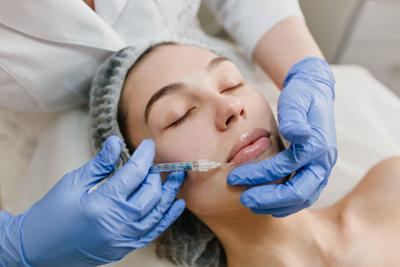

Botox and dermal fillers have become as routine as a facial for many of FINE's readers. Booking a treatment usually starts with the same checklist: good reviews, strong before-and-after photos, and a clean, welcoming space. Almost nobody asks where the product in the syringe actually came from.
That question matters more than it used to. As demand for injectables has surged, so has the number of resellers willing to sell products outside the manufacturer's approved supply chain. Most patients don't learn this until a treatment goes wrong. This piece looks at why product sourcing deserves the same scrutiny as an injector's technique.
Why Sourcing Has Become a Bigger Deal
The medical aesthetics market has grown at a pace few consumer health categories can match. Global estimates put the market at more than $6 billion in 2024, with steady growth projected as injectables move further into mainstream skincare routines. Texas has been one of the fastest-growing markets in the country, with new medspas opening across Dallas, Houston, Austin, and San Antonio.
That growth has a side effect. More clinics means more competition on price, and more pressure on some operators to cut corners on where they buy product. A distributor selling well below market rate is rarely offering a deal. More often, it is a signal the product never came through a manufacturer-approved channel.
Key data points worth knowing:
- The global medical aesthetics market, valued at roughly $6.25 billion in 2024, is projected to top $8.6 billion within a decade.
- Botox alone generates billions in annual revenue, with more than 100 million vials produced each year, which shows how large the incentive is for counterfeiters targeting this one product.
- Industry monitoring groups regularly flag unauthorized resellers as a source of diverted or counterfeit injectables sold outside verified professional channels.
What Counterfeit or Gray-Market Injectables Actually Are
"Counterfeit" and "gray market" get used interchangeably, but they describe different problems. Counterfeit product is fake from the start, sometimes containing the wrong dose or nothing resembling the labeled ingredient. Gray-market product is often genuine but diverted from its intended path, imported or resold by someone without manufacturer authorization. Either way, the buyer loses any guarantee the product was stored or handled correctly.
The risks are not theoretical. Botulinum toxin and dermal fillers are temperature-sensitive biologics, and mishandling can cause:
- Infection at the injection site
- Unpredictable or asymmetrical results
- Botulism-like symptoms from mishandled or counterfeit neurotoxin
- Allergic reactions to unknown filler ingredients
Texas has prosecuted cases involving unlicensed individuals injecting patients with substances never approved for cosmetic use, a reminder that sourcing problems and licensing problems tend to travel together.
How to Become an Aesthetic Injector in Texas?
Understanding who is legally allowed to inject is a useful starting point, because supply chain problems and licensing problems tend to show up in the same clinics. Texas treats cosmetic injections as the practice of medicine, meaning every injection traces back to a licensed physician's authority even when someone else holds the needle.
Who can legally inject:
- Physicians (MDs and DOs) have unrestricted authority to inject, prescribe, and delegate the procedure.
- Nurse practitioners and physician assistants can inject under a formal delegation agreement with a supervising physician.
- Registered nurses can inject when delegated, with documented training and a signed written protocol.
- Dentists can administer neurotoxin and filler within the scope of oral and maxillofacial treatment.
- Licensed vocational nurses, medical assistants, and untrained estheticians cannot legally inject in Texas under any circumstances.
A provider who cannot clearly explain their delegation arrangement or supervising physician is not following the rules Texas has in place to protect patients, and that gap in oversight is often where sourcing shortcuts happen too.
Who Distributes Botox?
Botox is manufactured and distributed in the United States through exactly one authorized manufacturer channel. There is no legitimate secondary source. Any Botox sold outside that channel falls outside the manufacturer's chain of custody, meaning there is no way to confirm how it was stored, transported, or authenticated along the way.
This is also where patients often get confused, since many clinics advertise "neurotoxin" treatments without naming the brand. Botox competes with several other FDA-approved neuromodulators on the market, each manufactured by a different company and distributed through its own tightly controlled, manufacturer-approved network. A reputable clinic will name its product and distributor without hesitation.
Working with a licensed, manufacturer-approved aesthetic injectables supplier in Texas is what actually closes the gap between "this product is popular" and "this product is verified." Legitimate wholesale distributors source their inventory exclusively through manufacturer-approved channels, with proper cold-chain handling and documentation available on request. That kind of traceability is what should exist behind every product a clinic uses, regardless of brand.
Who Can Inject Fillers in Texas?
The same licensing framework that governs Botox applies to dermal fillers. Filler injection is a nonsurgical medical procedure, requiring physician oversight even when a delegated nurse or physician assistant performs the injection. Before booking, it is reasonable to ask:
- Is the injector working under a documented delegation agreement?
- Who is the supervising physician, and are they reachable if a complication occurs?
- What brand of filler is being used, and can the provider show the product box and lot number?
- How is the filler stored between deliveries and appointments?
A provider confident in their sourcing and licensing will answer without friction. Hesitation or an unwillingness to show packaging is worth treating as a signal to look elsewhere.
A Simple Checklist Before You Book
Reviews and photos still matter, but they tell only part of the story. Before committing to an appointment, consider asking:
- What brand and manufacturer is the product from, and can I see the packaging?
- Who is the supervising physician, and is that information available?
- How does the clinic store its injectables?
- Will the clinic show a lot number or invoice on request?
- Does the price seem unusually low compared to other clinics offering the same brand?
A practical limitation: most patients cannot verify a supply chain themselves, and a polished clinic is not proof of proper sourcing. Asking direct questions, rather than relying on appearances alone, remains the most reliable tool a consumer has.
Choosing a medspa has always been about trust, but that trust has typically stopped at the door of the treatment room. The clinics doing this well are transparent about where their products come from, not just how their injectors perform. As injectables grow more common across Texas and beyond, sourcing may be the one question worth asking before any other, because even the most skilled injector cannot make an unverified product safe.
(0) comments
We welcome your comments
Log In
Post a comment as Guest
Keep it Clean. Please avoid obscene, vulgar, lewd, racist or sexually-oriented language.
PLEASE TURN OFF YOUR CAPS LOCK.
Don't Threaten. Threats of harming another person will not be tolerated.
Be Truthful. Don't knowingly lie about anyone or anything.
Be Nice. No racism, sexism or any sort of -ism that is degrading to another person.
Be Proactive. Use the 'Report' link on each comment to let us know of abusive posts.
Share with Us. We'd love to hear eyewitness accounts, the history behind an article.