
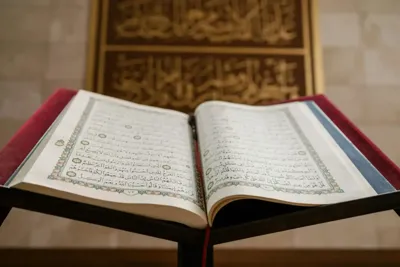

People always want to find meaning in life. We all feel the need to ask some big questions. Why are we here? Why do people go through pain, and how can that fit if there is a good God? How do science and faith go together? Many people have said over time that reason and faith do not agree. Philosophy comes from what people think, but religion is about what God says.
In the Islamic way, this fight between reason and faith is not there. The holy text has strong answers for life’s big questions. To learn what the text says, you need to read closely and think with care. If you read God’s words while thinking about history and simple thoughts, exegesis helps turn old religious ideas into lessons we can use now.
Understanding Exegesis: The Scientific Method of Islamic Thought
Quran Tafsir helps people read and understand the Quran. There are clear steps to learn about the history and purpose of the text. This practice does not follow just one set of ideas or rules. It helps people link the old teachings with reason and facts. People use simple logic and trusted sources from the text for this practice.
People who read these texts often use a simple plan. They read in steps to help them understand.
- Looking at Language & Word Origins: This means studying old Arabic roots, how people speak (Balagha), and how sentences are put together. This helps keep the meaning clear. It also stops people from getting it wrong.
- Looking at History (Asbab al-Nuzul): This checks what was going on in society and politics when certain verses came out.
- Main Ideas Work Together (Tafsir al-Quran bi-l-Quran): This uses other verses to explain a verse. It helps us see a bigger picture. We do not just read single lines on their own.
- Careful Thinking (Tafsir bi-r-Ra'y): This uses clear thinking to answer new questions people have in their lives today. It talks about what is right, what matters now, or science.
Text needs to be readable and comprehensible. According to Pew Research Center, the total number of Muslims in the world is around 2.0 billion. That is 25% more than the total world population. 60% of the Muslims live in areas other than the Middle East, and many among them don’t even know the language Arabic. Simplicity of text ensures clarity for diverse people, and this benefits both the body and soul.
Reconciling Existential Questions Through Rational Exegesis
Exegesis helps people find answers to important questions about life. It brings together what we see, know, and can prove with facts, and what we read as true in faith or from holy books. This gives us clear ways to think about hard problems.
Existential Question | Materialist / Secular View | Exegetical Synthesis (Tafsir Insight) |
|---|---|---|
Purpose of Being | Accidental biological occurrence with self-constructed meaning. | Purposeful creation (Khalaq); humans serve as ethical stewards (Khalifah) entrusted with moral agency. |
The Problem of Suffering | Random cosmic misfortune or systemic biological failure. | A purposeful mechanism for spiritual growth, moral testing (Bala'), and ultimate cosmic justice. |
Origin of the Cosmos | Self-caused singularity or infinite multiverse hypothesis. | A finely-tuned universe (Itqan) designed by an Intelligent First Cause, encouraging empirical exploration. |
1. The Purpose of Human Consciousness
When it comes to the origin of man, the connotation implied by the Quran directs us to contemplate our surroundings. We need to ponder and reflect upon what we see (Tadabbur). Numerous passages ask, "Have you not considered?" or "Have you not thought?" This means that the human brain was not an accidental creation through evolution, but was created for a purpose; and that purpose is to comprehend the "book of nature" in addition to the book of Quran.
2. Pain, Suffering, and Divine Justice
Why do humans have to experience pain? Some humans find comfort in reading holy books and believe that hardships are not due to God’s lack of mercy. Hardships help develop positive qualities in individuals. If there were no difficulties, humans would never learn to be patient, brave, and merciful towards others. Hardships are a part of the bigger plan that will continue unfolding in time until justice is achieved.
Faith and Science: Harmony Over Conflict
Many believe that religion stops science from moving forward. However, by tracing through history, you find out that it was not always like that. The early Islamic scholars believed that gaining new information and science was necessary for them to have a firm foundation of faith. This was their obligation and made their faith firm.
Classical thinkers like Al-Razi and Ibn Kathir added what they knew about space, stars, and health from their own time when they wrote. They said God made everything we read in holy books and also made the world around us. If something is true in science, it will not be different from what the holy text says.
- Cosmological Expansion: Some people look at Surah Dhariyat (51:47) to conclude that there exists a notion about the expansion of the sky. This notion existed for many years. It predates the discovery of the Big Bang by years.
- Embryology & Biology: Surah Al-Mu’minun talks about how a baby starts to grow in the body. These words fit well with how we now see the process today. They are also clear if you read them using old Arabic word meanings.
The Contemporary Need for Exegetical Literacy
In a time when there is a lot of information, problems with mental health, and people feel lost in life, looking deeply into ideas helps people feel more stable and clear in their minds.
- Countering Literalism and Extremism: When people read text in a fast or surface way and take parts away from how they fit in the whole text, they can make big errors in how they see and feel about things. Exegesis asks you to look at where text comes from. This helps keep people safe from being pushed to feel or act in a wrong way by others’ strong ideas.
- Bioethics and Technological Advancement: From tools to new ways to change genes, exegesis gives the right set of rules (Maqasid al-Shariah) to look at change in this world, and not forget what is good or bad.
- Psychological Strength: When you know what decree (Qadar) means in the right way by using exegesis, it lowers deep worry. It helps people feel hope, feel they are not to blame for their own acts, and feel there is sense for them and for us.
Bringing faith and reason together is not about making old words fit today's ideas. It is about finding the truth that is already in God's words. When you read Quran Tafsir, you will see that people looking for truth—researchers, people who want meaning, or anyone who thinks about life—can get one clear view of the world. Careful study helps build faith. Asking real questions with your mind lets you get closer to God's true message.


(0) comments
We welcome your comments
Log In
Post a comment as Guest
Keep it Clean. Please avoid obscene, vulgar, lewd, racist or sexually-oriented language.
PLEASE TURN OFF YOUR CAPS LOCK.
Don't Threaten. Threats of harming another person will not be tolerated.
Be Truthful. Don't knowingly lie about anyone or anything.
Be Nice. No racism, sexism or any sort of -ism that is degrading to another person.
Be Proactive. Use the 'Report' link on each comment to let us know of abusive posts.
Share with Us. We'd love to hear eyewitness accounts, the history behind an article.