
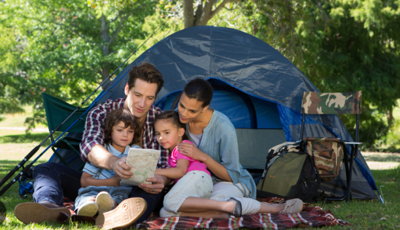

Many families already have a ton of activities they like to do together. The problem is just that: they're activities. They fill up the schedule. And when you fill up the schedule, you need your phone to coordinate schedules. And to check work emails. And reply to your neighbor about bringing in the bins from the curb. Remote camping works because all those things disappear - and therefore aren't available to fill your time (or thoughts).
The first 24 hours are the hardest
A real psychological adjustment happens when a family goes off grid. Kids get restless. Parents feel the phantom buzz of their phones. Someone's always mad about the drive. None of that is a sign something's wrong - it's just the friction of transition, and it disappears way more quickly than you'd think.
By morning two, things start to slide into place. Your body clock resets according to sunlight. Conversations that used to happen in five-minute intervals between all of life's regular tasks now stretch out over hours. You can actually see what your kids are excited about, because they're telling you instead of staring at a TV screen.
Camping can make you feel closer to your family and bring happiness to parents by seeing the adventure in their children's eyes that they won't usually have at home.
Getting there is half the strategy
There is a tangible difference between a campground with power hookups and a truly remote site on dispersed public land. It's the latter that really hits the reset button, but to get there requires a few essentials.
The wrong vehicle prevents you from ever arriving. A capable camper trailer handles rough tracks, carries enough payload for water storage and off-grid power, and gives the family a secure basecamp to return to after a day on the trails. That basecamp matters more than people expect.
A basecamp you can trust to work, and be a safe place to recharge each day, never feels better than when you're miles from anywhere. No one's packing up because the tapwater tastes different and no one's crying in the night from the cold while you're trying to assemble a sooty stove. Solar power from a reliable lithium battery keeps your vital devices running, your LED lights glaring, and your heated blankets heated.
You're suddenly moving, living like some nomads seem to do, entirely on your own terms. For many modern families, this is how you find time to enjoy being a family again. And it plainly cannot be overvalued.
Shared problems build something real
Remote camping allows families to face problems that are impossible to solve alone. Problems like setting up camp before dark, filtering water, or reading a trail without a signal aren't true emergencies. Rather, they are the perfect level of difficulty for bringing a family together to solve as a team.
Children are enriched by camping, gaining situational awareness and practical problem-solving skills when they are actual contributors to the success of the group, not just along for the ride. When a twelve-year-old helps navigate a trail or is responsible for figuring out the camp kitchen, they'll remember that in a way that's different from any classroom achievement. Parents get to see their kids in a new light as well, and it's rare for that new context not to lead to some changes of assumption on both sides.
The shared accomplishment of what we built, where we went, what we figured out becomes a part of how the family tells its story. It's a shared reference that will stick.
What slow living actually looks like
Modern family life is dependent on planning. Sports, appointments, homework, meals - everything needs to be scheduled. While this organization is necessary, it hardly leaves any room for casual conversations that allow families to bond.
When you are camping in the wilderness, things happen differently. Meals are more time-consuming as cooking outside with a cast iron or over a campfire demands time and effort from everyone. Evenings are wide open. You can talk about things that never come up otherwise.
And that's where the real return on the camping trip lies. Not a single moment, but in hours and hours of not having anything else going on. Kids tell you what's happening in their world. Parents give real answers.
A note on doing it right
Remote camping comes with its own set of duties. You'll need to follow the Leave No Trace guidelines, which include proper garbage disposal, wildlife respect, and maintenance of the site. It's not only polite but a precaution to store food while camping as wildlife may be attracted to it, posing a danger to both the animals and your family. Knowing the access and fire regulations/limitations for the area in which you'll be camping on public lands like a state forest or national park is the most important planning you'll do.
None of this is rocket science. It's just basic knowledge that, once your family has it, will serve you well on every campout you take in the future.
The families who return from a remote camping trip aren't usually the families who everything went right for. They're the families who worked through something that went wrong and discovered themselves in the process.


(1) comment
Amazing article !
(Edited by staff.)We welcome your comments
Log In
Post a comment as Guest
Keep it Clean. Please avoid obscene, vulgar, lewd, racist or sexually-oriented language.
PLEASE TURN OFF YOUR CAPS LOCK.
Don't Threaten. Threats of harming another person will not be tolerated.
Be Truthful. Don't knowingly lie about anyone or anything.
Be Nice. No racism, sexism or any sort of -ism that is degrading to another person.
Be Proactive. Use the 'Report' link on each comment to let us know of abusive posts.
Share with Us. We'd love to hear eyewitness accounts, the history behind an article.