
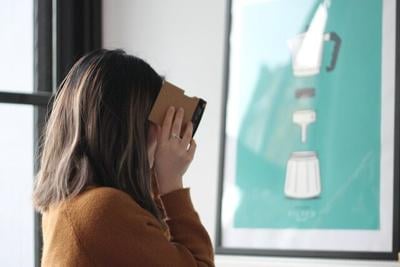

Apple's brand-new product, the Vision Pro AR headset, is truly spectacular. It has the potential to change how we work and play, browse the web, watch movies, and keep in touch with our friends and coworkers. Its only problem is its price - it needs to be more original.
The concept behind the Vision Pro is familiar: others have tried to release products offering the same features. Unfortunately, all of them have failed.
Honorable mention: Meta Quest Pro
The most recent contender is the Meta Quest Pro, released last October by Reality Labs (part of Meta, Facebook's parent company). It is a product meant to be used as much for entertainment as remote work and office tasks. Its size and weight have been seriously reduced compared to the Meta Quest 2, and it has better front-facing cameras that make it much better than its predecessors for mixed reality applications.
But unlike the others, it's also a VR headset capable of running games like Bonelab or Beat Saber. It can even run online casino games through the Quest Browser. Just imagine playing your favorite slot machine on a screen the size of a wall - it's an experience that's hard to match. If you wonder where to find the best slot machines, you can learn more from gamblingsites.org.
Meta Quest Pro is not a failed AR headset - at least not yet. Its initial reviews were mixed, and it has already suffered a serious price cut (to $999 from $1499), which could be a better sign.
Google Glass
Google Glass, introduced in 2013, was the first AR headset that created excitement in this area. Its futuristic design and augmented reality features made it look and feel like a gadget straight out of science fiction. It was certainly an exciting innovation, but it failed at various levels.
The most significant issues with Google Glass were privacy concerns, a high price tag, and a lack of compelling consumer applications. The device faced criticism for potential surveillance and social implications, earning wearers the moniker "Glassholes." The Google Glass Explorer Edition was discontinued in 2015. As expected, Google redirected its efforts towards enterprise applications in sectors like healthcare and manufacturing.
Google Glass contributed to advancements in augmented reality technology. It expanded the possibilities for future development in the field, even though it was a major failure from a consumer point of view.
Microsoft HoloLens
When it was first presented in 2016, Microsoft called the HoloLens a "holographic computer." And the Star Trek community saw it as a "wearable holodeck." And for a good reason: it was able to project holographic images upon the real world, allowing its users to interact with them as if they were truly there.
There was one major issue with it that limited its spread in the consumer space: its price. Incidentally, it was similar to that of the Vision Pro: around $3,000. Besides, it was a bit ahead of its time: it was big, bulky, and heavy, with a limited field of view. It did spread in professional settings, though, where its features like spatial mapping and gesture recognition have proven quite useful.
Microsoft continued to develop HoloLens for years after its initial release. The HoloLens 2, released in 2019, had better FOV, resolution, eye tracking, fully articulated hand tracking, and spatial audio. But its price remained prohibitive: $3,500.
The Redmond giant was working on a third edition of its AR headset until last spring, when it was reportedly scrapped. This year, the company laid off 10,000 employees, most of them from its AR, VR, and HoloLens departments, suggesting that we will be seeing a new headset soon.
Magic Leap One
Florida-based startup Magic Leap has spent four years, between 2010 and 2014, working on a secretive "revolutionary" product. Then it presented its first demonstrations, which the public received with enthusiasm and doubt. Finally, to general disappointment, the Magic Leap One was released: it was a far cry from what was initially promised. Besides, it also had a prohibitive price: it cost $2,300 upon its release.
The Magic Leap One was riddled with the same issues as its predecessors: a lack of applications and a price tag that needed to be lowered. By the end of 2019, Magic Leap only sold about 6,000 units.
Ultimately, the company slashed the headset price to just $500, focused on enterprise users. And in 2020, it got rid of half of its staff, and the management started scrambling for extra funding.
The company released a second iteration of the headset, Magic Leap 2, but once again, its price is prohibitive for the everyday user - $3,200.
Can Apple's Vision Pro succeed?
While its capabilities are pretty much "nothing new," and its price is also very high, Apple's Vision Pro can succeed where the others have failed. First and foremost, it is an Apple product, and these tend to sell well, even if their price is too high for the average pocket. Plus, Apple has a huge network of developers that it can call upon to develop software for its new VisionOS, along with Apple Studios, which will be able to develop immersive experiences for the platform. Its price will eventually decrease, making it more accessible to the masses. All this guarantees that the Vision Pro will finally bring on the AR revolution we've been expecting for the better part of the last decade.
(0) comments
We welcome your comments
Log In
Post a comment as Guest
Keep it Clean. Please avoid obscene, vulgar, lewd, racist or sexually-oriented language.
PLEASE TURN OFF YOUR CAPS LOCK.
Don't Threaten. Threats of harming another person will not be tolerated.
Be Truthful. Don't knowingly lie about anyone or anything.
Be Nice. No racism, sexism or any sort of -ism that is degrading to another person.
Be Proactive. Use the 'Report' link on each comment to let us know of abusive posts.
Share with Us. We'd love to hear eyewitness accounts, the history behind an article.