
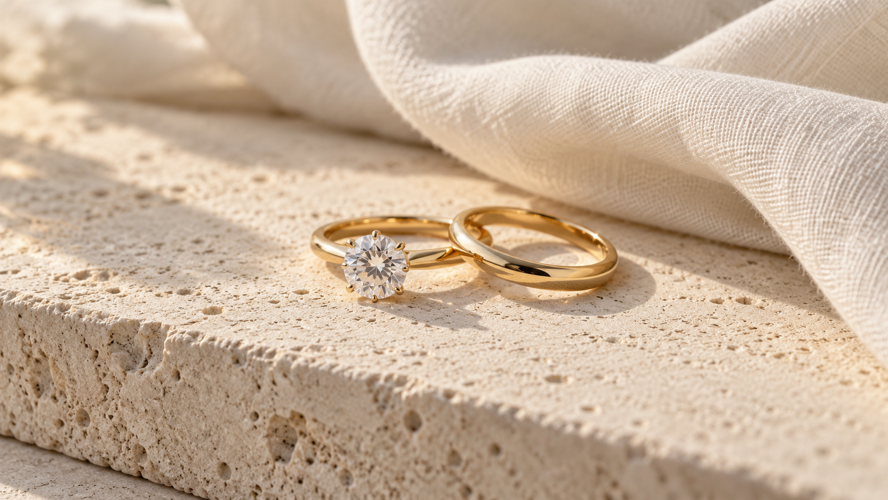
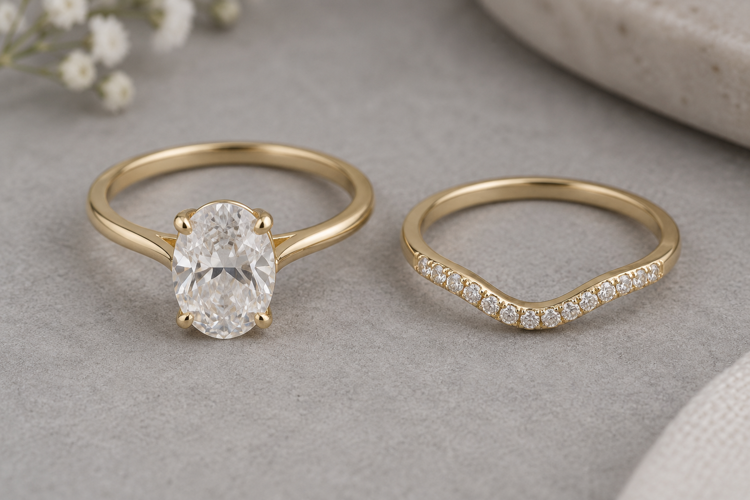

Couples often treat the wedding band as a later decision because the engagement ring gets the dramatic photographs. That is understandable, but it can create a familiar frustration: the engagement ring arrives, a straight band will not sit beside it, and the only close-fitting options change the look or cost of the pair.
You do not need to buy both rings at once. You do need to decide early what kind of relationship you want them to have. The answer affects the setting you choose, the amount of metal you see on the finger, and the budget you should reserve for the complete set.
First Decide Whether a Gap Is a Problem
Some engagement-ring settings sit high enough for a straight wedding band to rest closely against them. Others have a low basket or protruding detail that leaves space between the rings. A contoured or notched band can follow that setting more closely.
None of these outcomes is inherently better. A visible gap can look deliberate, especially with an airy setting or a substantial band. A flush pair can feel clean and architectural. The trouble begins when a buyer assumes one result and receives the other.
Ask to see the engagement ring from the side and next to the type of band you imagine wearing. Do not settle for the phrase “wedding-band friendly.” It can mean several things. Ask whether a straight band sits flush, whether a curve is needed, and how much space will remain if you choose a plain band of a particular width.

Let the Engagement Setting Do Its Job Before You Decorate the Pair
The setting is not a hidden engineering detail. It is the part that decides where the center stone sits, how it is supported, and how the wedding band can approach it.
When browsing Affordable Moissanite Engagement Rings, view the side profile as carefully as the face-up image. A low setting can be comfortable and sleek, but it may ask more of the wedding band. A raised setting can create clearance for a straight band, while changing the ring’s profile on the hand. If you care about both a low feel and a close fit, tell the jeweler those priorities together; do not assume one will automatically follow from the other.
Check physical contact, too. Rings that press against prongs or the base of a setting may need professional assessment before being worn together daily. A still image cannot show every point of contact or movement. This is one of the situations where a plain side view and a direct question are worth more than another round of browsing.
Build the Pair as One Shape, Then Look at It From Normal Distance
Once you know the rings can coexist physically, look at what they do visually. Widths add up quickly. Two slim rings can become a more substantial stack than either product photo suggests, while a detailed band beside a detailed engagement ring can make both designs harder to read.
Choose the visual lead. If the center stone and setting are expressive, a plain band may give them space. If the engagement ring is a clean solitaire, the wedding band can introduce texture, small stones or a curve. Matching sets are one solution, but they are not the only way to create coherence.
Romalar Jewelry lists bridal-ring sets as well as individual engagement and wedding rings. That is useful as a reference point: a set shows one answer to proportion and contour, while a separately chosen pair may suit you better if you have a different preference about metal, width or detail.
Look at the pair from arm’s length, then look at your full hand. Close images make every tiny diamond and engraved edge seem equally important. In ordinary life, the overall line of the two rings is what people see first.
Compare the Complete Cost, Not the Engagement Ring’s Starting Price
The figure attached to an engagement ring is only one part of the decision when a wedding band is planned. A setting that needs a shaped companion band may still be the right choice. You simply need to compare it with the actual alternative, not with a lower starting price for an unrelated design.
When you explore Affordable Engagement Rings, record the cost of the exact configuration you would order: selected stone, metal, size and any changes. Then add the band you would genuinely pair with it. Check whether a product photograph shows one ring or a set, and whether engraving, resizing or shipping changes the final total.
This exercise often makes a decision easier. You may learn that the ring you liked most works with a straightforward band, or that the sculptural option remains worth the added cost of a contoured one. Both are legitimate answers. What is unhelpful is discovering the comparison only after the engagement ring is no longer a choice.
Approve a Pair You Can Describe Clearly
Before production, keep one written record of what is included. It should name the rings, the selected metals, stone measurements, band widths, ring sizes, total price and expected fit. If the wedding band will be bought later, save the engagement ring’s side-view specifications and discuss compatible bands now.
Have the intended finger measured professionally when possible, especially if the pair will be worn together. Do not automatically size up because there are two rings; the appropriate fit depends on their widths and contours.
The best pairing does not need to look as though it came from a single display card. It needs to be a pair whose gap, balance, feel and cost were chosen on purpose.
(0) comments
We welcome your comments
Log In
Post a comment as Guest
Keep it Clean. Please avoid obscene, vulgar, lewd, racist or sexually-oriented language.
PLEASE TURN OFF YOUR CAPS LOCK.
Don't Threaten. Threats of harming another person will not be tolerated.
Be Truthful. Don't knowingly lie about anyone or anything.
Be Nice. No racism, sexism or any sort of -ism that is degrading to another person.
Be Proactive. Use the 'Report' link on each comment to let us know of abusive posts.
Share with Us. We'd love to hear eyewitness accounts, the history behind an article.