
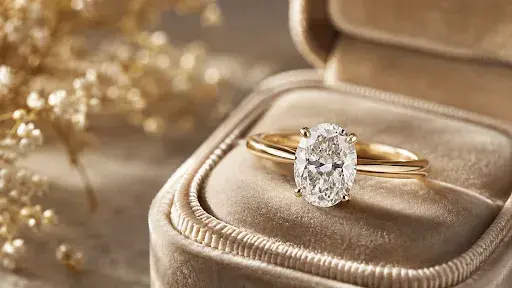
Engagement rings once came with a fairly predictable script: a diamond solitaire, a surprise proposal and a budget supposedly dictated by salary. Today, almost every part of that formula is open for discussion.
Couples are shopping together, comparing natural and laboratory-grown diamonds, resetting family stones, considering colored gemstones and commissioning rings around personal style rather than convention. The most useful modern engagement ring trends are therefore less about what happens to be fashionable this season and more about making informed choices that will still feel right years from now.
Engagement-Ring Shopping Is Becoming More Personal
The biggest change is the disappearance of the idea that there is one “correct” engagement ring.
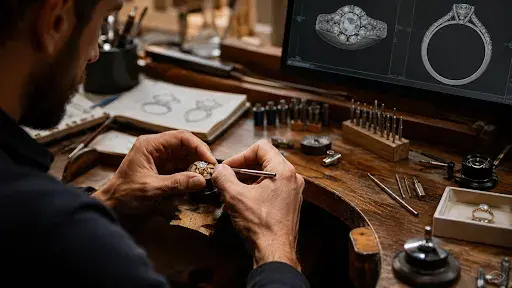
Custom design is part of that shift, but bespoke does not always mean creating an elaborate one-of-one piece from scratch. It might mean lowering a setting, changing a metal, adjusting proportions, adding an engraving, designing the wedding band at the same time or creating a new setting for a family diamond.
Southern California offers a wide range of custom-jewelry options, from North County San Diego to Los Angeles, but the value is less about geography than the greater control buyers now have over the finished piece.
In Carlsbad, Redmond Diamond Center is one North County example, offering custom engagement-ring design along with natural and lab-grown diamond options through a private showroom. The broader takeaway for buyers is simple: ask what can actually be modified and whether those changes improve comfort, durability or meaning—not merely appearance.
FINE’s look at how custom fine jewelry moves from a CAD file to a finished ring is useful reading before commissioning custom work because design and manufacturing decisions can affect stone security, matching bands and future alterations.
Natural or Lab-Grown? Understand What You Are Buying
Natural and laboratory-grown diamonds can look remarkably similar, but their origins and markets are different.
According to the Gemological Institute of America, laboratory-grown diamonds have essentially the same chemical, optical and physical properties as natural diamonds, although their growth histories differ.
GIA also changed its laboratory-grown diamond service in October 2025. For qualifying colorless-to-near-colorless laboratory-grown diamonds, its current quality assessment uses “Premium” and “Standard” classifications based on clarity, color, polish, symmetry and cut rather than the grading nomenclature GIA developed for natural diamonds.
That distinction matters when comparing paperwork.
Natural diamonds may appeal to buyers who value geological origin and rarity. Lab-grown diamonds can often make a larger stone or different design choices accessible within the same budget. Neither is automatically the right answer.
For natural diamonds, understand the 4Cs—cut, color, clarity and carat weight—and review an independent grading report. For a lab-grown diamond, ask which laboratory evaluated it and what that laboratory’s terminology means.
Shape and Alternative Stones Offer More Freedom
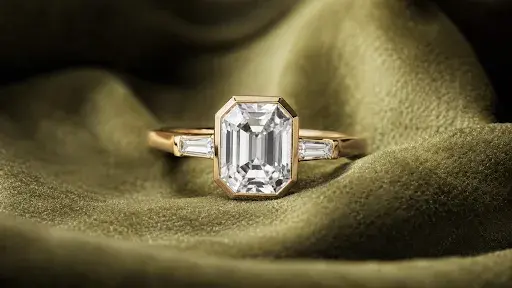
Round brilliant diamonds remain classics, but they no longer dominate every engagement-ring conversation. Ovals, emerald cuts, cushions, radiants, pears and marquises create noticeably different proportions and personalities.
Colored gemstones offer even more variety. Sapphire and ruby, for example, combine distinctive color with durability that can suit frequent wear, while other gemstones may require greater care.
GIA’s colored gemstone engagement-ring guide recommends considering hardness, toughness, stability and treatments before choosing a gemstone intended for everyday use.
Whenever possible, try several shapes on the hand. A stone that looks spectacular in a photograph can feel surprisingly different once worn.
Heirloom and Vintage-Inspired Rings Bring History Forward
Sometimes the most personal ring begins with something already in the family.
An inherited diamond can be reset, an antique ring restored or details such as milgrain and engraving incorporated into a new design. Vintage influence does not have to mean reproducing an antique exactly; it can simply add character to an otherwise contemporary setting.
Before altering an heirloom, have it inspected and documented. Ask whether the stone is suitable for resetting and what parts of the original piece can be preserved.
FINE’s guide to heirloom jewelry and whether to keep, sell or repurpose it offers additional perspective when sentimental and financial value do not necessarily point in the same direction.
Sustainability Claims Deserve Questions
Terms such as “ethical,” “responsible,” “sustainable” and “conflict-free” sound reassuring, but buyers should ask what sits behind them.
For natural diamonds, that might include sourcing policies, origin information or documentation. For the setting, ask whether recycled gold or platinum is available and how that claim is verified. Treatments to diamonds or colored gemstones should also be disclosed.
In Los Angeles, Peter Norman Jewelers offers made-to-order engagement rings with both natural and lab-grown diamond options. The company states that its diamonds are ethically sourced and conflict-free. As with any jeweler making those claims, buyers should ask what sourcing standards, records or origin information support the terminology.
A sustainability label should begin the conversation, not end it.
Forget the Three-Month Salary Rule
There is no universal formula for what an engagement ring should cost.
A realistic budget is one that does not compromise emergency savings, create high-interest debt or interfere with other shared priorities. Decide what feels comfortable first, then determine which elements matter most.
One couple may prioritize the center stone. Another may prefer a more intricate setting, hand engraving or a matching wedding band. Lab-grown diamonds, alternative gemstones and simpler designs can change the cost considerably.
Luxury is not synonymous with maximum spend. A thoughtfully chosen ring that fits comfortably within the couple’s finances is a better beginning than one purchased to satisfy an outdated rule.
Buy for the Life the Ring Will Actually Live

An engagement ring may star in proposal photographs, but afterward it has to survive ordinary Tuesdays.
Someone who works with their hands, regularly wears gloves, exercises frequently or dislikes jewelry catching on clothing may prefer a lower-profile setting, stronger band or protective bezel. Very delicate pavé and high-set stones can be beautiful, but they may require more maintenance.
FINE’s guide to choosing an engagement ring around personal style and lifestyle reinforces why wearability deserves as much attention as appearance.
Before buying, ask about resizing limitations, inspections, cleaning, prong tightening, warranties, returns and repairs. For custom pieces, it is also worth asking whether design records or CAD files are retained.
Craftsmanship matters on day one. Long-term service matters on day 1,000.
The FINE Take
The most significant modern engagement ring trend is not a particular cut, metal or setting. It is the freedom to question old rules.
A ring can be natural or lab-grown, newly made or inherited, quietly classic or unmistakably individual. What matters is whether the buyer understands the stone, trusts the craftsmanship, can comfortably afford the purchase and chooses a design suited to the person who will actually wear it.
Ask better questions before buying: What documentation comes with the stone? How will the setting handle everyday life? Can sustainability claims be substantiated? Who will service the ring years from now?
The most luxurious engagement ring is not necessarily the largest or most expensive. It is the one chosen deliberately enough to remain meaningful long after the proposal.

(0) comments
We welcome your comments
Log In
Post a comment as Guest
Keep it Clean. Please avoid obscene, vulgar, lewd, racist or sexually-oriented language.
PLEASE TURN OFF YOUR CAPS LOCK.
Don't Threaten. Threats of harming another person will not be tolerated.
Be Truthful. Don't knowingly lie about anyone or anything.
Be Nice. No racism, sexism or any sort of -ism that is degrading to another person.
Be Proactive. Use the 'Report' link on each comment to let us know of abusive posts.
Share with Us. We'd love to hear eyewitness accounts, the history behind an article.