
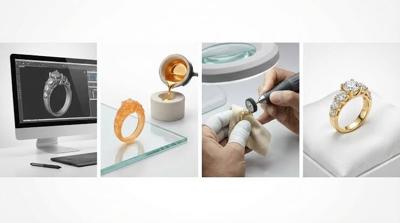

A great deal has been written about choosing a ring the stone, the setting, the metal, where to buy. Comparatively little is written about what happens between that decision and the finished piece arriving in its box.
That gap matters more than it appears. The manufacturing route selected for a custom piece determines the crispness of its detail, the security of its stones, whether a matching band can be produced years later, and how the surface behaves after a decade of wear. Those outcomes are decided in a workshop, not in a showroom, and they are rarely explained to the person paying for them.
Everything begins as a file
Contemporary fine jewelry manufacturing starts in CAD. Designers work in Rhino, Matrix, JewelCAD or Fusion 360, and the model produced there carries every dimension the finished piece will have: band thickness, seat depth, prong diameter, gallery clearance, the exact position of every stone.
This is a genuine change from a craft that was, until relatively recently, dimensioned by eye and hand. It also means the digital file becomes the permanent record of the piece. A house that retains its CAD models can reproduce, resize or extend a design decades later. A piece carved by hand without a digital record cannot be replicated with the same precision, which becomes relevant in circumstances discussed below.
Three routes from file to pattern
Almost all fine jewelry reaches its final form through lost-wax casting, in which a pattern is encased in investment plaster, burned out, and replaced by molten metal. What differs between workshops is how that pattern is produced.
Hand carving remains in use for one-off artistic work. A skilled carver can produce forms that are difficult to describe in CAD, and the process allows judgement to be applied throughout. Its limitation is repeatability: each carved pattern is unique, and matching a second piece to the first is a matter of skill rather than specification.
CNC wax milling cuts the pattern from a solid wax block using rotary tools following the CAD file. Because material is removed rather than built up in layers, milled surfaces are typically crisper and more precisely defined than layer-built alternatives, and the pattern can be refined by hand before casting. The constraint is geometric: subtractive cutting struggles with deep undercuts, enclosed hollows and lattice structures that a tool cannot physically reach.
Additive patterns — produced on SLA or DLP machines from castable resin, or on wax-jetting machines from true casting wax — have been standard production tools across the trade since the mid-2010s, from high-volume houses to bespoke ateliers. Their advantage is geometric freedom: undercuts, hollow interiors and lattice forms present no difficulty, and multiple patterns can be built simultaneously on one plate.
The trade-offs are real on both sides. Layer lines can appear on curved or shallow surfaces where print resolution or part orientation is unfavourable; at the 25 to 50 micron layer thicknesses current machines routinely achieve, these are generally removed during normal post-cast finishing, but they remain a consideration on large flat areas. Photopolymer resins can also leave ash or carbon residue during burnout, producing black spots, porosity or roughness on the casting, and they typically require their own burnout schedules and investment formulations rather than running alongside conventional wax. Wax-jetted patterns avoid most of this, burning out cleanly with negligible residue.
The practical conclusion is that no route is universally superior. Geometry decides. A clean, faceted band with crisp edges often favours milling; an openwork gallery with hollow sections favours an additive pattern.
Why the metal is cast rather than cut
Direct machining of a ring from solid gold or platinum is technically possible and occasionally done, but it is uncommon in the trade for a straightforward reason: subtractive machining converts a substantial share of the workpiece into chips, and in precious metal every gram removed is capital sitting in a swarf bin. Casting places approximately the required quantity of metal into the mould, and the sprues and trees are recovered and remelted.
This is why the machining expertise in a jewelry workshop is usually applied to the pattern and the tooling rather than to the finished article a distinction that surprises people who assume "CNC jewelry" means the ring itself was cut from billet.
Setting precision and stone security
This is the part of the process with the most direct bearing on whether a piece survives daily wear, and the part least visible to the buyer.
A prong or bezel does not simply touch a stone; it holds it against a seat cut to match the stone's girdle. The dimensional relationship between that seat, the stone and the retaining metal is measured in hundredths of a millimetre. A seat cut marginally oversized allows microscopic movement, and movement under daily impact loosens the setting progressively. A seat cut too tight concentrates stress on the girdle, which for some stone types risks chipping during setting itself.
None of this is visible to the naked eye at the point of purchase. A ring with a slightly generous seat looks identical to one cut correctly. The difference emerges after several years, when one stone is still secure and the other has begun to move.
This is also the strongest argument for digital manufacturing in jewelry. A CAD-defined seat, cut by a machine following that definition, is repeatable across every piece. Hand-cut seats depend entirely on the individual setter, which in the hands of a very good one is excellent and in less experienced hands is variable.
Repeatability, and when it matters
Repeatability sounds like a manufacturing concern rather than a customer one. Three common situations prove otherwise.
Matching bands. A wedding band commissioned to sit flush against an engagement ring must follow the same profile and curvature. Where the original exists as a retained CAD model, the band is derived from it directly. Where it does not, the match is approximated.
Resizing. Altering a ring's size changes its geometry, and on pieces with stones set around the shank it changes the relationship between those settings. Work planned against the original model is considerably more predictable than work performed on the piece alone.
Replacement within a set. For suites — earrings, a pendant and a ring designed together — the loss of one element is recoverable only if the design exists in a form that can be reproduced to match the survivors.
Buyers commissioning bespoke work are generally well advised to establish whether the CAD model is retained, and on what terms.
Finishing determines what is actually seen
The surface of a finished piece is the result of a defined sequence rather than a final buff. Castings emerge with an as-cast texture and are worked through progressively finer abrasive stages before polishing, and the number and consistency of those stages is a large part of what separates a piece that reads as expensive from one that does not.
Plating adds a further layer. White gold, which is naturally warmer in tone than its appearance suggests, is commonly finished with a thin rhodium plating to produce the bright white surface associated with it. Rhodium is a wearing surface: it thins with use and is periodically renewed, which is a maintenance requirement rather than a defect, though one that is not always explained at purchase.
Finishing is treated as a specified process across precision manufacturing generally, with the outcome defined before work begins rather than assessed afterwards — the range of polishing and plating options for machined parts documented by contract manufacturers such as Yonglihao Machinery illustrates how many distinct surface treatments sit behind what a buyer perceives as simply "polished". The same logic applies in jewelry: the finish is a decision, and it should be a documented one.
Metal behaviour is not uniform
Gold and platinum are frequently discussed as interchangeable premium options distinguished mainly by colour and price. They behave differently at every stage of manufacture.
Platinum is considerably denser, melts at a far higher temperature than gold, and works differently under tools — it tends to displace rather than remove cleanly, and it work-hardens as it is manipulated. Casting, setting and finishing all require different handling, and platinum work is correspondingly more demanding and more expensive in labour terms independent of metal price.
The relevance to a buyer is that a workshop competent in gold is not automatically competent in platinum, and the difference shows in setting quality and finish consistency rather than in anything apparent at first inspection.
What to establish when commissioning
For anyone commissioning bespoke work, a small number of questions separate workshops that manage these variables from those that do not: whether the design will be produced as a retained CAD model, which pattern method will be used and why that method suits the geometry, whether stone seats are machined to the model or cut by hand at setting, what the finishing sequence is, and whether the piece will be plated and what its renewal interval is likely to be.
None of these questions require technical knowledge to ask, and the quality of the answers tends to be informative in itself.


(0) comments
We welcome your comments
Log In
Post a comment as Guest
Keep it Clean. Please avoid obscene, vulgar, lewd, racist or sexually-oriented language.
PLEASE TURN OFF YOUR CAPS LOCK.
Don't Threaten. Threats of harming another person will not be tolerated.
Be Truthful. Don't knowingly lie about anyone or anything.
Be Nice. No racism, sexism or any sort of -ism that is degrading to another person.
Be Proactive. Use the 'Report' link on each comment to let us know of abusive posts.
Share with Us. We'd love to hear eyewitness accounts, the history behind an article.