
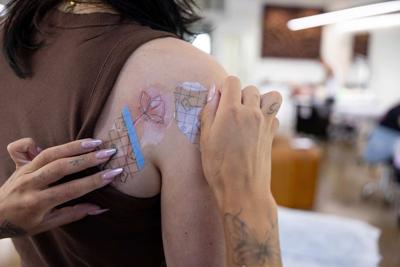

Could your passion for delicate tattoo designs become a creative skill you can build a career around?
Fine line tattooing has become a popular style for people who prefer delicate, understated designs. From small botanical illustrations and minimalist symbols to lettering and intricate line art, the technique allows tattoo artists to create work that can look elegant while still carrying personal meaning.
However, creating a clean fine line tattoo is considerably more demanding than it may appear. Thin lines leave little room for inconsistency, making machine control, hand stability, needle selection, skin stretching and depth control particularly important.
For aspiring artists, a structured fine line tattoo course can provide a foundation for understanding these techniques and developing them through deliberate practice.
Tattooing also sits within Australia's broader personal services sector. Jobs and Skills Australia reports 3,700 people employed as Body Artists, a classification that includes tattooing and other forms of body modification. Its data also shows that 49% of workers in this occupation are female and 51% work part-time.
While employment statistics don't specifically measure fine line tattoo artists, they provide useful context for people considering tattooing as a professional pathway.
So, what does it actually take to develop the precision needed for fine line work?
1. Understand What Makes Fine Line Tattooing Different
Fine line tattooing is built around precision.
Unlike styles that rely heavily on bold outlines and dense shading, fine line work generally uses much thinner lines and subtle details. This can make even a small tattoo surprisingly challenging.
A tiny variation in hand movement can change the appearance of a line. Going too deep can create unnecessary trauma to the skin, while insufficient saturation may result in a line that appears uneven or fades more quickly.
This is why learning the fundamentals is so important.
A fine line tattoo course should introduce you to the technical considerations behind the style rather than focusing purely on creating attractive designs.
You need to understand how your machine, needle, hand movement and skin interact.
The goal isn't simply to make a thin line. It is to create a line that is intentional, consistent and appropriate for the design.
2. Learn Proper Machine Control
Your tattoo machine is one of the most important tools you will use, and learning to control it takes practice.
Beginners often concentrate on the machine itself without paying enough attention to the relationship between machine movement and hand movement.
You need to become comfortable controlling:
- Machine angle
- Hand speed
- Machine speed
- Stroke length
- Needle configuration
- Movement direction
- Consistent positioning
A machine that works well for one artist may not feel right for another. Your technique, hand speed and preferred style all influence how you work.
Training can help you understand these variables so that you're not simply changing settings randomly when something goes wrong.
Once you understand how the equipment behaves, you can make more informed adjustments.
3. Develop a Steady Hand
Fine line work demands excellent hand control.
A perfectly straight line may look simple on paper, but reproducing it consistently with a tattoo machine requires coordination and repetition.
Your hand needs to move smoothly while maintaining an appropriate machine angle and consistent needle depth.
This is where practice becomes essential.
Start with simple exercises rather than immediately attempting complex tattoos.
Practise:
- Straight lines
- Curves
- Circles
- Spirals
- Parallel lines
- Small geometric shapes
- Gradual changes in direction
Synthetic skin can provide a useful environment for practising these fundamentals before progressing to more advanced work.
The aim isn't to complete hundreds of random designs. It is to deliberately practise the movements that you will eventually use in real tattoos.
4. Understand Needle Selection
Needle choice can significantly influence the appearance of fine line work.
Different needle groupings can produce different results, and artists need to understand how their equipment interacts with the design they're creating.
Depending on the technique and desired result, artists may work with small round liner configurations or other specialised needle groupings.
However, smaller isn't automatically better.
Choosing an extremely fine needle simply because you want a delicate tattoo doesn't guarantee a better result.
Your choice should take into account the design, line weight, machine, ink and the skin you're working on.
A fine line tattoo course can help you understand these considerations and develop a more informed approach to equipment selection.
5. Learn Skin Stretching and Positioning
Skin isn't a flat canvas.
It moves, stretches and changes depending on the body part being tattooed. This makes positioning and skin stretching important parts of tattoo technique.
When the skin isn't appropriately stabilised, creating consistent lines can become more difficult.
You need to learn how to position yourself and the client comfortably while maintaining appropriate control over the area you're working on.
Different parts of the body also present different challenges.
A design that is relatively straightforward on a flat area may require considerably more planning on a curved or flexible area.
Understanding these differences helps you approach each tattoo as an individual project rather than applying exactly the same technique every time.
6. Learn About Tattoo Depth
Depth is another fundamental concept in tattooing.
The needle needs to deposit pigment at an appropriate depth within the skin. Working too superficially can affect how well the pigment remains visible, while going excessively deep can cause unnecessary trauma and potentially contribute to problems such as excessive bleeding or blowouts.
Fine line tattooing makes depth control especially important because the style depends on precision.
This is not something that should be learned through guesswork.
Proper education, supervised practice and understanding the relevant health and safety requirements are essential before tattooing clients.
A reputable training programme should place appropriate emphasis on technique and responsible practice rather than simply encouraging students to start tattooing as quickly as possible.
7. Practise Creating Clean Linework
Before attempting elaborate designs, spend time developing basic linework.
You can practise repeating the same movement until your lines become more consistent.
For example, draw a series of:
10 straight lines.
Then:
10 curves.
Then:
10 circles.
Compare the results.
Are the lines similar in thickness?
Do they remain smooth?
Are your curves controlled?
Do your lines wobble when changing direction?
This kind of deliberate practice can reveal weaknesses that aren't obvious when you're simply drawing complete designs.
For additional visual learning, this YouTube beginner tattoo linework tutorial demonstrates lining techniques, machine positioning, hand speed and skin stretching.
Use online tutorials as supplementary learning rather than a substitute for appropriate professional training and practical instruction.
8. Understand Fine Line Design Principles
Fine line tattooing isn't just about technical application.
The design itself needs to work with the technique.
A design containing too many tiny details can become difficult to tattoo cleanly, particularly when reduced to a very small size.
Good fine line designs often depend on simplicity and thoughtful spacing.
When designing a tattoo, consider:
- Overall size
- Line weight
- Negative space
- Detail density
- Body placement
- Proportion
- Long-term readability
Negative space is particularly important.
If every part of a small tattoo is filled with detail, individual elements may become visually crowded.
Sometimes removing a detail actually makes the final tattoo stronger.
9. Learn How Tattoo Placement Influences Design
The human body is three-dimensional, so placement needs to be considered during the design stage.
A tattoo on the forearm may have different visual requirements from one placed on the ribs, shoulder, ankle or upper arm.
The natural shape and movement of the body can influence how a design appears.
Fine line artists need to consider how the tattoo will look when the client is standing, sitting and moving.
Placement can also influence the orientation of the design.
For example, lettering or botanical elements may need to follow the natural direction of the body rather than simply being placed according to the dimensions of a sheet of paper.
This is where artistic judgement becomes an important part of professional tattooing.
10. Develop Strong Stencil Preparation Skills
A good tattoo begins before the machine touches the skin.
Stencil preparation helps you establish the position, scale and orientation of the design.
A stencil should be considered carefully rather than treated as a simple tracing exercise.
Before application, check:
- Size
- Placement
- Orientation
- Alignment
- Proportion
- Client approval
Take time to communicate with the client before starting.
A small change in placement can make a significant difference to the final appearance.
This is particularly important with minimalist tattoos because there may be fewer visual elements to distract from an incorrectly positioned design.
11. Learn Hygiene and Safe Working Practices
Technical skill is only one part of becoming a professional tattoo artist.
Hygiene and infection control are essential.
Tattooing involves breaking the skin, which means appropriate hygiene procedures, equipment handling, workspace preparation and waste management need to be taken seriously.
Australian requirements can vary between states and territories, so aspiring tattoo artists should understand the rules that apply in their location.
Jobs and Skills Australia's description of Body Artists specifically includes maintaining sterilisation equipment and ensuring studio and equipment practices meet health and safety requirements.
This is an important reminder that professional tattooing isn't simply an artistic activity.
It carries responsibilities towards the health and wellbeing of clients.
12. Understand Client Consultation
A technically perfect tattoo can still be a poor experience if the artist doesn't communicate effectively.
Consultation allows you to understand what the client wants and determine whether their expectations are realistic.
Ask questions about:
- Preferred design
- Desired size
- Placement
- Style
- Existing tattoos
- Design modifications
- Long-term expectations
You should also be prepared to explain when a requested design may not be suitable for fine line treatment.
For example, a client may want an extremely detailed image at a very small size.
Instead of simply agreeing, a professional artist should explain how reducing the design or simplifying certain details could improve the final result.
Good communication builds trust.
13. Learn How to Adapt Designs for Different Clients
Not every tattoo should be reproduced exactly as it appears in a reference image.
A client's body, skin and placement are unique.
A good tattoo artist knows how to interpret a reference while creating something that works specifically for the person receiving the tattoo.
You may need to adjust:
- Size
- Line thickness
- Spacing
- Orientation
- Detail
- Shape
- Placement
This doesn't mean changing the client's idea without permission.
Instead, it means working collaboratively to create a design that is both visually appealing and practical to tattoo.
14. Build Your Portfolio Through Practice
Once you begin developing your technique, document your strongest work.
A portfolio allows potential clients to see what you can actually create.
If you're still developing your skills, focus on quality rather than trying to fill your portfolio with dozens of designs.
You might create a collection featuring:
- Botanical designs
- Minimalist animals
- Geometric patterns
- Small symbols
- Fine lettering
- Line-art illustrations
Photograph your work clearly and consistently.
Avoid heavily editing images to the point that they no longer accurately represent your tattooing.
Your portfolio should give clients a realistic idea of your capabilities.
15. Find Your Own Fine Line Style
There are many different approaches to fine line tattooing.
Some artists focus on delicate botanical work. Others specialise in minimalist portraits, ornamental designs, geometric tattoos or fine lettering.
As you gain experience, pay attention to the types of designs you naturally enjoy creating.
Study artists whose work inspires you, but don't try to become a copy of someone else.
Instead, ask yourself:
What do I like about this style?
Is it the simplicity?
The line weight?
The composition?
The subject matter?
The use of negative space?
Understanding what attracts you to particular work can help you gradually develop your own visual identity.
16. Continue Practising After Training
Completing a fine line tattoo course doesn't mean you've finished learning.
Training provides a foundation, but repetition develops confidence and consistency.
Continue practising your drawing and tattooing techniques. Review your completed work and identify areas where you can improve.
You may discover that your curves are stronger than your straight lines, or that your line consistency changes when working around curved body parts.
Those observations give you specific areas to practise.
You can also continue expanding your knowledge through workshops, professional communities and further education.
The goal is continual improvement rather than perfection.
17. Think About the Business Side of Tattooing
If you eventually want to work independently, artistic skill is only one part of the equation.
You'll also need to think about the business side of your career.
Depending on your circumstances, this could include:
- Pricing
- Appointment management
- Client communication
- Marketing
- Social media
- Photography
- Bookkeeping
- Business insurance
- Studio requirements
- Local regulations
Your portfolio may attract someone's attention, but professional communication and reliable service can determine whether that person becomes a returning client.
A successful tattoo career therefore combines creativity with professionalism.
18. Choose Training That Supports Your Goals
Before enrolling in a fine line tattoo course, consider what you want to achieve.
Are you completely new to tattooing?
Do you already have drawing experience?
Are you looking to add fine line work to existing tattoo skills?
Do you eventually want to build a professional tattoo career?
These questions can help you determine what type of education will be most useful.
Look at the course structure, learning outcomes, practical components and support available.
You should also consider whether the training covers more than simply creating fine lines.
A strong foundation should include relevant technical knowledge, design principles, safe working practices and professional considerations.
19. Turn Precision Into a Creative Skill
Fine line tattooing can be incredibly rewarding because it combines technical discipline with artistic expression.
A small tattoo may require considerable planning and precision, but that challenge is also part of its appeal.
The finished piece can be subtle while still carrying significant meaning for the person wearing it.
For aspiring tattoo artists, the process starts with learning the fundamentals.
A dedicated fine line tattoo course can be one pathway for developing your understanding of fine line techniques and building a foundation for continued practice.
The important thing is to approach tattooing responsibly.
Don't rush the learning process.
Develop your drawing skills. Practise on appropriate training surfaces. Learn about hygiene and safety. Understand your equipment. Study skin and placement. And most importantly, keep refining your technique.
Fine line tattooing may look effortless when performed by an experienced artist, but the delicate appearance often hides a considerable amount of technical skill.
Clean lines require control. Small designs require thoughtful composition. Successful results require an understanding of equipment, skin, placement and client expectations.
A fine line tattoo course can help aspiring artists develop these foundations in a structured way, but your development won't stop when the training ends. Consistent practice, careful observation and continued education are what can help turn basic knowledge into genuine skill.
If you're serious about exploring tattooing as a creative profession, start by learning the fundamentals rather than chasing complicated designs.
Master the simple lines first.
Then build from there.
Could your attention to detail be the beginning of your future as a fine line tattoo artist?
(0) comments
We welcome your comments
Log In
Post a comment as Guest
Keep it Clean. Please avoid obscene, vulgar, lewd, racist or sexually-oriented language.
PLEASE TURN OFF YOUR CAPS LOCK.
Don't Threaten. Threats of harming another person will not be tolerated.
Be Truthful. Don't knowingly lie about anyone or anything.
Be Nice. No racism, sexism or any sort of -ism that is degrading to another person.
Be Proactive. Use the 'Report' link on each comment to let us know of abusive posts.
Share with Us. We'd love to hear eyewitness accounts, the history behind an article.