
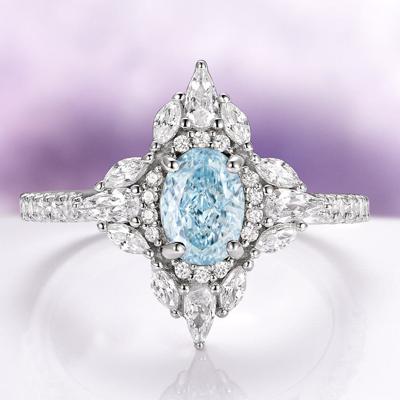
Most explanations of the custom engagement ring process compress it into a friendly diagram: talk, design, make, done. That is not wrong, but it hides the part people actually want to know, which is where the decisions sit. A commission is a sequence of narrowing choices, and at every stage some of those choices are yours and some belong to the maker. Understanding the split in advance is what separates a project that feels collaborative from one that feels like sending a request into a void and hoping. Here is the whole sequence, from the first conversation to the last pass of polish.
Stage one: the brief
Everything starts with a brief, whether or not anyone calls it that. This is where you describe the wearer, the intended feel of the piece, any non-negotiables, and any constraints worth knowing about, such as an existing band it will sit next to or a strong preference about how high a stone can sit. Good briefs are specific about intent and loose about execution. "Something quiet that does not catch on a coat sleeve" is more useful to a maker than a screenshot of a ring you half liked.
This is also where the maker's questions matter more than yours. A workshop that runs commissions properly, like the studio behind Aquamarise.com, will ask about daily wear, hand proportions and what the wearer already reaches for, because those answers quietly rule out a third of the possible designs before anyone draws a line. You decide what the piece is for. The maker decides which questions need answering to get there.
Stage two: stone selection
The center stone is chosen early for a structural reason, not a ceremonial one. Its shape, proportions and depth determine how the setting has to be built. A shallow oval and a deep cushion of similar outline need different heads, different gallery clearance and different shoulder angles. Choose the setting first and you will spend the rest of the project bending it around a stone it was never drawn for.
The customer generally decides the species, the color direction and the outline: sapphire or aquamarine, cool or warm, elongated or round. The maker weighs in on what the specific stone in front of them can support - whether the outline suits a bezel, whether a claw arrangement will read as balanced, whether a particular cut wants a lower profile to look right in the hand rather than only in a photograph.

An elongated oval sets the terms for everything above and below it: head height, shoulder angle and how much gallery detail the design can carry.
Stage three: design direction
With a stone chosen, the brief becomes a form. This is the stage where words turn into geometry, and it usually produces a small number of distinct directions rather than one answer. A vintage leaning treatment with milgrain and a decorated gallery is a different proposal from a clean modern bezel, even when both start from the same stone and the same conversation.
Your job here is to react honestly, including to the parts you dislike. Makers learn as much from a clear "the shoulders feel heavy" as they do from enthusiasm. Their job is to keep the design coherent: to notice when a request borrowed from one direction will fight the logic of another, and to say so before it gets built into a model.
Stage four: rendering and approval
For solid gold and platinum work, the agreed direction is modeled in three dimensions and rendered. This is the most useful and most misread stage of the whole process. A render is highly accurate about proportion, profile, symmetry, stone placement and how the piece will sit against a finger. It is genuinely unreliable about sparkle, about how light moves through a translucent stone, and about the exact warmth of a metal color on skin. Read it for architecture, not atmosphere.
Revisions belong here, which is exactly why studios offering custom engagement rings build approval into the sequence and keep revising until the model is signed off. Once approval is given, the design closes: the model becomes the instruction set for production, and changes after that point mean going backward rather than adjusting forward. Spend your attention here. Rotate the model, look at it from the side, ask about the height and the underside, not only the flattering three-quarter view.
Stage five: production
An approved model can be realized by two broadly different routes, and the choice is the maker's rather than yours. Lost-wax casting grows or carves a wax pattern, invests it, burns it out and fills the void with metal. It handles organic and complex forms well and reproduces fine detail faithfully. Hand fabrication builds the piece from stock metal - sawing, forming, soldering - and suits crisp geometry, sharp edges and situations where the maker wants to judge and adjust as the piece takes shape.
Neither route is the premium one. They are different tools. A sculpted, flowing gallery is a casting job; a severe flat-topped band with knife-sharp shoulders often wants fabrication. What you should expect is a reason, not a slogan, if you ask which route your piece is taking.
Stage six: setting and finishing
The raw piece that comes out of production is not the finished object. Sprues are removed, surfaces are filed and pre-polished, the seat for the stone is cut, and the stone is set - a slow, irreversible operation where the metal is moved by hand around the stone with the stone already in place. Then comes final finishing: the polish, or the brushed or matte texture chosen earlier, and the detailing of edges and the interior of the band.
This stage is almost entirely the maker's. Your decisions were made upstream. What finishing determines is whether all those decisions read cleanly - whether the claws look intentional, whether the transitions are smooth, whether the piece feels resolved when it turns in the light.
Where the line between your call and theirs actually falls
Across the whole commission process, the split is consistent enough to summarize. You decide intent, stone, style direction, and approval. The maker decides structure, engineering, production route and execution. The overlap sits in stages three and four, where a proposal goes back and forth until it is right.
Understanding that division is the practical benefit of knowing the stages. A custom made engagement ring is not built by handing over a picture and waiting. It is built by being precise where your input carries weight and trusting the workshop where theirs does, which is exactly why a custom engagement ring rewards people who engage early and stay engaged through the approval stage rather than only at the end.

(0) comments
We welcome your comments
Log In
Post a comment as Guest
Keep it Clean. Please avoid obscene, vulgar, lewd, racist or sexually-oriented language.
PLEASE TURN OFF YOUR CAPS LOCK.
Don't Threaten. Threats of harming another person will not be tolerated.
Be Truthful. Don't knowingly lie about anyone or anything.
Be Nice. No racism, sexism or any sort of -ism that is degrading to another person.
Be Proactive. Use the 'Report' link on each comment to let us know of abusive posts.
Share with Us. We'd love to hear eyewitness accounts, the history behind an article.