


A pristine designer handbag once represented the safest form of luxury. Keep the leather unmarked, preserve the hardware and, for heaven’s sake, do not take a paintbrush anywhere near it.
Philip Karto has built an atelier around doing nearly the opposite.
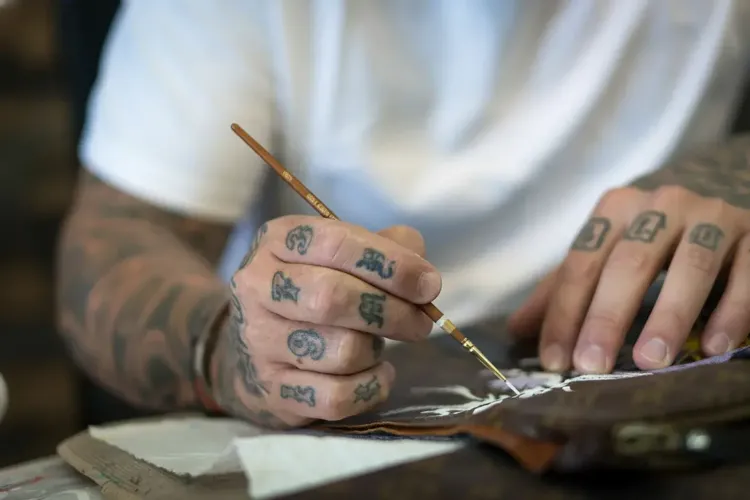
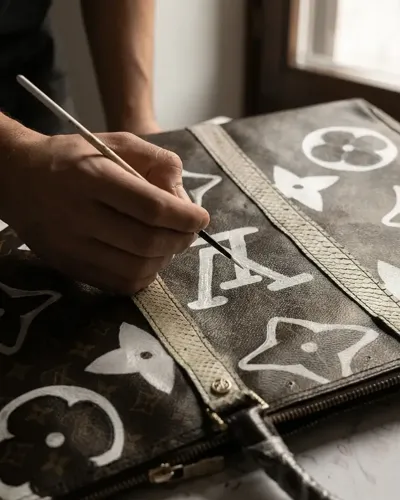
Working with authenticated vintage bags from recognizable heritage houses, the French-born artist dismantles, restores, paints and reconstructs each piece by hand. Familiar silhouettes emerge wearing pop-art imagery, comic-book references, provocative lettering and the occasional visual wink that would never make it past a traditional luxury house’s approval committee.
The result is neither a conventional vintage bag nor a standard customization. Karto sees each finished piece as a documented work of wearable art—one intended to retain the history of the original object while refusing to be defined by it.

The Appeal of a Bag That Has Already Lived
Karto was never interested in starting with something anonymous.
“A vintage bag already carries a life within it—the places it has traveled, the hands that have held it, the years visible in its leather,” he says. “That history gives me something to respond to.”
That point of view feels particularly relevant as luxury consumers reconsider the assumption that the newest item is automatically the most desirable. The secondary market has made vintage bags easier to locate, authenticate and collect, while buyers have become more comfortable with pieces that show some evidence of a previous life. The RealReal’s 2025 resale report found sales of items classified in fair condition had increased by 32 percent, suggesting that visible age is no longer necessarily treated as a luxury defect.
For Karto, however, the attraction is not simply that the bag is old. It is that the object arrives with a design language, cultural reputation and physical history already attached.
“When I first painted on a heritage bag, the gesture felt almost forbidden, and that tension interested me,” he says. “I did not want to erase its identity. I wanted to create a new chapter for it.”
Inside the Philip Karto Atelier

A finished Philip Karto bag may appear spontaneous, but the process is considerably more involved than painting over an intact surface.
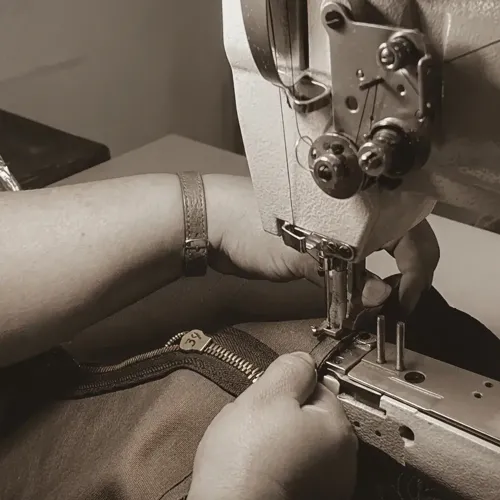
Each project begins with a carefully sourced, authenticated vintage bag. After its condition is assessed, the piece is completely dismantled by hand inside the brand’s Miami atelier. The canvas, leather, lining, hardware and structural elements are separated so the team can work with the bag as a complete material composition.
Individual panels are prepared and restored before Karto applies the artwork by hand. Artisans then reconstruct the bag while preserving its intended proportions and functionality.
The completed work is inspected, signed, numbered and entered into the atelier’s registry. Even the original components removed during reconstruction accompany the finished bag, maintaining a physical record of what came before. It is an unusually thorough process for an object that, at first glance, might be dismissed as simply “customized.”
“The objective is restoration, not erasure,” Karto explains. “If we removed every trace of time, we would also remove the reason for choosing a vintage foundation in the first place.”
That means a softened handle, variation in the canvas or naturally developed patina may remain. The bag should look renewed, but it should not pretend that its history never happened.
French Discipline Meets Miami Rebellion
Karto’s aesthetic sits somewhere between the South of France, where he grew up, and Miami, where he established the atelier.
He credits France with giving him an understanding of proportion, craftsmanship and restraint. Miami supplied a considerably louder set of influences.
“It is a city where cultures collide and where excess can become a language of its own,” he says. “The French side brings discipline and savoir-faire; Miami brings irreverence and confidence.”
That contrast explains why the bags can be meticulously constructed without feeling overly polite. One may feature expressive lettering, another a collage of cultural imagery or a face that looks as though it has wandered in from a particularly glamorous underground art show.
Karto’s recurring rock-and-roll influence is less about reproducing a specific era than embracing its lack of obedience.
“It represents freedom, imperfection and the courage to make something that will not be accepted by everyone,” he says.
The atelier’s forthcoming capsule is appropriately titled Not For Everyone.
Customization Is Not Necessarily Art

Luxury customization is hardly new. Monograms, made-to-order color combinations and private commissions have long allowed buyers to personalize expensive possessions. Karto draws a firmer distinction between fulfilling a customization request and creating a collectible artwork.
“For me, the difference lies in authorship, intention and coherence,” he says. “Customization responds primarily to a client’s request. Art must also express the creator’s point of view.”
A recognizable artistic language matters. So does the willingness to reject an idea that does not belong within it.
Private clients can participate in the commission process by discussing imagery, color palettes and personal history. Karto will not, however, reproduce an existing one-of-one piece exactly, nor will he accept every proposed design.
“The client brings the personal meaning; I bring the artistic interpretation,” he says.
That balance prevents the finished bag from becoming an extremely expensive version of ordering initials on a tote.
What Happens to Traditional Collector Value
The obvious question is also the most contentious. What happens to the conventional resale value of a heritage handbag after it has been dismantled and painted?
Karto does not argue that an altered bag should be assessed in the same way as an untouched vintage example. Instead, he views them as separate collecting categories.
“An untouched vintage bag derives its value from condition, rarity and historical fidelity,” he says. “A Philip Karto piece derives its value from transformation, artistic authorship and singularity.”
The distinction is important. Traditional handbag collectors may prioritize original materials and pristine condition. A collector purchasing one of Karto’s pieces—currently priced from approximately $3,400 to $34,000—is choosing a work whose value proposition rests on creative intervention rather than preservation alone.
Each piece is authenticated, numbered and documented to establish provenance within the atelier’s own history. Once sold, the artwork is not repeated in precisely the same form.
For buyers who already have access to conventional luxury, that singularity may be the point.
“They are not looking for access; they already have access,” Karto says. “They are looking for distinction.”
A Second Life Without the Sustainability Speech
The fashion industry frequently uses the word sustainability until it begins to mean almost anything. Karto is careful not to position the atelier’s process as an environmental miracle.
“I do not believe sustainability should be used as a decorative claim,” he says. “Our primary purpose is artistic.”
Still, the practical model begins with an existing object rather than manufacturing a new foundation. Usable materials are preserved, removed parts remain with the finished piece and the bag is reconstructed for continued use.
It is a more convincing approach than attaching a vague green claim to an otherwise conventional production cycle. The process extends the life of an object while also making it desirable for a different reason.
The bag is not merely saved. It is given enough personality to begin causing trouble again.
Luxury Beyond Perfection
Karto’s work arrives during a broader shift in how collectors interpret status. A recognizable logo still communicates expense, but familiarity alone is not always enough to make an object feel rare.
FINE has previously explored why craftsmanship, longevity and resale value continue to support the appeal of luxury bags. Karto adds another consideration: artistic authorship.
A heritage silhouette provides instant recognition, but the hand-painted composition prevents the bag from quietly blending into a room filled with similar purchases. It may provoke admiration, confusion or debate. Indifference is less likely.
Nearly a decade after founding the atelier, Karto says his own definition of luxury has changed.
“I once associated luxury more closely with perfection,” he says. “Today, I associate it with freedom.”
That freedom includes the time required to dismantle and rebuild an object manually, the skill to make decisions that cannot be automated and the confidence to create something that does not require universal approval.
“Perfection can be reproduced,” Karto says. “True character cannot.”
For an industry that has spent decades persuading people to protect their handbags from every scratch, that may be the more interesting investment.
(0) comments
We welcome your comments
Log In
Post a comment as Guest
Keep it Clean. Please avoid obscene, vulgar, lewd, racist or sexually-oriented language.
PLEASE TURN OFF YOUR CAPS LOCK.
Don't Threaten. Threats of harming another person will not be tolerated.
Be Truthful. Don't knowingly lie about anyone or anything.
Be Nice. No racism, sexism or any sort of -ism that is degrading to another person.
Be Proactive. Use the 'Report' link on each comment to let us know of abusive posts.
Share with Us. We'd love to hear eyewitness accounts, the history behind an article.