
The Baby Boomers may remember a glorious time when the cost of college was a few thousand dollars each semester and a four-year degree guaranteed a full-time, steady job with a reasonable—maybe even generous—income and benefits package. Undergo the college cakewalk and bask in a lifetime of financial security... or so everyone thought.
Nowadays, the job market has become increasingly competitive; a degree guarantees nothing but a hefty price and a battle for underwhelming entry-level positions. As your kids age and college looms on the horizon, the massive tuition charges can feel like a fevered firestorm, smoke curling around your head and choking your throat—and your wallet. With the value of a degree decreasing and the cost of tuition increasing, it’s no wonder so many people—a large number of them students—leapt to Bernie Sanders’s side during the primary elections. Students are intrigued by the idea of a free education, and for good reason, but are rising tuition costs really unreasonable?
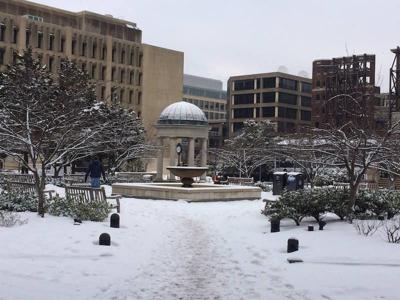
Over the past twenty years, college tuition has climbed exponentially across the nation, and there are no signs of this perpetual increase ending. Now it’s more likely that a college will raise their tuition every year, hiking the price by hundreds—sometimes a thousand—dollars at a time. Some universities, like the private institution The George Washington University (GW), offer a small condolence: they provide a fixed tuition rate. This means the tuition cost of your child’s freshman year will be the same as their senior year—it will never increase. Of course, that doesn’t necessarily mean much in the long-run; famously, for the 2016–17 school year, GW is charging $51,875 a year for tuition.
GW isn’t the only school gouging students and their families on tuition every year. University of California San Diego (UCSD) charged out-of-state students $49,908 for the 2015–16 year. Even schools without a strong metropolitan draw, such as the University of Missouri, charge out-of-state rates the Baby Boomers would have gawked at years ago ($25,998 for the 2016–17 year).
And tuition, unfortunately, is just the tip of the iceberg in college costs. Parents and students also have to shell out payments for meal plans, parking passes and housing. GW, for example, currently requires all freshmen and sophomore students to live on campus, where the cheapest campus housing is $1,062 a month per person—and that’s with three other roommates.
Another wallop to the wallet? Textbook costs. According to NBC News, since 2006, the cost of a college textbook has increased by 73%. Schools like the University of Missouri now recommend that students budget $1,200 a year solely for textbooks and classroom supplies. While e-books and renting textbooks offer helpful savings, costs are still well outside what the average student earns monthly at a part-time job. Gone are the days when a student could work their way through college; now students face the burden of debt and parents are asked to fill in the gaps. With jobs not guaranteed and college costs skyrocketing, many weary students—and skeptical parents— find themselves asking: is college worth it? Where does all of that money go?
As it turns out, the answer is complicated. College tuition money doesn’t vanish into thin air—or into the pockets of greedy provosts and officials. The money paid to universities is (mostly) used for the betterment of students. There are the obvious expenses—paying professors and university employees as well as performing maintenance on university property—but there are less obvious costs. Some of the money, for example, is used in the upkeep and updating of classrooms. Regular overhead projectors have now turned into "Smart Boards." Now, with the click of a button, a professor can transform a lecture into an interactive experience; this has been proven to aid in students’ recollection abilities. To combat overcrowded lecture halls, upgraded speaker systems have been installed so the professors are always heard. Universities across the country are implementing modern technology in innovative ways for the betterment of students—and unfortunately, that costs money.
A renewed focus on the health and wellness of students is another perk. Athletic facilities are constantly updated, and many college campuses—such as GW and University of Missouri—include a gym membership to their campus recreational center to promote a healthy lifestyle and teach students how to properly use gym equipment. Most universities work gym maintenance into their yearly budget to give students safe and effective equipment. Even better, the majority of schools also have a health center. With top-of-the-line labs and qualified doctors, parents don’t need to worry about their child’s wellbeing––and in this day and age, student health centers often cover mental check-ups as well. Students at some universities are able to receive anywhere from three to seven visits with a psychiatrist or psychologist before having to use insurance or pay out of pocket.
Of course, some tuition money goes towards providing students with a well-rounded experience. Guest lecturers and speakers are secured, school formals and events are held and student organizations are funded. The price of a college education may be rising but so is the quality of the modern college experience. There’s no question that tuition money is used in large part for the betterment of students... but why does the cost have to be so high?
The truth is, it doesn’t. For budget-conscious parents (or anyone who doesn’t feel like writing a $50,000 check every year), there are cheaper alternatives. A public school like UCSD offers tuition at $25,200 a year for California residents—that’s nearly half of the out-of-state cost. Scholarships and financial aid packages are available to keep expenses low too. The cost of a college degree depends more on where your child goes to school than anything else. While shelling out $25k a year certainly isn’t a walk in the park, it’s more manageable than the cost of a private university. Even though a degree doesn’t guarantee a job anymore, the knowledge and personal growth your child will gain is still well worth the university price tag; while you can put a price on education, you can’t put a price on experience.
For Related Articles Try:
San Diego Reality Changers: Giving Gang Members a New Life
Top 5 Private Schools in San Diego


(0) comments
We welcome your comments
Log In
Post a comment as Guest
Keep it Clean. Please avoid obscene, vulgar, lewd, racist or sexually-oriented language.
PLEASE TURN OFF YOUR CAPS LOCK.
Don't Threaten. Threats of harming another person will not be tolerated.
Be Truthful. Don't knowingly lie about anyone or anything.
Be Nice. No racism, sexism or any sort of -ism that is degrading to another person.
Be Proactive. Use the 'Report' link on each comment to let us know of abusive posts.
Share with Us. We'd love to hear eyewitness accounts, the history behind an article.