
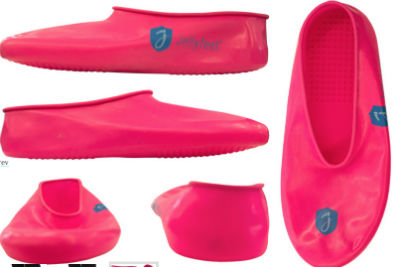
Health experts would agree that you should spend the most money on what lies between your body and the ground. The two main things that lie between people and the ground are beds and footwear. For footwear, that means protective yet small, sleek, durable, and stretchy material. In that case, Jellyfeet has got your back—er, your feet. For those of you who love shoes, want better support, or desire a more durable, form-fitting shoe, Jellyfeet is for you.
Jellyfeet is an occlusive foot cover designed with both health and fitness in mind. The foot covering is made from non-allergenic materials, stretches to fit feet, and collapses and fits in small spaces. This modern foot covering has many advantages, some of which include but are not limited to textured soles, being water resistant, sleek comfort, total coverage, and compression. These traits are unique to Jellyfeet only.
Enhancing Orthotic Benefits with Jellyfeet
Jellyfeet are made with health being the foremost goal, whether for moisturizing, protection from communicable foot fungus, compression, stability, and much more. A recent addition to the list of health benefits is using Jellyfeet with orthotics or other medical foot and ankle braces.
Orthotics is a specialty within the medical field concerning the design, manufacture, and application of an orthotic. An orthotic is an external device (such as a brace, like an ankle-foot orthotic, or AFO) that is used to modify the structural and functional characteristics of the neuromuscular and skeletal system.
Foot orthotics are custom-made footbeds to fit into a shoe. Orthotics provide foot support by redistributing ground reaction forces and realigning foot joints while the patient walks, stands, or runs. Orthotics can also aid knee, hip, and spine deformities. Whether athletic or elderly, orthotics help anyone live with anything from post-surgical pain or biomechanical deformities to soft tissue inflammatory conditions, like plantar fascitis.
Ankle-Foot Orthotics (AFOs)
AFOs are externally applied to the ankle and foot to control the position and motion of the ankle, correct deformities, or compensate for weakness of a joint or muscle. Ankle-foot orthotics are the most common type of orthotics used. An AFO is typically made up of lightweight polypropylene-based plastic in the shape of an upright "L." The leg of the "L" goes behind the calf, and the lower part runs under the foot. They attach to the calf with a strap and fit inside accommodative shoes. However, with an orthotic shoes wear out faster, and not all types of shoes accommodate orthotics.
There are many reasons why a patient can be prescribed an orthotic, whether for an injury or a disease, an adjustment or rehabilitation. In any circumstance, orthotics are hard on footwear. Often patients have to buy a specific shoe (or a larger-sized shoe) just to get the brace to fit. But even then, walking can be strained if the shoe causes friction on the ankle. All of these worries are put aside when the patient wears Jellyfeet.
Revolutionizing Foot Care: Teresa Alpert's Endorsement of Jellyfeet for AFO Patients and Beyond
Teresa Alpert, Certified Orthotist, Pedorthist, PMAc, has been working with Jellyfeet since 2016 and states this product has revolutionized how she diagnoses AFOs to her patients. She also uses Jellyfeet personally. She loves Jellyfeet and wears them mostly camping and while practicing yoga. "It has given me another vehicle, a product to share with my patients that gives them options. It's a great option for my patients," she says.
For AFO patients who are frustrated with the immobility of regular shoes, Jellyfeet is a fresh breath of air. Alpert's patients think that Jellyfeet is cool, they are typically excited about the fun colors, and the fact that they stretch. They are very receptive and eager to get their hands on a pair.
"The advantage of using Jellyfeet is you can place [them] in your orthotics, three-quarter length or full length, [with a] custom or ankle brace, and it provides a non-skid surface," Alpert says. The satisfaction has been great for Alpert's patients. "It gives them a secondary foot covering that they can wear with their orthotics. Being able to change out of daily shoes, allowing it to air out, supporting it better, protects the integrity of the orthotic," Alpert explains. "It's not bulky... It's lightweight and fun to wear."
An orthotic can cost between $500 to $700, so why waste more money on secondary footwear that will not last as long and is not as durable as Jellyfeet? Alpert stresses that the average person without AFOs should wear Jellyfeet as opposed to going barefoot. "Socks don't give protection, but the Jellyfoot would," she says.
Whether you have healthy or sick feet, are worried about hotel or airport floors, have a medical condition, or just like to be protected, Jellyfeet has you covered Jellyfeet.
.
For Related Articles Try:
-

(0) comments
We welcome your comments
Log In
Post a comment as Guest
Keep it Clean. Please avoid obscene, vulgar, lewd, racist or sexually-oriented language.
PLEASE TURN OFF YOUR CAPS LOCK.
Don't Threaten. Threats of harming another person will not be tolerated.
Be Truthful. Don't knowingly lie about anyone or anything.
Be Nice. No racism, sexism or any sort of -ism that is degrading to another person.
Be Proactive. Use the 'Report' link on each comment to let us know of abusive posts.
Share with Us. We'd love to hear eyewitness accounts, the history behind an article.