
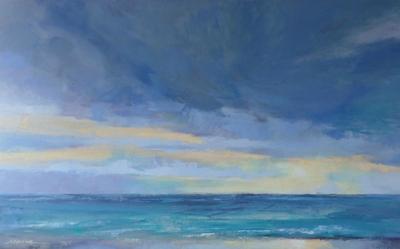
FINE Magazine interviews painter Mona Ray.
When did you start painting? How has your upbringing influenced your work?
I was always a creative kid—loved drawing and painting and making things in general. A bookworm and daydreamer, I grew up on the high prairie of Wyoming, 10 miles from the nearest town. Without many planned activities or other kids around, I had to make my own fun. I spent hours wandering through the sagebrush, looking for agates and arrowheads, catching lizards and watching the clouds roll in with afternoon thunderstorms.
Creativity was valued in our family. My dad channeled his into black-and-white photography, and I watched him develop prints in the darkroom. My mom created elaborate sewing projects and an unbelievable garden. There was always music in the house… Several guitars (both my folks play), banjo, keyboard, recorders, bongo drums, tambourine, harmonica, autoharp.
We were encouraged to follow our curiosity and explore our passions. I loved to paint and started private lessons with a local watercolor artist when I was fourteen. She taught in her studio, and I learned the basics of landscape painting from her, including composition, color theory and watercolor techniques. She was a fabulous teacher, and I studied with her for several years.
I continued painting in watercolor for the next decade or so, until I started showing my work professionally, in my early 30s. At that point, I switched to acrylics.
While watercolors required extensive planning of composition, value patterns, color palette, [while] acrylics offered bold freedom. I could start with a vague idea, or only a feeling for the subject, and continue to layer and build color and texture as the painting evolved. The pressure to execute every stroke perfectly was lifted, and I was hooked.

Mona Ray painting
What inspires your paintings? How would you describe them?
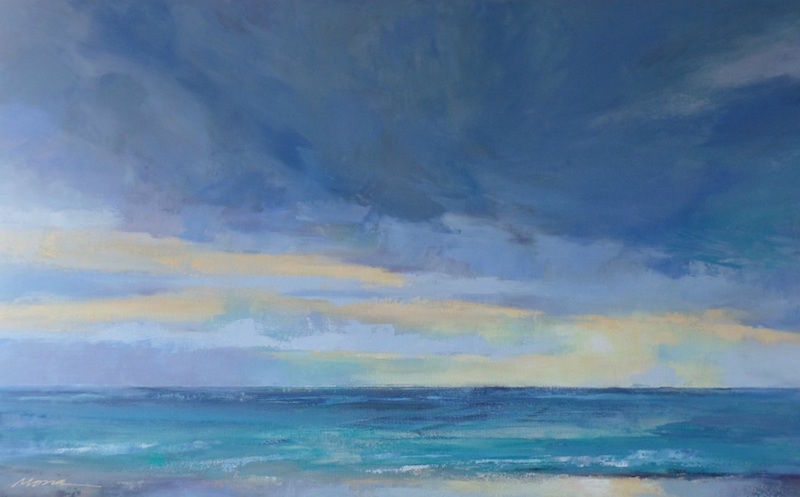
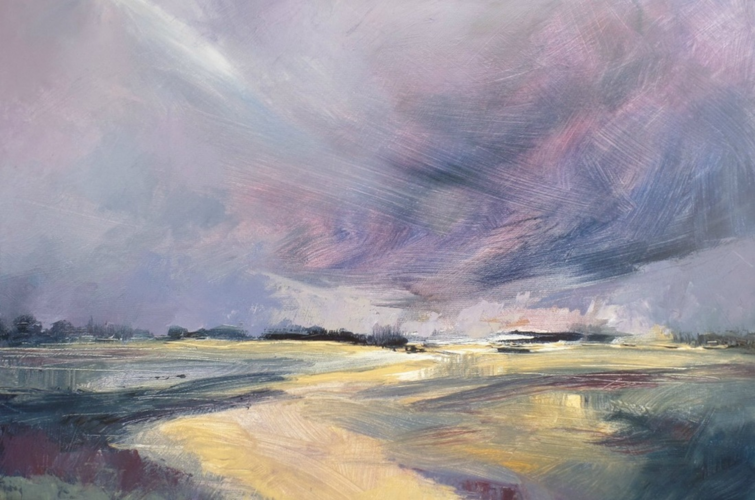
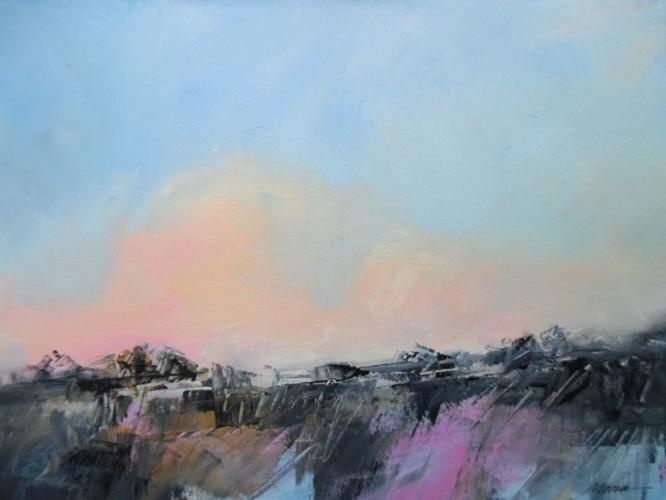
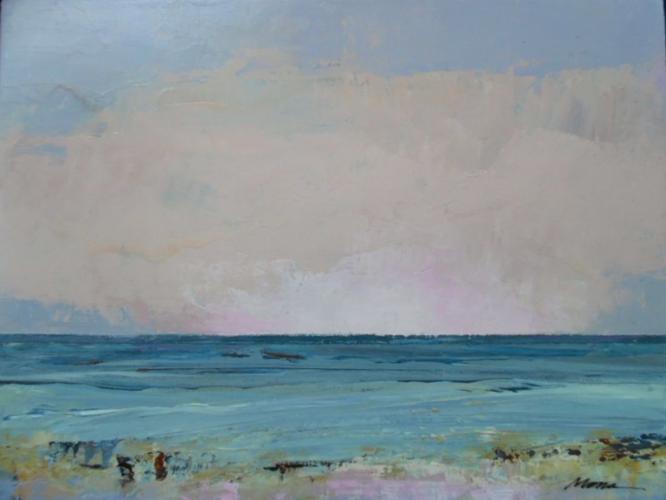
I describe my paintings as "abstract landscapes." Many things inspire my work, most of all the world around me—the light in the sky, the color of the sea, the pattern on a cliff face. Travel, museums, reading, writing, thinking...these are all ways I find fresh ideas. Landscape artists who have influenced my work include Joaquin Sorolla, George Innes, J.M.W. Turner, and Richard Diebenkorn.
You paint a lot of landscapes, though some are more abstract than others. How do you begin designing a piece on a fresh canvas?
Yes, some of my landscapes are more abstract than others, although in all of them my aim is always to create a distillation of the landscape while amplifying mood … I communicate with paint and embrace many of the abstract expressionist philosophies and practices. The landscape is my starting point, but what hangs on a collector's wall is a painting, and as I see it, all the marks and drips and blobs and smears and scratches have to come together as a work of art in their own right, and not read as a transcription of reality.
I am constantly seeking new ways of painting and new ways of seeing. I see my studio as a paint "laboratory" and my paintings as "experiments." Not every one is successful, but the process is a joyful exploration, and each new piece builds upon the discoveries made in the last work.
Unless I'm working on a specific commission, my approach to painting is spontaneous and minimally planned. I may have an idea in mind, or else browse through my sketchbooks or photos of recent paintings until I find a place to begin.
I generally start by sketching loosely and gesturally with a large brush or chunk of charcoal, establishing some main divisions of space and breaking up the monotony of the rectangle. The most important spatial division in a landscape is the horizon line, so that is usually the first descriptive line I place.

Mona Ray Painting
Then I start applying paint over the drawing, often obliterating the lines as the painting takes over. Pulling, pushing, creating, destroying, scratching, wiping, rubbing out, brushing, allowing the layers to dry and then coming back into the piece again. It's a very physical process—and a messy one! I wear gloves, but usually end up with paint up my arms, on my shoulders, knees, glasses, face. I'm not a tidy painter!
The first stage of a large painting is usually two to three frenetic hours, depending on the humidity. I stop when the paint is no longer workable and step away for a break. Successive layers build on what I see emerging on the canvas. There comes a point when I stop letting the paint guide me and I begin to orchestrate the piece. There is a lot of "negotiation" in this process.
The closer a painting gets to completion, the more thinking and looking there is. What starts off as a frenzy of brushes and knives and color slows down to a crawl. I work on several pieces at once to let each one rest in between stages. I force myself to step away from the piece, because a fresh eye is always more honest than a jaded one.
I know when I'm starting to get somewhere when I get a little flutter in my gut, a catch in my breath. I can never put my finger on it, but I know when the piece starts to work…
Sometimes I finish a piece in a week, sometimes a month, sometimes a year or more. I sign my work when I'm satisfied and ready to release it. Finally, there is nothing like the thrill of meeting a collector who resonates with my work! With their appreciation, collectors complete the communication loop begun with those first gestural marks on the canvas.

Mona Ray Painting
What kind of materials do you use in your work?
I paint with acrylic or oil paint to panel or canvas with brushes of all kinds, sticks, palette knives, vintage tools, my fingers—anything to make a satisfying mark. Additional materials include charcoal, graphite, India ink, pastels, acrylic and oil mediums of all kinds, and collage papers.
What are some of your favorite paintings?
It's hard to pick a favorite painting, but my newest works are often favorites, as they are closest to me. I've been working on the Sea Series for about a year now, and I'm enjoying this new subject and cooler palette.
Where can people find your work?
Much of my work is on my website: MonaRayFineArt.com, though I don't always get my recent work up right away! Private studio tours are available by contacting me directly: Mona@MonaRayFineArt.com. Commissions are welcome!
For Related Articles Try:
Interview with Photographer Roy Kerckhoffs
Spotlight on Artist Dawn Hough Sebaugh


(0) comments
We welcome your comments
Log In
Post a comment as Guest
Keep it Clean. Please avoid obscene, vulgar, lewd, racist or sexually-oriented language.
PLEASE TURN OFF YOUR CAPS LOCK.
Don't Threaten. Threats of harming another person will not be tolerated.
Be Truthful. Don't knowingly lie about anyone or anything.
Be Nice. No racism, sexism or any sort of -ism that is degrading to another person.
Be Proactive. Use the 'Report' link on each comment to let us know of abusive posts.
Share with Us. We'd love to hear eyewitness accounts, the history behind an article.