
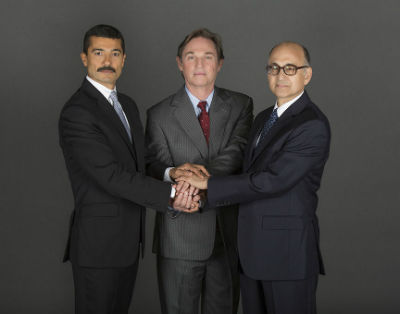
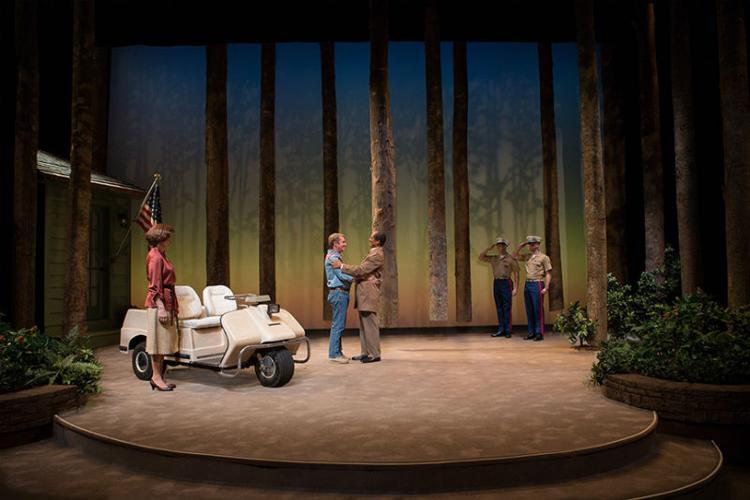
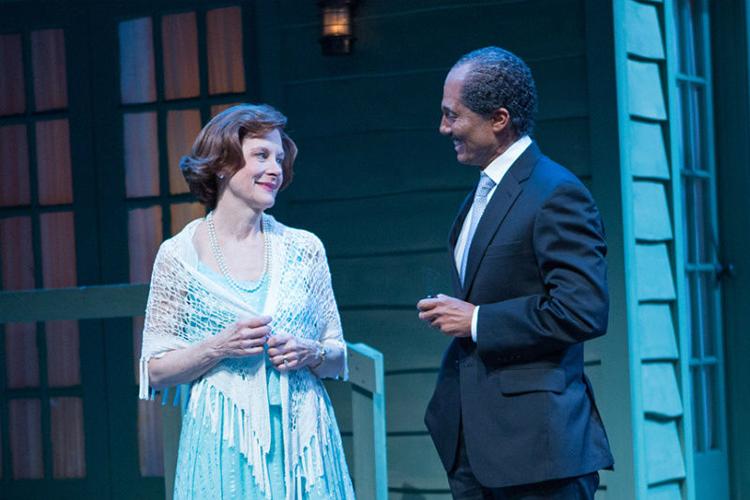
A US president, Israeli Prime Minister, and Egyptian President walk into Camp David... it's either the start of a really bad joke or a life-changing political truce. In 1978, President Jimmy Carter invited Israeli Prime Minister Menachem Begin and Egyptian President Anwar Sadat to Camp David to discuss peace. Over a tumultuous thirteen days, somehow, a peace agreement was achieved. Such is the subject of playwright Lawrence Wright's production Camp David. The play is premiering at The Old Globe on May 13th, with opening night scheduled for May 20th. Directed by Molly Smith, this west coast premiere finds 75% of the original cast reuniting to perform Camp David once more for a San Diego audience.
Camp David stars Richard Thomas as former President Jimmy Carter. Thomas is most well-known for having won an Emmy award for playing John-Boy Walton in the classic CBS drama The Waltons. The Old Globe veteran previously starred as Iago in the 2014 production of Othello, in which Thomas gave a deliciously dark performance as one of William Shakespeare's most complex characters. Now, Thomas is returning The Old Globe to bring this historical figure to life on the Donald and Darlene Shiley stage. FINE magazine interviewed Richard Thomas about his involvement with Camp David, working at The Old Globe, and his experience meeting President Carter.
You previously performed Camp David in Washington DC. How was that?
Great, wonderful. So exciting. It was the perfect town to do this play in, especially for the first time. To introduce it in Washington DC is great because the audience knows the shit. I mean, it's like a Shakespeare audience here... they really know their stuff. They got the jokes, and they had the exciting experience of knowing how the story ends but forgetting how the story ends because of the way [Lawrence Wright] tells it. It was a wonderful experience.
What's it like to bring Camp David to San Diego?
I expect because it's a mature audience that people will bring their history with them and know just enough. It's a second production, so [Wright]'s done work on the play. He's done rewrites, which is very exciting. We have a new [Israeli Prime Minister] Menachem Begin, which is great. Whenever you have a new actor, everything is new--which makes everything different--which is terrific and very exciting. Because what you want to do the second time is not do a carbon copy. You want to do something different and sort of solve problems you might not have solved the first time around.
Are there any marked changes? Something very different from the first time around?
No. The play was in astonishing good shape the first time around. Larry [Wright] has written plays, but he hasn't spent his whole life as a playwright, so he's still in the process of becoming that. And that's not to talk down about him. It's just that he's a master of journalism and nonfiction, and he is an amazing playwright considering it's not been his main thing.
There have been some cuts. He's moved things around from scene to scene, which makes it a little difficult because the play is very much the same but different, so it's easy to make mistakes. It's muscle memory. It's so in your body. But it's terrific, and I wanted to get in this theatre because the last time I was at The Old Globe, I was at the [Lowell Davies] Festival Theatre. I love the [Donald and Darlene Shiley] house; it's a beautiful house.
How much did you know about the Camp David peace talks before being cast in this production?
I was in my late 20s, so I was very aware of it. I wasn't a current events geek at the time--I was starring in a television series and learning to be a young star! So my life was far too narcissistic to be wrapped up in other people's history, but I obviously knew about it. I knew it was a great accomplishment and a Hail Mary accomplishment against all odds. I knew Jimmy Carter, obviously. The presidency was troubled and [Carter] went out with a whimper.
But I had been such an enormous fan of his post-presidency. I always thought to myself "It's not like it's just this one guy in office who became a different guy when he got out of office." He didn't leave the presidency and become the Jimmy Carter we know now. He was always that guy... One of the exciting things about doing this play was to find that man in this early iteration of him.
But I knew about the Camp David talks, and I knew who the players were, I just didn't know in depth. The great thing is, Larry wrote the book after the play. The book is a fantastic primer for it because you not only get the story of the thirteen days at Camp David, but as Larry tells that story, he gives you the whole picture and the story of that conflict, and all those issues, and all the players. You really get a comprehensive view of that history, and that was something I was able to enjoy coming into this production.

The Old Globe Camp David
President Carter is known as one of the weaker presidents in the last century. Does knowing how his presidency will ultimately end impact how you play him at all?
No, [it] can't. You've got to play it for what's on the page and what's happening with that character in that moment in time. But it's a beautiful revisiting of Carter because it's a very flattering portrait. It's a testament to him--and to all three of the men--so whatever baggage you bring into the play about Carter will be challenged in terms of him as a person and as a very single minded, very determined, and very intelligent guy. He inherited a lot of crap, and there was a lot of stuff going on. It can be argued that great men aren't great in all situations.
The play doesn't make a case for that one way or the other. It really just talks about who Carter was when these things took place. And I would be the last person in the world to talk about his failings. Some Fox reporter asked me in Washington, "What would you consider his flaws to be?" I said it's not my business; ask me about my flaws. If you want to know about his, ask him! I'm sure he knows what they are. But it's really not about that. It was about one thing that was accomplished. What the play tells us is that there is never a good time to make peace. You have Carter, a president who is going down the tubes, Begin, who is an old terrorist who's become a statesmen, Sadat, an old assassin who is a Nazi sympathizer. You get these men together and you think "Well that's never going to happen." One of lessons of the play--if it has lessons--is that peace is possible, even when you think it isn't. And as horrible as you think situation is there now, it seemed as impossible in 1978.
It's a terrific history play because like a Shakespeare history play, it's the interiority of the characters that makes us come back to them again and again. Although the history is pretty fascinating, it's the people and the characters. I think the smartest thing Larry did was make it about four characters rather than one of these big historical productions where you have all of these brief appearances by famous figures. I think he was able to distil the historical events into these four characters and have us embody that... That makes it much more satisfying to the play and I think more compelling for the audience emotionally.
Now President Carter actually saw this, didn't he?
Yeah, he did. He was there opening night in Washington DC.
Did you have any trepidation?
*Laughs* Are you kidding me? Are you out of your mind? Trepidation? I'll tell you, when I was a young actor opening night was not only when the luminaries came, but all the critics came on opening night. Basically, all of your critics were out there as well as your family, friends, and whatever celebrities they would invite. In Washington, we had critics opening night and we had the Carters. But because the Carters were there, I didn't give a shit about the critics! That was the last thing on my mind. To play a historical character carries a certain sense of obligation to begin with. Now a living one, it's like "Okay, I've really got to try and get this right." And the guy is in the audience.
But we met him before the show. He came backstage before the show, which was great because it broke the ice. He and Rosalynn were there. He went up to the other actors and said, "It's such a pleasure to meet you. I admire Begin so much, and Mr Sadat so much. And you're playing Rosie, I love Rosie." Then he came up to me and said, "I'm not so sure how I feel about meeting you." *Laughs* Yeah, I understand! And I realized at that point that he was just as nervous about how it was going to turn out as I. He was just as concerned about how he was going to be portrayed as I was about how I was going to do justice to the character.
Once I realized that and we sort of broke the ice of looking at each other and shaking hands, then the performance was great. What I knew that he didn't--because he hadn't read the play--was what a flattering portrait of him it is, and so we felt like we could make a present of the play to him. It's a testament to all of those people and what they did, and sure enough at the end of the performance when [Jimmy and Rosalynn Carter] came up on stage, they were both in tears. Tears, just running down their cheeks. It was so sweet. I was very nervous making this, but it had a very happy ending.

The Old Globe Camp David
Do you think Camp David could potentially get picked up in New York?
Oh, there are always rumors about plays going on. I'm too old to carry that flag, however I have to say I think the show will be done a lot--though not necessarily with me or with this company... This play, I think, has that potential. I also think that this play is a good play for New York. It's challenging, it's funny, it's touching, it's very entertaining, it's got a very good company. And I think that this play would fair very well... But one doesn't want to look at a production as a stepping stone to something else. For me, this is the last time and the only chance I get to do this play again. If something happens after that, terrific. But I don't look at San Diego as a rung on the ladder to New York. It has its own value; it'll be its own experience.
That'll make every night count.
Yes, exactly. Of course. This is a well-trained audience here. So I'm expecting great things from them. *Laughs*
What should the audience expect from you, then?
Great things!
Great things! Vice versa?
Yeah, exactly. I think we'll have a good time together. I think they'll be surprised. I think some people will be like, "Oh it's political, it's about the Middle East. It's going to be depressing." And I think people will be disarmed by how entertaining and how human the play is. For a lot of people, there's resistance to material like this because it doesn't feel like entertainment, but it's a very entertaining play.

(0) comments
We welcome your comments
Log In
Post a comment as Guest
Keep it Clean. Please avoid obscene, vulgar, lewd, racist or sexually-oriented language.
PLEASE TURN OFF YOUR CAPS LOCK.
Don't Threaten. Threats of harming another person will not be tolerated.
Be Truthful. Don't knowingly lie about anyone or anything.
Be Nice. No racism, sexism or any sort of -ism that is degrading to another person.
Be Proactive. Use the 'Report' link on each comment to let us know of abusive posts.
Share with Us. We'd love to hear eyewitness accounts, the history behind an article.