
San Diego’s own UC San Diego has always had a prolific scientific community, but Professor Igor Tsigelny and his colleagues may have discovered a world-changing new cancer treatment through their potential drug SKOG102. This new drug, licensed to Curtana Pharmaceuticals, is designed to stop glioblastoma cancer from spreading, and to actually shrink the tumors. The drug is still in development, and it is currently undergoing testing prior to any potential drug trials. Fine Magazine spoke with Professor Igor Tsigelny, one of the researchers and authors of this study, about this scientific breakthrough.
What is Glioblastoma?
Because it has been awhile since most of us took a biology or chemistry class, allow us to break down the science for a moment. Glioblastoma is a type of aggressive, malignant brain tumor. Patients diagnosed with glioblastoma generally survive less than 15 months, though children tend to have a better prognosis. Currently, this form of cancer is treated with surgery, radiation, and chemotherapy, though with little success. According to Tsigelny, "these methods prolong life for around 6 months." Needless to say, the prospects are rather bleak.
Everyone knows about the painful three staples of treating cancer in our modern society: surgery, radiation, and chemotherapy. What makes Tsigelny’s research so remarkable, therefore, is that he and his colleagues are bypassing these usual treatment options and creating something new. Their research centers around transcription factors. Since the vast majority of people don’t know what transcription factors are, allow us to break them down: Transcription factors are proteins that either activate or inhibit the conversion of DNA into RNA for targeted genes. In layman’s terms, transcription factors regulate the transcription (or transformation) of genes.
Tsigelny and colleagues have managed to identify one of the misfiring transcription factors in glioblastoma: Oligodendrocyte Transcription Factor (or OLIG2). Despite the ungainly name, the purpose of OLIG2 is simple: it causes cell growth to continue in the brain and spinal cord. OLIG2 is necessary for human development, but if this transcription factor misfires, OLIG2 can cause rapidly growing tumors.
In discussing his research, Tsigelny describes, "We analyzed the protein called OLIG2—[a] transcription factor—that is highly involved in glioblastoma development." From analyzing OLIG2, the team created a series of potential drug molecules aimed at disrupting OLIG2 dimerization and shrinking tumors. The most successful of these drug molecules is called SKOG102. It is another mouthful of a name, but it produced promising results: SKOG102 managed to shrink glioblastoma tumors in mice models by approximately 50 percent, making it a viable potential treatment option in the future.
The Science Behind SKOG102
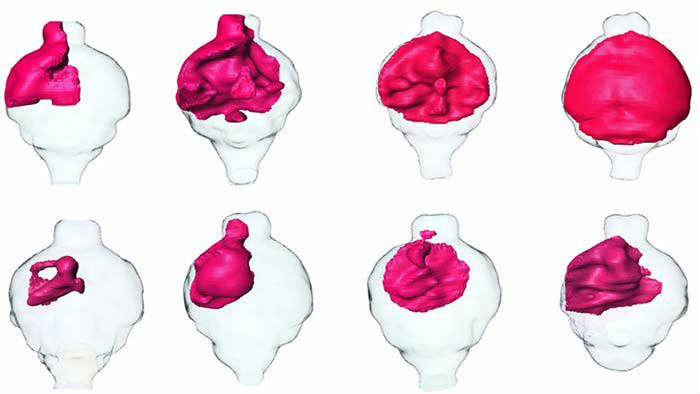
MRI renderings of mouse brain tumors from Tsigelny's study.
Images courtesy of http://www.impactjournals.com/oncotarget/index.php?journal=oncotarget&page=article&op=view&path%5b%5d=5633
SKOG102—as well as the other drugs tested in the study—was designed through using the novel computational strategy of drug design via a supercomputer. Tsigelny’s lab also developed the drugs against Parkinson’s disease—which are currently in clinical trials—hypertension, and whooping cough. Developing drugs through a supercomputer program is called theoretical drug design, and it is an inexpensive way to develop new drugs. "Theoretical drug design saves literally hundreds of millions of dollars for moving drugs to patients," Tsigelny pointed out.
SKOG102 and other potential drugs that were developed through Tsigelny’s lab faced heavy testing. The experimental and biomedical experiments were done in the lab of Professor Santosh Kesari.
So what made Tsigelny and his team target transcription factors in the first place? Tsigelny told us, "This can be compared with the old joke: A man on the beach sees that from the nearest cliff, someone throws animals in the ocean. His friend goes to the water every time after the throwing and saves them. When he arises, the friend asks: ‘Why don’t you help me save the animals?’ The man answers: ‘I want to find out how to stop this throwing.’ This situation is exactly what currently happens with cancer medicine. Doctors try to inhibit proteins that are involved in cancer development… If one can inhibit transcription factors, it would stop the dangerous protein over-expressing and eventually cure a patient."
Tsigelny’s research could be a potentially industry-changing development in cancer research, something that Tsigelny and his colleagues are aware of. Tsigelny is quick to note that every cancer patient has different kinds of tumors fueled by "aberrations in different genes;" essentially, each tumor has different underlying causes. Thus, Tsigelny argues that each tumor should be treated differently and not with the standard radiation or chemotherapy responses. Tsigelny believes his research is a huge step towards this. "The main impact on a general cancer treatment is ‘personalized medicine,’" Tsigelny explained. "There are no similar patients. Each [tumor] has its own genomic aberration, and they have to be addressed."
The Bottom Line and How You Can Help
The results of SKOG102 are promising, but the potential new treatment is still a few years away from drug trials. At this time, SKOG102 has to undergo a variety of studies—such as biophysical, pharmacodynamic, and mechanistic studies—in an effort to make sure the drug is not toxic to humans. However, this breakthroughs is still one of the most promising in relation to glioblastoma treatment to happen in recent years, and Tsigelny and his colleagues have a lot of faith in SKOG102’s potential. "We have a large number of good anticancer drugs approved by the FDA—not for brain cancer, though," Tsigelny explained. "Selection of their proper combination can drastically increase survival time of patients. With this finding, we potentially added new drugs for brain cancer to this assortment."
The drug is currently being studied, researched, and improved. Though the research is well-funded in part by the National Institutes of Health and the Voices Against Brain Cancer Foundation, Tsigelny welcomes any donations to help further their research and development of this potentially life-saving drug. "Definitely, readers can help by donating funds for research," Tsigelny said with enthusiasm. Funds can be donated to UC San Diego, but all donations need to be specifically marked for Professor Tsigelny and his lab in order to ensure the glioblastoma project receives the donation. Tsigelny can be contacted to assist in streamlining the donation process.
For more information on how you can donate and help fund this breakthrough research, you can email itsigeln@ucsd.edu.
The study was first published in Oncotarget, a scientific peer-review journal, on October 30th. Other contributors to this research include Rajesh Mukthavaram, Valentina Kouznetsova, Ying Chao, Ivan Babic, Elmas Nurmemmedov, Sandra Pastorino, Pengfei Jiang, David Calligaris, Nathalie Agar, Miriam Scadeng, Sandeep Pingle, Wolfgang Wrasidlo, Milan Makale, and Santosh Kesari.
Funders of this research include the National Institutes of Health, the Voices Against Brain Cancer Foundation, Christopher and Bronwen Gleeson Family Trust, and the American Brain Tumor Association Drug Discovery Grant.

(0) comments
We welcome your comments
Log In
Post a comment as Guest
Keep it Clean. Please avoid obscene, vulgar, lewd, racist or sexually-oriented language.
PLEASE TURN OFF YOUR CAPS LOCK.
Don't Threaten. Threats of harming another person will not be tolerated.
Be Truthful. Don't knowingly lie about anyone or anything.
Be Nice. No racism, sexism or any sort of -ism that is degrading to another person.
Be Proactive. Use the 'Report' link on each comment to let us know of abusive posts.
Share with Us. We'd love to hear eyewitness accounts, the history behind an article.