
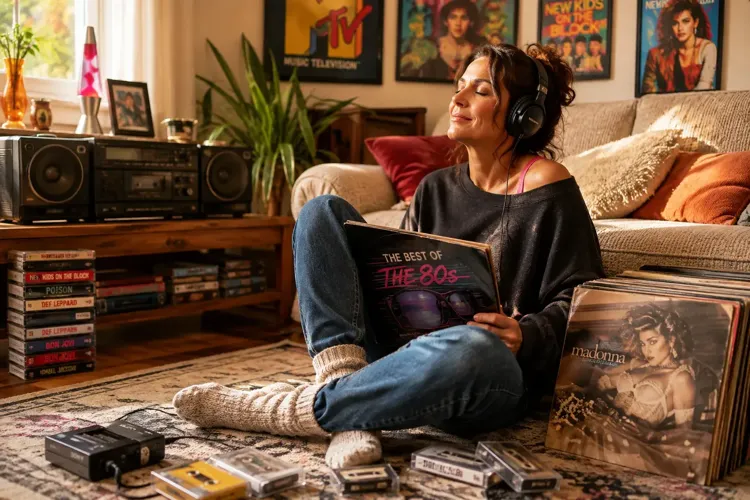

A song comes on and suddenly you are not standing in your kitchen, sitting in traffic, or scrolling through your phone.
You are 17 again.
Maybe you are driving home after Thanksgiving dinner. Maybe you are being dropped off at the movie theater with friends for the first time. Maybe it is a beach day, a first kiss, a family road trip, or one of those ordinary afternoons that seemed completely unimportant until decades later.
That ability of music to seemingly collapse time is at the center of a social-media idea often described as the “nostalgic reset” — deliberately returning to familiar songs, movies, memories, and cultural touchstones to create a sense of comfort or improve your mood.
The phrase may be new, but the experience is not. And right now, the 1980s and 1990s seem to be supplying a disproportionate amount of the material.
Movies are being rebooted. Vinyl is thriving. Retro sneakers, vintage cameras, ’90s beauty trends, familiar television franchises, and decades-old songs continue finding new audiences.
The intriguing part is that nostalgia is no longer reserved for people who were actually there.
Gen X and older millennials are remembering the ’80s and ’90s. Younger generations are discovering them.
And somehow, everyone has ended up listening to some of the same songs.
Why Nostalgia Feels Especially Powerful Right Now
Allyson Mandelbaum and Alix Abbamonte understand the appeal better than most.
The longtime friends are co-hosts of Nostalgia Nerds, a podcast devoted to the movies, television, music, toys, trends, and cultural moments of the 1980s and 1990s.
Abbamonte believes timing has something to do with the current resurgence.
“I think that nostalgia, particularly for the ’80s and ’90s, is so popular right now because the people who grew up in that time are now middle aged, and in a time in their lives where you reflect back on your life and memories,” she says.
She also sees nostalgia as a counterweight to modern worries about politics, technology, and the economy.
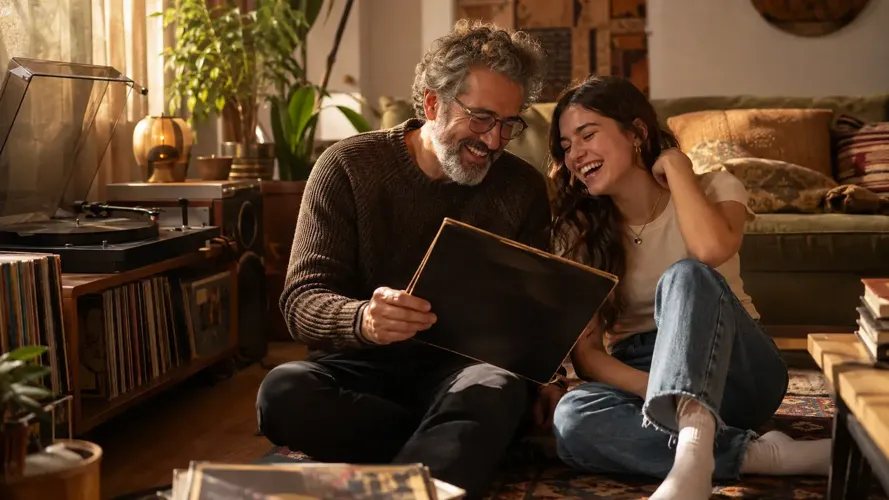
For Mandelbaum, there is another component. Adults who loved these decades now have children of their own.
“With our own kids, we want them to have what we had growing up,” she says. “Whether that’s showing movies, TV shows, music, or anything from the time.”
That creates an unusual cultural exchange. Parents are not merely recommending entertainment. They are sharing pieces of their own history.
Why a Song Can Take You Back So Quickly
Of all the ways we revisit the past, music may be the most immediate.
“Hearing an opening few notes to a song can flood your heart and mind with a memory you haven’t consciously thought of in decades,” Mandelbaum says.
Psychiatrist Dr. Jeffrey Ditzell explains that familiar music can operate as what he calls an “emotionally loaded” retrieval cue.
“Familiar music acts as a conditioned retrieval cue,” he says. “It was encoded alongside emotions, people, places, and bodily states during important experiences.”
That is part of the reason a song can retrieve much more than the memory of hearing it.
According to Ditzell, music can reactivate networks involved in episodic memory, emotion, reward, and personal identity.
“Music can bring back not just a fact but the feeling, setting, and bodily sense of that time,” he says.
Mandelbaum describes the same phenomenon in less clinical terms.
A song is rarely “just a song.” It may be connected to a first kiss, a day at the beach, a long family drive, a high-school adventure, or a particular person.
“Photos help,” she says, “but a song can really remind you how you felt in a moment.”
Is the Nostalgic Reset Actually Real

Dr. Jeffrey Ditzell, www.jeffditzellpsychiatry.com
This is where the social-media version of the trend needs a little restraint.
Claims that nostalgia automatically floods the brain with dopamine and oxytocin or reliably lowers cortisol make for catchy posts. The science is more nuanced.
Ditzell says there is legitimate research behind the broader concept.
“Though limited, there is real science behind the idea of a ‘nostalgic reset,’” he says.
Research suggests that deliberately evoking nostalgia through familiar music and memories can temporarily increase positive emotion, social connectedness, optimism, meaning, and a sense of continuity between past and present.
But it is not a guaranteed mood switch.
“The effect is not uniformly positive,” Ditzell cautions. “Music-linked memories can raise both positive and negative affect.”
The evidence involving dopamine is stronger than some of the other biological claims.
“Listening to preferred music has direct evidence of engaging dopaminergic reward pathways,” Ditzell explains. “But this does not mean every nostalgic song reliably produces a measurable dopamine surge.”
Claims involving oxytocin and cortisol require even more caution. Research findings vary depending on the individual, the type of music, the setting, and a person's baseline stress.
In other words, your favorite high-school anthem may make you feel fantastic.
Science simply does not promise that everyone else's will.
The Past Should Be Somewhere You Visit
Nostalgia becomes particularly interesting when it stops being merely pleasant and starts helping people understand who they are now.
Mandelbaum says revisiting old journals for Nostalgia Nerds has allowed her and Abbamonte to encounter their younger selves with both affection and a little embarrassment.
It has also made their memories more honest.
“We also wrote a lot about events that are historical, to our generation at least,” Mandelbaum says. “It’s been really cool to revisit. It also helps us to remember the past more honestly instead of idealizing it completely — although we do idealize it.”
Abbamonte draws an important distinction.
“Nostalgia doesn't have to mean, ‘I want to go back,’” she says. “It can mean, ‘There was something meaningful there that I carry with me.’”
Then she offers perhaps the best description of healthy nostalgia.
“The past should be a really special place you can visit.”
Ditzell makes a remarkably similar point from a psychiatric perspective.
He says nostalgia can become unhealthy when reflection turns into persistent rumination or avoidance.
Warning signs include idealizing the past, withdrawing from present-day work or relationships, consistently feeling worse after reminiscing, or using memories primarily as an escape.
Healthy nostalgia, by comparison, should ultimately reconnect us with the present.
“The goal is not to escape into the past,” Ditzell says, “but to draw on it as a resource for the present.”
Why Gen Z Is Falling for Decades It Never Lived

The current resurgence becomes even more interesting when the audience is too young to remember the era.
Abbamonte points out that this is not entirely new.
“When we were young we loved the music and style from the ’60s and ’70s without too much more than a record to look at,” she says.
What has changed is access.
A teenager curious about the 1990s can now encounter an entire decade almost instantly through streaming services, TikTok, YouTube, vintage fashion accounts, old television clips, music videos, and digital archives.
“What social media gives to younger generations is access to the pop culture of other eras in a much more advanced way,” Abbamonte says.
Mandelbaum is fascinated by how powerful those connections can become.
“It’s pretty crazy that you no longer have to have lived through a time to develop such an emotional attachment to it.”
Ditzell says nostalgia can indeed have psychological effects across generations.
“Nostalgia can be powerful across all generations, not only in older adults,” he says.
The content changes. The function often does not.
That may explain why one person hears a song and remembers where they were in 1987, while another discovers the same track in 2026 and simply thinks it sounds fantastic.
Different memory.
Same pleasure.
Familiarity Is Also Very Good Business
Entertainment companies have understood the commercial value of nostalgia for decades.
Reboots, sequels, reunion tours, remastered albums, revived fashion labels, and familiar franchises arrive with something new ideas must earn from scratch: recognition.
“Seeing an old toy or hearing a familiar theme can trigger memories before someone has even consciously decided whether they like the new product,” Mandelbaum says. “That's a very powerful starting point for marketing.”
Nostalgia also crosses generations easily.
A parent can introduce a teenager to Clueless, Beverly Hills, 90210, Madonna, or Michael Jackson. The teenager may then discover an entire cultural ecosystem surrounding it online.
The parent arrives through memory.
The child arrives through curiosity.
Both may end up loving the same thing.
The Ordinary Memories May Be the Most Powerful
Interestingly, when Mandelbaum and Abbamonte were asked which memories immediately transport them back, neither chose a spectacular milestone.
For Mandelbaum, it is the experience of being dropped off at the movie theater with friends.
“The thrill of being dropped off at the movie theater for the first time with your friends and tasting that freedom,” she recalls.
She remembers a decade filled with coming-of-age films such as Clueless, American Pie, Can’t Hardly Wait, and She’s All That.
For Abbamonte, it is music.
“Certain ’80s music will bring me back to car rides home from Thanksgiving dinners, Christmas Day, and really just family times that we no longer have together,” she says. “I love that feeling and am always excited when a song I’ve forgotten pulls me there.”
That may be the real secret of nostalgia.
It is often not the extraordinary moments we are trying to recover.
It is the ordinary ones we did not realize we would miss.
The FINE Take
There is no need to pretend the 1980s or 1990s were perfect.
They weren't.
Nostalgia does not require rewriting history. At its healthiest, it simply allows us to revisit something meaningful and bring a little of that feeling forward.
Ditzell recommends using nostalgia intentionally and paying attention to how it leaves you feeling. If the music or memory makes you calmer, warmer, connected, or more hopeful, use that energy in the present — call someone, reconnect, or do something meaningful.
So play the song.
Watch the movie you can still quote embarrassingly well.
Show your children what you once considered impossibly cool and accept that they may have notes.
The most interesting thing about the return of the ’80s and ’90s is not that those decades are fashionable again.
It is that the people who remember them and the people discovering them for the first time are finding something good in the same cultural moments.
Maybe we are not actually trying to go back.
Sometimes we just want to remember how it felt.


(0) comments
We welcome your comments
Log In
Post a comment as Guest
Keep it Clean. Please avoid obscene, vulgar, lewd, racist or sexually-oriented language.
PLEASE TURN OFF YOUR CAPS LOCK.
Don't Threaten. Threats of harming another person will not be tolerated.
Be Truthful. Don't knowingly lie about anyone or anything.
Be Nice. No racism, sexism or any sort of -ism that is degrading to another person.
Be Proactive. Use the 'Report' link on each comment to let us know of abusive posts.
Share with Us. We'd love to hear eyewitness accounts, the history behind an article.