
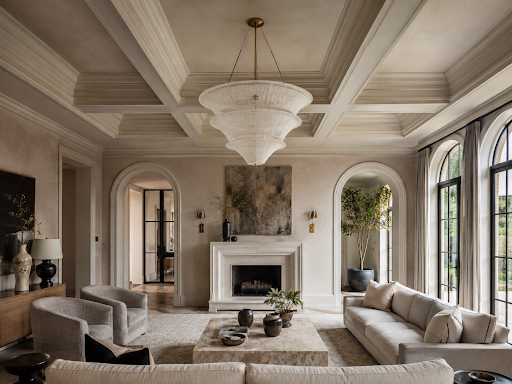
Designers are looking beyond the automatic white ceiling and using color, pattern, natural materials, architectural detail, and sculptural lighting to transform the mood and proportions of a room.
There are rooms that impress immediately, and there are rooms that reveal themselves slowly.
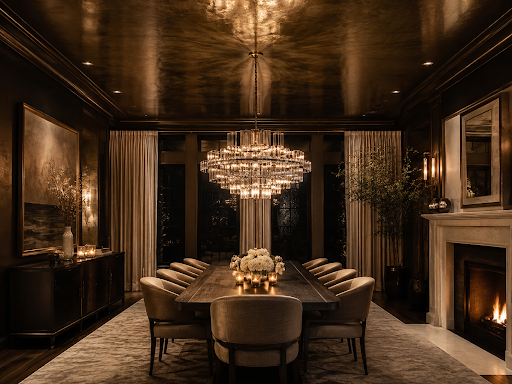
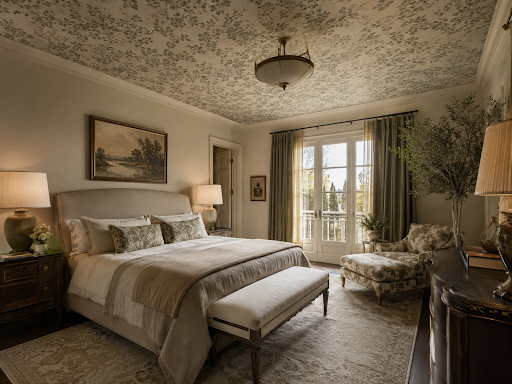
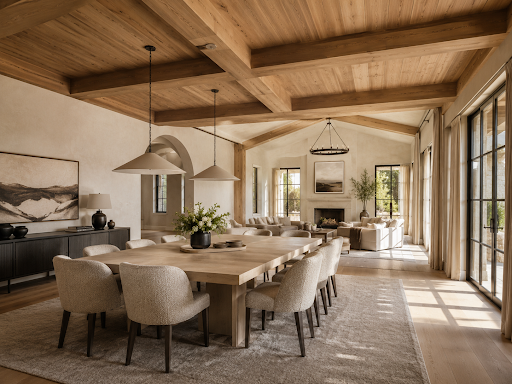
The furniture may be restrained. The palette may consist of limestone, linen, oak, and one beautifully placed work of art. Nothing appears designed to demand attention. Then the light changes, the eye travels upward, and the room’s defining feature comes into view: a tobacco-colored ceiling catching the glow of a chandelier, a hand-painted botanical floating above a bed, pale oak beams drawing order across an open living space, or plaster that seems to hold the last warmth of the afternoon.
That moment explains why the ceiling is becoming one of the most closely considered surfaces in luxury interiors.
For years, it was treated as a practical lid—painted white, fitted with lighting, and largely forgotten. Designers are now using it to influence intimacy, proportion, movement, and mood. The most successful statement ceiling ideas are not decorative flourishes applied after the room is finished. They are part of the architecture, helping determine how the space feels before a single chair or accessory is added.
Why Designers Are Looking Upward
The renewed attention overhead reflects a broader change in interior design. Homes are becoming more individual, more expressive, and less interested in looking as though every decision was made by the same algorithm.
The American Society of Interior Designers’ 2026 Trends Outlook identifies a move toward stronger color, playful forms, and greater personal expression. In that context, the ceiling offers designers an unusually valuable opportunity. It can give a room personality without filling it with more objects.
A pale plaster finish can prevent a minimalist living room from feeling sterile. Wallpaper can lend ceremony to a dining room whose furnishings remain deliberately simple. Timber paneling can give warmth and architectural presence to new construction that might otherwise feel too pristine.
This is not about abandoning restraint. It is about making restraint feel intentional. The ceiling allows a room to remain composed at eye level while introducing color, material, or drama above it.
How the Ceiling Changes a Room’s Proportions
A ceiling treatment alters the way a room’s boundaries are perceived.
Strong contrast makes the ceiling more visible and can bring the upper plane visually closer. Tonal continuity softens the corners, making the walls and ceiling feel like a single envelope. A darker ceiling can calm a tall bedroom or library, while a pale reflective surface can increase the sense of openness.
In an open-concept home, the ceiling can also define space without introducing walls. A timber-clad section above the dining table visually gathers the furniture beneath it. Beams can direct movement through a long living area. A change in molding or plaster texture can mark the transition from kitchen to lounge while preserving the flow of the floor plan.
These statement ceiling ideas are effective because they do more than add visual interest. They correct proportion, clarify zones, and give architectural order to rooms that might otherwise feel expansive but undefined.
Painted Ceilings Set the Emotional Temperature
Paint is the most direct way to make the ceiling participate in the room, yet its success depends on more than choosing an unexpected color.
A ceiling painted slightly lighter than the walls can preserve airiness while making the space feel more considered. Using the same shade across the walls, trim, and ceiling creates an enveloping effect that works especially well in bedrooms, libraries, and intimate dining rooms.
Deep blue, olive, burgundy, and warm brown can feel surprisingly restful overhead when the finish is sufficiently matte. Rather than reading as heavy, the color can make the room feel protected and complete.
Farrow & Ball Dead Flat is one example of a multisurface, ultra-matte finish that can be carried across the ceiling, walls, woodwork, and architectural details. That continuity allows color to flow through the room without abrupt changes in sheen.
The room’s natural exposure must also be considered. As FINE explored in How Natural Light Is Shaping Modern Luxury Home Design, daylight influences the perception of color, texture, material, and volume. A ceiling shade that feels muted in morning light may become considerably warmer or brighter as the sun moves across the room.
Gloss creates the opposite experience. A lacquered ceiling in an entry or dining room can catch windows, candlelight, and chandeliers, producing a soft mirrored effect after dark. It also reveals every ripple and repair, making careful surface preparation essential.
Wallpaper Turns the Ceiling Into a Story
Wallpaper introduces something paint cannot: narrative.
A small geometric repeat can sharpen a study. A drifting botanical can soften a bedroom. A scenic paper can transform an entry hall into a moment of escape. Grasscloth and other textural coverings create quieter depth, allowing the ceiling to appear layered without making pattern the room’s dominant subject.
The strongest wallpapered ceilings are composed from below. Pattern scale should be judged from the floor rather than from a sample held at eye level. Seams, vents, sprinklers, recessed lights, and fixture canopies all become part of the composition.
The room below should respond accordingly. When the ceiling carries an expressive pattern, the furnishings may need greater restraint. Simpler drapery, quieter upholstery, and a less complicated rug give the eye room to travel upward.
Among the most transporting statement ceiling ideas, wallpaper has the power to make a familiar room feel as though it belongs to another place or period—without requiring a complete architectural renovation.
Wood and Plaster Bring Material Warmth
Not every memorable ceiling depends on a strong color or pattern. Some of the most sophisticated treatments rely on material alone.
Wood gives the ceiling weight, warmth, and visual direction. Narrow boards can lengthen a room, while wider planks create a more grounded, substantial effect. Pale oak suits contemporary and coastal homes; darker timber can reinforce Mediterranean, Spanish Revival, and traditional architecture.
The ceiling wood does not need to match the floor or cabinetry precisely. A slight variation in tone often appears more natural and layered. The materials should relate to one another without looking as though they were purchased as a coordinated set.
Plaster, limewash, and hand-applied mineral finishes offer a quieter expression of luxury. Their subtle irregularities become visible as daylight moves across the surface. Instead of bouncing from a perfectly uniform plane, light gathers in some areas and recedes in others.
This movement can soften sharp contemporary architecture, lend permanence to new construction, and restore character to an older room. It is noticeable without demanding attention—the kind of detail that may be felt before it is consciously identified.
Beams, Coffering, and Molding Require Conviction
Architectural ceiling details succeed when they appear to belong to the building.
Beams need enough depth and scale to feel credible, even when they are decorative rather than structural. Coffering should respond to the dimensions of the room and the position of doors, fireplaces, and furniture. Molding should create order rather than simply outline every available edge.
A coffered ceiling can bring rhythm to a broad living or dining room, but deep coffers may compress a room with average ceiling height. Conversely, shallow details can look timid in a double-height space.
The most convincing statement ceiling ideas respect the room’s existing proportions. A modest bedroom may need little more than tonal paint and a narrow perimeter molding. A large salon can carry deeper coffering, substantial beams, or an elaborate plaster composition.
Luxury is not created by adding the greatest amount of detail. It comes from choosing the correct scale and executing it with precision.
Lighting Completes the Overhead Composition
A statement ceiling and its lighting plan should be developed together.
The Illuminating Engineering Society’s Lighting Design Objectives procedure considers the area and reflectance of significant room surfaces when assessing how a space will be illuminated. The ceiling does not simply hold the lighting; its color and finish affect how that light is distributed.
Matte, saturated color absorbs more illumination and may require additional ambient light. Pale plaster softens and spreads it. Gloss produces highlights that shift as people move through the room. Cove lighting can reveal the variation in a hand-finished surface, while poorly positioned downlights may interrupt wallpaper or coffering with distracting circles.
Decorative lighting must also respond to the ceiling around it. A patterned surface may call for a quieter fixture, while restrained plaster can support lighting with greater sculptural presence.
The Solene 36 Pendant by Christiane Lemieux for Visual Comfort demonstrates the latter approach. Its tiered silhouette gives a quiet ceiling architectural presence, while its finished interior reflects light downward and outward in a softer, layered glow.
Placement is equally important. FINE’s guide to Designer Lighting and Layout Ideas That Transform Your Home Interior explains why successful rooms rely on layered illumination instead of a single central source.
A chandelier should not appear to have been suspended beneath a finished ceiling as an afterthought. The two should read as one composition.
When a Statement Ceiling Becomes Too Much
The danger is not drama. It is a competitiona.
Patterned wallpaper, saturated paint, deep coffering, ornate molding, metallic finishes, and sculptural lighting can each command a room. When several attempt to lead at once, the eye has nowhere to settle.
A stronger approach is to establish hierarchy. Wallpaper may be paired with restrained lighting. Heavy timber beams may sit against quiet plaster. A lacquered ceiling may require little more than precisely scaled crown molding and one elegant pendant.
Sightlines matter as well. A treatment that looks remarkable from the center of a dining room may appear abrupt from the adjoining kitchen. In an open layout, the design should either continue deliberately or end at a convincing architectural boundary.
The best statement ceiling ideas remain persuasive from several viewpoints and in both daylight and evening light. They feel as though they belong to the room rather than having been attached to it for effect.
Choosing the Right Treatment for Each Room
Bedrooms respond well to enveloping paint, soft pattern, limewash, and understated molding. These treatments can reduce the perceived distance between the bed and the ceiling, creating a greater sense of shelter.
Dining rooms can support bolder choices. Because they are often experienced after dark, they benefit from reflection, richer color, and a strong relationship between the table and the fixture above it.
Living rooms require more balance because they are viewed for longer periods and from multiple directions. Wood, plaster, or carefully proportioned coffering can add depth without exhausting the eye.
Entry halls and powder rooms are natural settings for concentrated drama. Their smaller scale and shorter dwell time allow wallpaper, lacquer, metallic details, and expressive lighting to feel memorable rather than overwhelming.
Kitchens and bathrooms require practical scrutiny. Moisture, heat, ventilation, access to mechanical systems, and cleanability should influence the finish before the visual decision is finalized.
Whatever the room, samples should be viewed overhead in morning, afternoon, and evening light. Color and texture behave differently above the eye than they do on a vertical wall.
The FINE Take
A white ceiling is not inherently unimaginative. An automatic white ceiling may be.
The larger design shift is not toward decorating every visible surface. It is toward treating every visible surface as a decision. The ceiling may ultimately remain pale and quiet, but it should do so because that choice strengthens the architecture—not because no one thought to look upward.
The most enduring statement ceiling ideas shape the light, gather the furnishings, refine the proportions, and establish the emotional temperature of the room below.
A beautifully designed interior should not lose its conviction at the crown molding. Increasingly, the difference between a room that looks furnished and one that feels complete is written overhead.

(0) comments
We welcome your comments
Log In
Post a comment as Guest
Keep it Clean. Please avoid obscene, vulgar, lewd, racist or sexually-oriented language.
PLEASE TURN OFF YOUR CAPS LOCK.
Don't Threaten. Threats of harming another person will not be tolerated.
Be Truthful. Don't knowingly lie about anyone or anything.
Be Nice. No racism, sexism or any sort of -ism that is degrading to another person.
Be Proactive. Use the 'Report' link on each comment to let us know of abusive posts.
Share with Us. We'd love to hear eyewitness accounts, the history behind an article.